Quick Answer
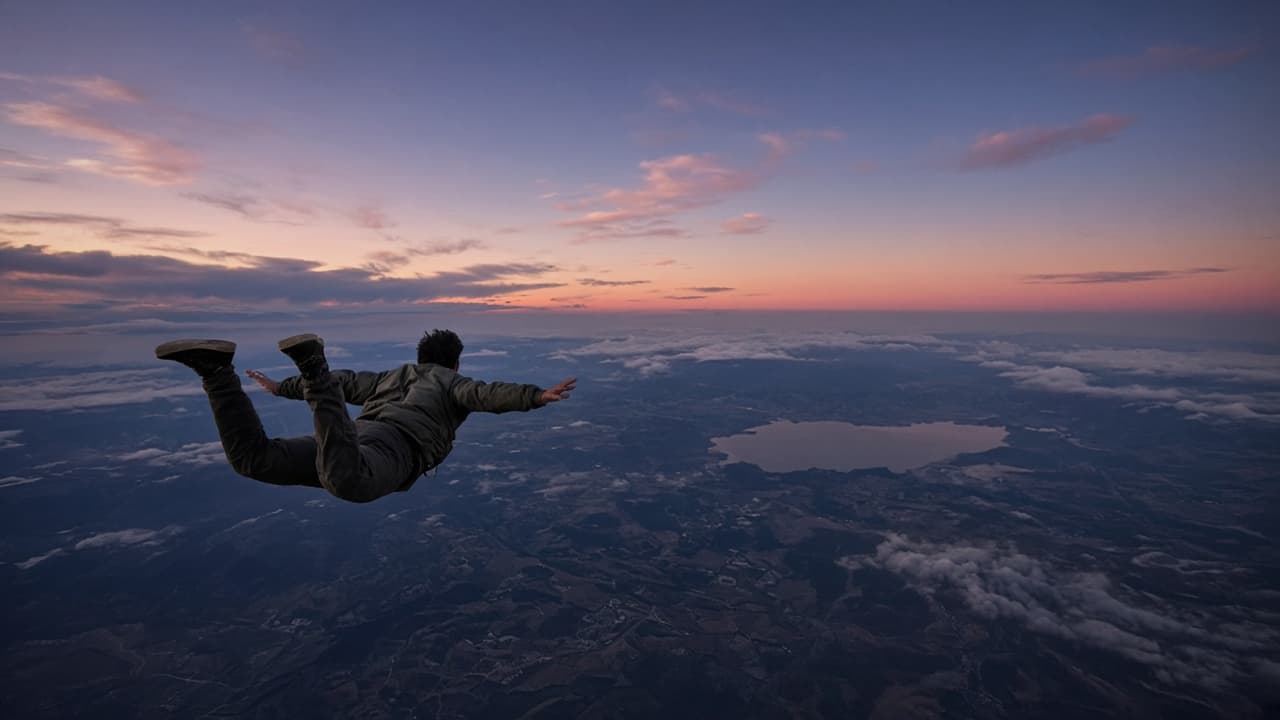
Falling is one of the most commonly reported typical dreams, and it usually means support has gone missing, a person, a paycheck, a plan, a body of knowledge you were standing on. Height is the metaphor; the drop is the feeling of nothing underneath. Two readings compete and they are not interchangeable. A full scene with a building, a cliff, or a long fall tends to track evaluation and loss of footing. A split-second drop as you fall asleep is often a [hypnic jerk](/dreams/falling-off-a-cliff), not a verdict on your life. Recover when it happened, what you fell from, and whether anyone pushed.
Falling From a Cliff or Building
This is the classic: edge, air, ground a long way down. Dreamers describe looking at a ledge they did not mean to step off, or finding themselves already in space with the structure receding above them.
Buildings lean toward social height, status, a role, a reputation you have been occupying. Cliffs lean toward terrain you cannot negotiate with: money running out, a diagnosis, a relationship with no remaining foothold. The falling-off-a-cliff variant is worth reading on its own when the edge itself was the whole dream.
Whether you stepped, slipped, or were already falling when the scene began changes the agency. A step you remember taking usually accompanies a risk you chose. A slip maps onto a footing you thought was solid. Already-in-the-air often means the support failed before you had language for it.
Falling in Slow Motion
Time thickens. You have seconds that feel like minutes, enough to notice windows, faces, the particular colour of the sky.
Slow-motion falls cluster around descents that are already public and unfinished, a resignation period, a breakup everyone can see coming, a parent whose health is changing by weeks rather than overnight. You are not surprised. You are in it.
The detail worth recovering is whether you tried to grab something. Reaching for a railing, a person, or a window ledge usually tracks a last attempt to keep a version of the old arrangement. Falling with your arms still is closer to acceptance, even when the feeling is miserable.
Falling Forever
There is no ground. The dream continues past the point where impact should have happened, and the absence of an ending becomes the terror.
This version shows up when a situation has lost its timeline, a legal process, an unexplained medical wait, a job search with no replies, grief that does not arrive at a stage. The psyche cannot find the floor, so it cannot stage the landing.
Dreamers sometimes report boredom mixed with panic, which is an accurate report of chronic uncertainty. If the forever-fall repeats, ask what in waking life has no scheduled resolution, and whether anyone is pretending there is one.
Falling Into Water
The landing medium changes the meaning. Water is not pavement. It can hold you, swallow you, or turn the fall into a swim.
Clear water that you enter and then move in often tracks a loss that becomes an emotion you can actually inhabit, sadness that is finally allowed, a change that hurts and is survivable. Murky or violent water leans toward overwhelm; see drowning and flood if the scene became about breathing rather than falling.
Temperature and depth matter. A shallow splash is a different dream from a long drop into dark ocean. The first is often a shock you walk away from. The second is about scale: the thing you fell into is larger than the story you had for it.
Someone Pushing You
A push turns accident into attribution. There is a hand, a shoulder, a person behind you on the stairs.
Identity is the whole reading. A boss, a partner, a parent, a faceless figure, each names a different source of the unsupported height. Dreamers often wake angry, then guilty for having accused someone. Treat the anger as data about a waking power imbalance, not as proof of malice.
If you never saw the pusher, the dream is usually about a system rather than a person: a restructure, an algorithm, a family rule nobody will own. The shove is real; the owner is distributed.
Have a Falling dream of your own?
Write what you remember and get a clear reading.
Landing Safely or Waking Before Impact
Two common endings get treated as one, and they are not.
Waking before impact is the default. Fear peaks, sleep breaks, and the plot never has to resolve. That is a feature of intense typical dreams, not a withheld prophecy. Many of these are also hypnic jerks: a motor twitch at sleep onset that the brain narrates as a drop. If you were barely asleep, check the body first.
Landing safely, on your feet, in a roll, in a net, in someone's arms, is rarer and more informative. It often arrives after a period of falling dreams that used to end in panic. Something in waking life has supplied a floor: a decision, a person, a number in a bank account. The dream is reporting that the drop is no longer total.
Falling Then Flying
The plot converts. Gravity gives way to flying, sometimes with a lurch, sometimes as if the fall remembered it had another option.
This is not luck. It tends to follow a waking shift from helplessness to improvisation, you stopped waiting to be caught and found a way to move in the air you were already in. Dreamers describe surprise more than triumph.
How you flew afterwards still matters. Effortless soaring after a fall is a different dream from frantic flapping. The first often tracks a skill you already had. The second tracks a recovery that is still expensive.
Slipping on Stairs or Ice
No great height, just a missed step. Stairs, a frozen path, a wet floor, the fall is local and humiliating.
These scenes cluster around ordinary competence that suddenly feels unreliable: a routine you have done a thousand times, a body that does not obey the old map, a social stumble in a place that was supposed to be safe. Ladders and stairs in dreams often mark vertical social movement; ice marks a surface that looked solid.
Whether anyone saw you slip is the evaluative twist. A private stumble tracks self-trust. A public one tracks reputation. Recover who was on the staircase.
Psychological Meaning
Falling sits in the small set of typical dreams that large surveys find across cultures. Tore Nielsen and colleagues' 2003 work on typical dream themes placed falling near the top of the list, alongside being chased and sexual dreams. Whatever produces the image is not local to your job title.
A physiological channel is well documented. Hypnic jerks, sudden, involuntary contractions as the nervous system crosses into sleep, are frequently accompanied by a falling sensation. Allan Hobson's activation-synthesis account is useful here: the brain has to make a story out of motor noise, and "I am dropping" is an efficient one. If the dream is a one-beat drop at the edge of sleep, you may be looking at sleep physiology wearing a plot.
G. William Domhoff's continuity hypothesis (1996, elaborated 2018) explains the longer narrative falls. Dream content continues waking concerns. People under evaluation, people losing institutional support, people whose relationships or finances have lost a floor, dream of height without a hold. The cliff is not a prediction. It is the current feeling of unsupported altitude, staged with whatever scenery your life has on hand.
Antti Revonsuo's 2000 threat-simulation theory adds a third layer when the fall is clearly dangerous: dreaming rehearses costly failures of footing. You do not need an ancestral cliff. A modern performance review will do.
Practically, split the file. Night-onset twitch versus mid-sleep story. Then name the support that is actually missing.
When Falling Dreams Keep Recurring
A repeating fall is usually an open structural problem, not an omen stacking up. The plot often stays stubbornly similar until the waking floor is replaced, a contract signed, a conversation had, a doctor seen, a resignation submitted.
If the dream is a hypnic jerk, treat sleep: caffeine late, irregular hours, stress that keeps the body from dropping cleanly into rest. If it is a full evaluative fall, write down the height you are currently occupying and what would have to be true for there to be ground under it. One concrete support, installed in daylight, ends more of these dreams than another night of decoding the cliff.