Quick Answer
A roller coaster dream is about committed motion. You chose to get on, the track was built before you arrived, and you cannot steer, slow down or step off. That combination, consent plus zero control, is what makes it such a precise image for certain stretches of adult life. The tone of the dream matters as much as the plot. People who wake up laughing are usually processing an exhilarating, overloaded phase. People who wake up gripping the mattress are typically dealing with something they agreed to before they understood what it would involve.
Cresting the First Drop
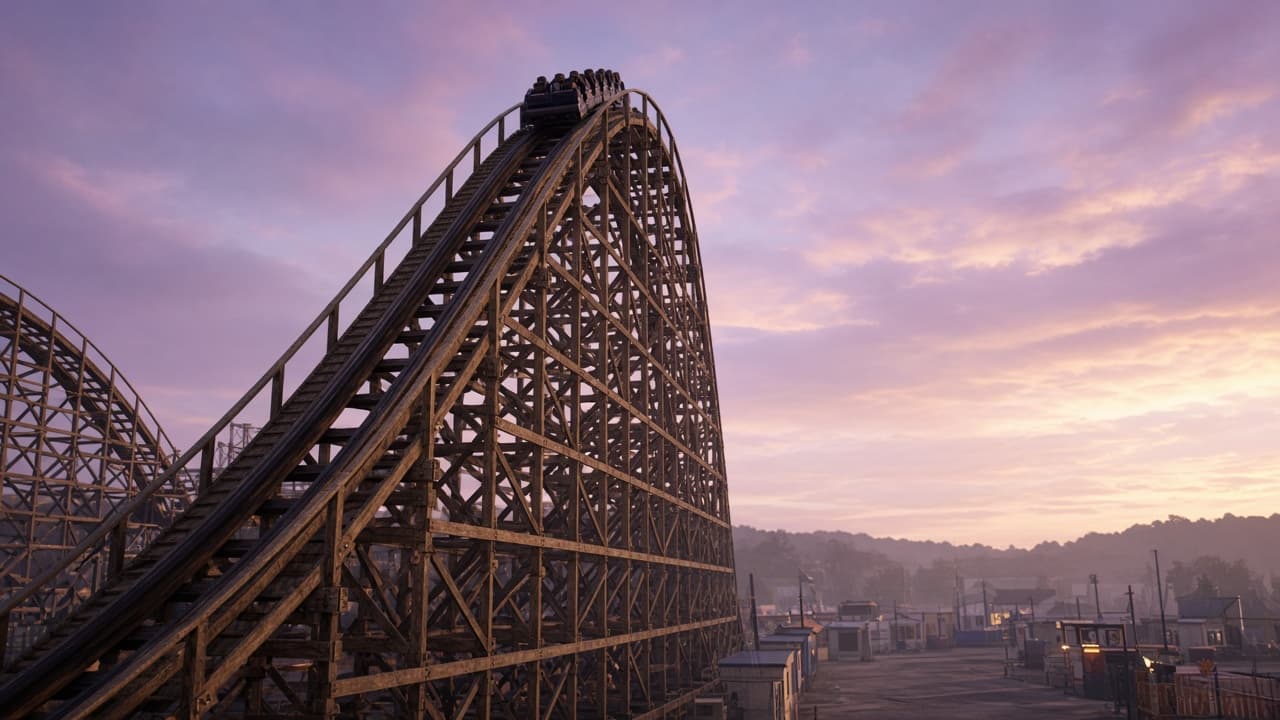
The classic scene isolates one moment: the slow climb, the pause at the top, and the instant the front of the car tips forward.
That pause is the whole dream for many people. It maps onto the last moment before something irreversible begins, the night before a wedding, the day before a job starts, waiting for a scan, a house sale about to complete. The climb is anticipation; the tip is commitment converting into consequence.
Dreamers often report waking at exactly that point, sometimes with a physical jolt. That is a common feature of dreams involving sudden falling, the same family as falling off a cliff, and it is not a sign that anything is wrong.
Track That Ends, Breaks, or Isn't There
Very frequently reported and genuinely alarming: you can see, from your seat, that the rails ahead stop, twist away, or were never finished.
The reading is usually about an incomplete plan rather than imminent catastrophe. The commitment is live, and one piece is unresolved, the funding not signed off, a visa pending, childcare not arranged, a date agreed with no venue. Because you are already moving, you cannot solve it from where you are, which is exactly why it appears at night.
Whether you shouted a warning is worth noticing. Dreamers who try to alert other passengers are often the person in a waking situation who has spotted the problem and cannot get anyone to take it seriously.
The Harness That Will Not Close
A distinct dream: the ride is fine, the track is fine, and the bar over your shoulders is loose, broken, or simply absent while everyone else is secured.
This version points at missing protection rather than a flawed plan. The waking equivalents tend to be specific and practical, freelance work with no contract, a move with no savings behind it, a relationship where only one of you has taken a legal risk, a treatment starting without anyone to drive you home.
Unlike most dream imagery, this one often has a literal fix. People frequently find these dreams stop once the missing safeguard exists.
Unable to Get Off
Some coaster dreams have no drama at all beyond duration. The ride does not end. It goes around again, then again, and the operator is not there.
These belong to sustained situations rather than events: long-term caring, chronic illness, a mortgage in a job you dislike, a family role nobody else will take. The dream reproduces the absence of an exit point, and dreamers typically report exhaustion rather than fear on waking.
If you asked to be let off and were ignored, that detail usually corresponds to something real, a request for help that was heard and not acted on.
Loving Every Second of It
Not all of these dreams are anxious. A substantial number are joyful: arms up, screaming, wanting to go again.
They tend to arrive during intense but genuinely wanted phases, a new relationship, a creative project consuming your evenings, early parenthood on a good week, a business finally moving. The lack of control is present and does not feel like a problem, which is worth taking as real information, and it is the opposite of what driving dreams usually raise, where the steering is yours and the responsibility comes with it. Dreams are not obliged to be warnings.
People sometimes distrust these dreams and search for the hidden dread. If there was no dread in the dream, do not import any.
Have a Roller Coaster dream of your own?
Write what you remember and get a clear reading.
Watching Someone Else Ride
A quieter variant: you are on the ground, watching a partner, child, or friend go over the top without you.
Spectator versions are almost always about proximity to someone else's risk. Parents report them when a child leaves home or starts driving. Partners report them during someone else's career gamble or medical treatment. The distinguishing feature is that you can see everything and influence nothing, which is a fair description of loving an adult who has made their own decision.
A Coaster Too High, Too Fast, or Falling Apart
Dream physics do what they like. The track climbs past the clouds, the cars rattle loose, bolts fall away, the structure sways.
Escalation like this generally tracks something that has outgrown its original scale: a small plan that became a huge commitment, a modest event that grew, borrowing that got out of proportion, a job that expanded without anyone renegotiating it. The wobbling structure is not a prophecy about collapse; it is a fair report of a system carrying more than it was designed for.
Dreamers frequently mention the sound in these versions, creaking, rattling, metal complaining. Auditory detail in dreams tends to accompany situations where you have already noticed warning signs.
Coming Off the Rails
Derailment dreams are less common than track-fear dreams and land harder. The car leaves the rails, tips, or flies free.
They usually follow something that has already gone wrong, rather than anticipating it. People describe them after a redundancy, a relationship ending abruptly, or a health event, the dream supplying an image for a life that departed its expected route. Notably, dreamers often report the moment of leaving the track and not the impact, which fits: the shock was the departure, not the destination.
Standing in the Queue Forever
The overlooked scenario: you never ride. The line moves slowly, the ride closes, you get to the front and step aside.
This is a dream about deferral rather than fear. It tends to appear during long waits for something you have chosen, a decision from someone else, a treatment slot, a promotion, an application. Getting to the front and not boarding is worth sitting with, though; it can point at genuine ambivalence about a commitment you have publicly agreed to.
Psychological Meaning
There is a good structural reason coaster dreams feel so physical: they combine two of the most reliably reported dream experiences, falling and being unable to control what is happening.
Falling dreams belong to what researchers call typical dreams, a small set of scenarios reported by large majorities of people across cultures. Tore Nielsen's work on typical dream themes places falling near the top of that list, alongside being chased and appearing naked in public. A roller coaster is essentially a socially acceptable, mechanically arranged fall, so it slots neatly into imagery your dreaming mind already produces easily.
Antti Revonsuo's threat-simulation theory, published in 2000, offers a reason the falling category exists at all: dreaming appears to rehearse ancestrally significant dangers, and losing height is one of them. That explains the vividness of the drop without implying any real risk in your life.
Michael Schredl's research on nightmare frequency accounts for when these dreams show up. Distressing dreams increase with waking stress and poor sleep, which is why coaster dreams arrive in overloaded weeks rather than calm ones. There is also a plausible bodily component: rapid heart rate, disrupted breathing and the vestibular sense of motion during sleep can all supply raw material that the dream narrates as a ride.
G. William Domhoff's continuity hypothesis explains the specific choice of image. If your waking phrase for the last three months is "it's been a roller coaster", a phrase most people reach for without thinking, you have handed the dream its set design. That is worth knowing, because it means the dream is often less mysterious than it feels: it is dramatising the metaphor you already use.
One practical note. Because control is the core theme, the most useful question is not "what will go wrong?" but "which parts of this are actually fixed, and which have I only assumed are fixed?" Many dreamers find at least one element of the situation is more negotiable than the dream implied.
When the Ride Keeps Restarting
Recurring coaster dreams are not warnings about accidents or signs that a decision was wrong.
If they keep arriving, the productive move is usually to look for the loose harness rather than the scary drop. Almost everyone in one of these situations can name one protection that is missing, a savings buffer, a written agreement, a person who knows the full picture, a fixed end date. Securing one of them tends to change the dreams faster than reinterpreting them.
If the drops are waking you repeatedly and you are starting the day already tired, treat the sleep as the presenting problem. Persistent nightmares respond to imagery rehearsal therapy, and general sleep hygiene work helps too. The ride in your life may still have months to run; you do not have to ride it exhausted.