Quick Answer
Dreaming of driving usually means you are looking at agency as a route: who has the wheel, whether the vehicle obeys, and whether the destination is still yours. Smooth night driving can be as informative as a crash. The informative nights are the ones where the ordinary contract of driving fails, no brakes, no map, no licence, a child at the wheel, you operating the pedals from behind a seat. If you drive a lot in waking life, allow for simple leftover motion. Then check whether the dream’s road matched any road you actually know.
Driving Well, at Night, in Control
Competence is easy to ignore. The road unrolls. Your hands know. The car is a body you trust.
Sufficiency dreams often arrive after a stretch of earning your own steering, a qualification, a move you planned, a week of doing the job without panic. Dreamers report a quiet pleasure that is easy to dismiss as “nothing happened.” Something happened: the psyche filed a period of adequate agency.
If the night was beautiful and you still felt sad, the control may be lonely. A competent empty car is a different life from a competent full one.
No Brakes, or the Pedal Goes to the Floor
Stopping is a skill. In this dream it has been revoked. Hills, schools, red lights, a wall.
Brake-failure maps onto momentum you can feel and cannot yet honour with a stop: spending, talking, a project that has become a runaway, anger, a care role with no off switch. Related car accident dreams are this plot with an ending. This one is the long horrible middle.
What you reached for instead, handbrake, gears, shouting at passengers, is often a list of waking substitutes you already use. If nothing worked, the night is arguing that substitutes will not be enough.
Lost, Wrong Destination, Roads That Will Not Stay Put
The map lies, or you cannot read it, or the city rearranges. You were going home and home has moved. You were going to work and the building is a forest.
Lost-driving dreams are transition dreams. New job, new country, post-breakup geography, a health identity you do not have routes for. Repeating the same missed turn is a precise picture of knowing the goal as a sentence and not as a muscle memory.
If a passenger kept giving bad directions, add a social layer: advice you are following against your own sense of the road. If you refused to ask anyone, the pride is part of the plot.
Someone Else Is Driving
You have a view and not a wheel. The quality of their driving becomes the weather of your life.
Passenger-agency dreams attach to trajectories owned by others: a partner’s visa, a parent’s ageing, a founder’s mood, a political climate, a teenager you cannot actually steer. Trust and terror can take turns in the same journey.
Recognised drivers should be named on waking. Unrecognised ones often stand for a system. Grabbing the wheel is a confrontation rehearsal. Falling asleep in the passenger seat is a different, sometimes wise, surrender, or a depression of agency that wants daylight attention.
Driving From the Back Seat or With No Wheel
The cartoon is accurate and humiliating. Your arms are the wrong length. The windscreen is a rumour. You are still, somehow, supposed to be the driver.
These scenes map onto accountability without authority: job titles that own outcomes and not budgets, eldest-child roles in adult families, producing a life for someone who will not sit up front. The dream is funny until you recognise the org chart.
If the car still went where you intended, you may be succeeding at an impossible ergonomics, at a cost. If it did not, the night is less willing to flatter you than your waking story is.
Have a Driving dream of your own?
Write what you remember and get a clear reading.
Too Fast, Too Slow, or Stuck in Traffic
Speed is a mood. Too fast is often anxiety, mania of schedule, a life that only feels real at velocity. Too slow, with people honking, is shame about pace, recovery, grief, a career that did not match the cohort. Traffic is a social constraint: you would move, the system will not.
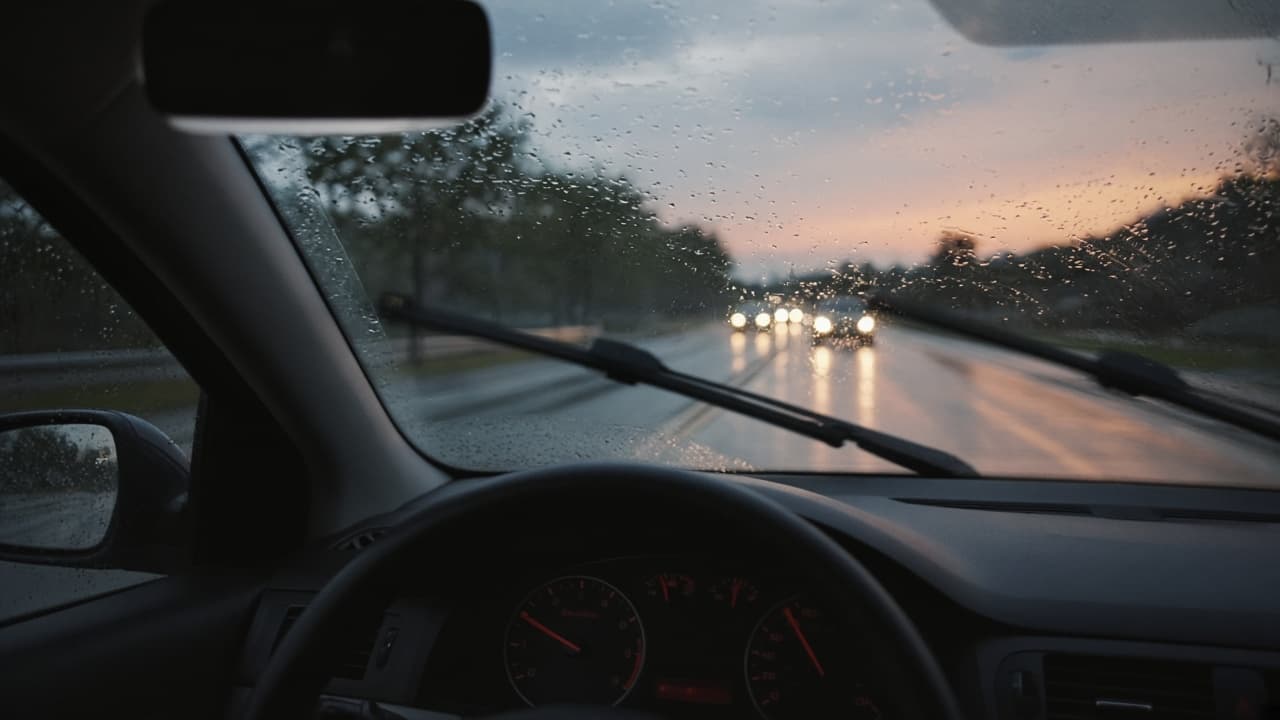
Storm rain on the windscreen plus speed is a particular cocktail of low visibility and high commitment. If that is your nightly commute in the dream, ask which project you are driving without weather information.
Stuck beside the same billboard or the same lorry for a long time leans toward a career or relationship plateau that still has the engine running. Fuel spent, scenery unchanged.
Teaching Someone to Drive, or a Child at the Wheel
Instruction dreams are about handing over a dangerous competence. Pride, terror, the wish to have a dual-control that does not exist.
They cluster around real teaching, children, junior colleagues, and around the fantasy that you can install your judgement in another body. A child who already has the wheel and will not let you in is a picture of a process that has started without your consent: ageing, a partner’s choice, a project that now belongs to a room you are not in.
If you were the child, you may be in a role that asked you to pilot before you had hours. Compassion is a better reading than “grow up.”
Night, Fog, Ice, a Road That Vanishes
Conditions eat the contract of driving. You slow. You do not. The white line is a theory.
Low-visibility driving maps onto decisions made without enough information: medical waits, negotiations, dating, a job that will not say the truth. Ice and mountains add a physics that does not care about your timetable. The dream is not always telling you to stop. Sometimes it is telling you that this is what the current road actually is, and your usual speed is the mismatch.
If headlights failed, inner orientation may be the thing that went. If only the road failed, the world is the fog and you are still a competent pair of hands.
Psychological Meaning
G. William Domhoff’s continuity hypothesis is the cleanest frame for driving dreams, and he has used everyday skilled activities exactly this way across The Scientific Study of Dreams (2003) and later papers: dream content extends waking concerns rather than inventing a separate language. If you are preoccupied with direction, competence, and who gets to decide the route, you will drive at night. The failures of the dream car, brakes, maps, seats, are failures of those waking functions, pictured with the most available adult machine.
Calvin Hall’s earlier work on dreams as picturing the self’s conception of its own situation sits underneath that. A person who feels like a passenger in a marriage will dream passenger-hood. A person who feels over-responsible for a family will dream the back-seat wheel. You can argue with the metaphor in the morning. You cannot honestly say the night picked it at random.
J. Allan Hobson’s REM account adds the occasional weird physics: roads that rearrange, cars that are also houses. Those bizarreness spikes are the sleeping brain’s weak story-editor, not a second secret code. Read them as texture on top of the continuity plot.
Practically: write down who had the wheel, what failed, and where you thought you were going. Those three notes beat a lot of symbol lists.
When You Keep Waking Still in the Lane
Driving dreams process direction and control. They are not a forecast of a crash, and they are not a command to quit your life at the next exit.
If the same brake-failure repeats, pick one waking momentum and decelerate it on purpose, a yes, a speed, a channel. Recurrence loves unchanged velocity.
If you are always lost, get one better sign in daylight: a conversation that names the destination, a map of the actual job, a GPS for the next year that is embarrassing in its concreteness. The dream can stop being the only place you admit you do not know the way.


