Quick Answer
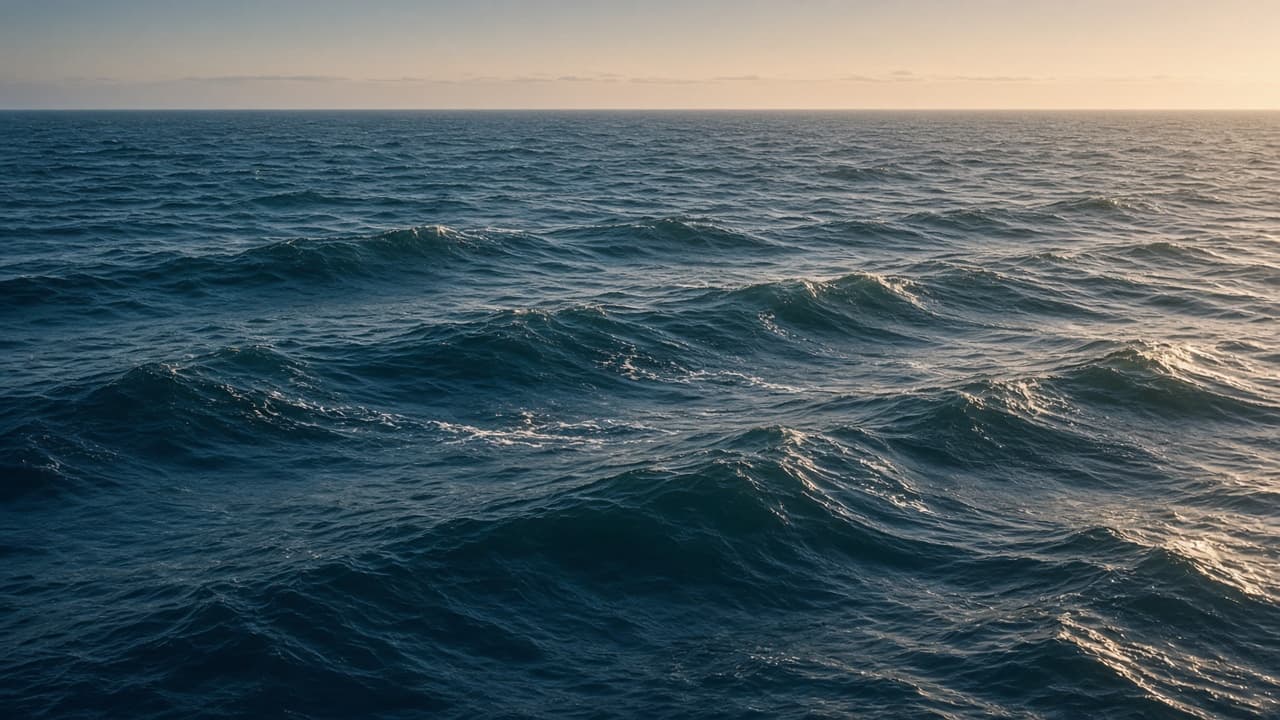
The ocean is [water](/dreams/water) that outscales you. A lake has banks. A pool has a ladder. The sea has a horizon and a depth you cannot personally audit. Ocean dreams usually mark being a small body in a large system: a family, a market, a grief, a vocation, a mood with no far shore. Undertow, wave height, clarity, [ships](/dreams/ships), and whether you were swimming, drowning, or merely looking decide the rest. Vastness can be belonging or erasure. The dream is asking which one you were in.
Standing on a Shore, Looking at the Horizon
You are not in it yet. The size is the subject.
Shore dreams are about relation to scale. People at the start of a large life (a career, a migration, a long illness in the family, a spiritual search) stand on sand and look. Desire and fear share the view.
If you waded, you have already begun. If you turned inland, you may be correctly refusing a scale you cannot survive this year, or postponing a belonging you actually want. Weather on the horizon (clear, storm, an odd colour) is often the forecast you already feel in the large system, not a separate omen.
Swimming in Open Water
No lane ropes. Depth under the chest. A coastline that gets smaller.
Competent open-water swimming is skill inside vastness. You have a stroke that works in something that could erase you. These dreams arrive when a person has found a way to be in a large field without needing to own it, research, faith, the sea itself, a big company, recovery.
Direction still matters. Parallel to shore is prudence. Straight out is a different appetite. Cramps, cold, or a fog that hides the land convert competence into exposure. That conversion is usually a waking energy limit you already know.
Undertow, Riptide, Being Pulled Out or Under
The surface lied. A current under the chop has its own destination.
Undertow is the ocean’s most specific gift as a metaphor. Institutions have it. Families have it. Depressions have it. Markets have it. You were handling the visible problem and the real force was lateral or down.
Fighting toward the beach against a rip is the classic waking error restaged. The surviving tactic in water is often sideways, out of the current, then in. Dreamers who remember being told that in the dream are sometimes being handed a strategy they have refused on land: stop charging the thing that is stronger than your will.
Giant Waves, Storm Surge, Tsunami
Volume. A wall of water that makes the human plot look like a footnote.
Giant waves mark events and feelings that exceed coastal defences: a death, a scandal, a war on the news, a financial wipeout, a panic that arrives as weather. Flood is water in the house; tsunami is the sea refusing the category of "shore."
High ground, a ship, a child’s hand, those are the values. If you surfed it, you may be someone who metabolises scale as sport, which has a cost. If you watched it take a town, the dream may be about a public wave, not your private swimming ability.
Have a Ocean dream of your own?
Write what you remember and get a clear reading.
Deep Water, the Drop-Off, Things Below
The colour goes dark. You cannot see the bottom. Something is there or might be.
Depth is the unconscious in the oldest sense, and also simply "more than I can inspect." Whales and sharks personalise the below: vast benign life versus predatory life. A drop-off you swam over is a threshold you crossed without a new skill. A drop-off you refused is a limit you are still honouring.
Pressure, ears, the wish to breathe, drowning lives here when the depth becomes the plot. Not every deep-ocean dream is drowning. Some are awe. Awe and terror share physiology; the story you woke with tells you which.
A Ship, a Small Boat, Being a Passenger
You are in the large system with a craft.
Boats are the mediating technology. A liner is an institution; a dinghy is personal resources. Engine failure is a different dream from a skilled crossing. Who captained, you, a stranger, a parent, is the authority map.
Going below decks while a storm runs is dissociation as strategy. Standing watch is the opposite. If the ocean was calm and the ship still felt like a prison, vastness is not your problem; the vessel is (a job, a marriage, a tour you cannot get off).
The Ocean Inside a City, a House, or a Street
Wrong place. Sea where sea should not be.
Indoor or urban ocean is scale invading the local, a global feeling in a kitchen, a public crisis in a private street, grief that will not stay in the "appropriate" container. It shares DNA with flood and with earthquake: the category of shelter has been rewritten by a larger medium.
If people around you treated it as normal, you may be in a culture that has already adapted to too-much. If you were the only one who noticed the tide in the living room, you are the one still using the old map.
Psychological Meaning
Jung’s ocean as image of the collective and the deep psyche is the cultural default, and it earns its keep when the dream is actually about scale and the below. It does not earn its keep for a beach holiday rerun. G. William Domhoff’s continuity hypothesis (1996/2018) will take the holiday, the dive certification, the climate anxiety, and the family that is "like the sea" without forcing archetypes.
Ernest Hartmann (2011) is especially useful: the ocean is a contextualising picture of "this is bigger than my banks." People in early grief, people entering large institutions, people with spiritual hunger, and people who feel small in a news cycle all borrow the same prop for different sentences.
Revonsuo’s 2000 threat-simulation theory covers drowning, sharks, storms at sea, and tsunamis as high-cost threats. Allan Hobson’s activation-synthesis view can account for floating and vestibular oddness; the choice of ocean rather than bathtub is still a meaning choice.
Deirdre Barrett’s problem-solving dreams sometimes use the sea as the problem’s actual size, you cannot "fix" an ocean, you can only navigate. That humility is often the insight.
A Small Body, a Large System
Finish by naming the system you were in: family, industry, grief, faith, weather, history. Then name your craft, if you had one, stroke, boat, shore, denial.
Repeating ocean dreams in the same key (always undertow, always tsunami, always a peaceful horizon you will not enter) are a climate report. Change one relation to the large thing in daylight: get out of a current sideways, admit the wave’s height, or finally wade. The night-time sea rarely shrinks. Your position in it can.