Quick Answer
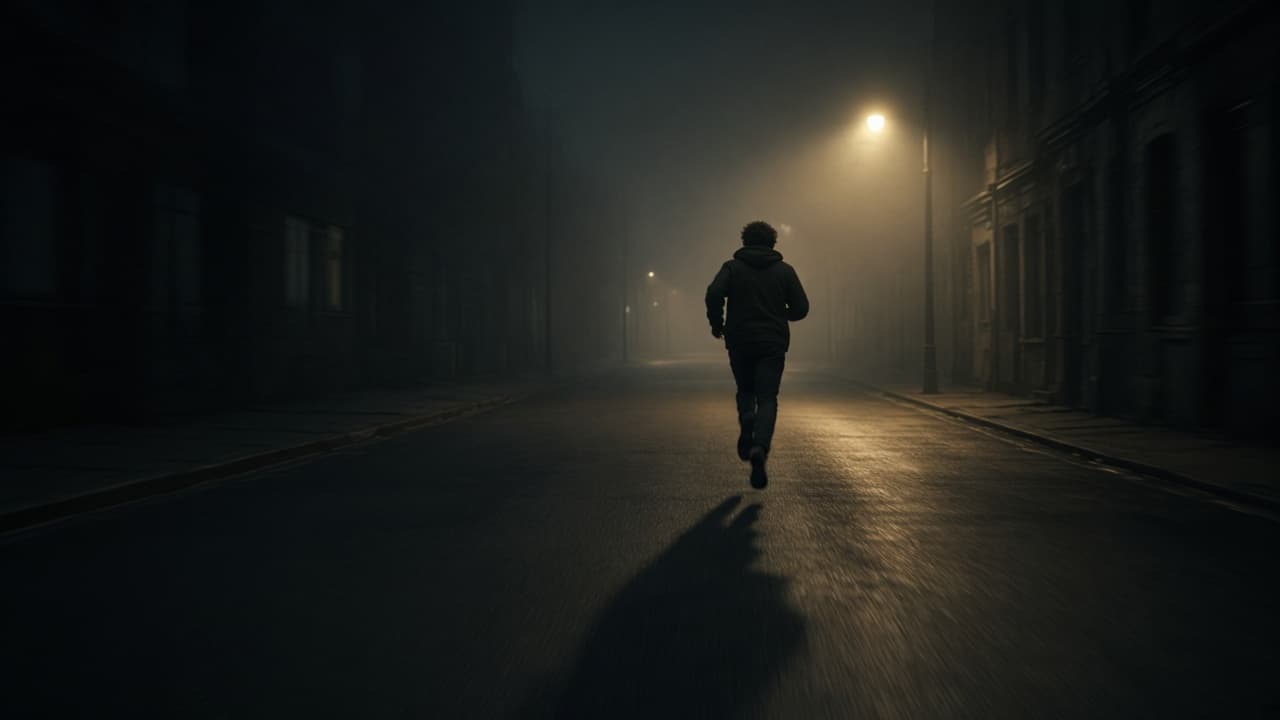
Being chased is the single most reported dream scenario in the research literature, and it usually means something in your waking life is pursuing your attention while you handle it by staying ahead of it. Deadlines, debts, diagnoses, arguments and decisions all behave like pursuers: they do not stop because you sped up. Four details carry most of the meaning, who or what was chasing you, whether your body worked, whether you hid, and what happened if you turned around. Take those in order and the dream usually resolves into something recognisable.
Who or What Is Chasing You
Before anything else, recover the pursuer, even partially. Dreamers often say "I don't know, I just knew it was behind me", and that itself is informative: an unidentified pursuer generally matches a diffuse pressure you have not put a name to.
The rough map is consistent. An animal tends to accompany something instinctive or appetite-driven, anger, desire, a habit. A human stranger leans toward social or situational threat: money, exposure, obligation. A monster or supernatural figure often marks a fear that has been exaggerated by being avoided for a long time. A person you know usually points at a specific unfinished demand.
One more thing to check: did the pursuer actually want to harm you? Many dreamers, pressed on it, admit they never saw aggression. They assumed it. That assumption is frequently the most honest detail in the whole dream.
Being Chased by a Stranger or a Faceless Figure
The featureless pursuer is the classic. A man in dark clothing, a shape, a presence with no face, close enough to be real, never close enough to identify.
This version clusters around pressures with no single owner. Debt is the clearest example: nobody is personally chasing you, but the thing is undeniably following. The same applies to an unfiled tax return, an untreated symptom, a qualification you never finished, a secret with no specific keeper.
Ask what you speed up to avoid thinking about. People describe filling evenings, taking extra shifts, scrolling until sleep arrives. A faceless pursuer often turns out to be whatever appears the moment you stop moving.
Being Chased by an Animal
Animal chases feel different from human ones: more primal, less negotiable, and often set outdoors. The species is worth recovering, because it usually carries a specific association for you rather than a universal meaning.
Predators such as wolves, dogs and big cats tend to accompany situations involving dominance, threat from a group, or an appetite you consider dangerous, rage, craving, attraction you are refusing to act on. Swarms and insects lean toward accumulation: many small obligations, not one big one. A domestic animal turned hostile is its own scene, and generally maps onto something once safe that has become unpredictable.
Dreamers frequently report that the animal is faster and quieter than a human pursuer. That texture matters. Chases with that quality usually involve something you cannot out-argue, only face or endure.
Being Chased by Someone You Know
A recognisable face changes the dream from atmospheric to personal, and dreamers usually wake with an unpleasant sense of having accused someone.
Read it as a claim, not a threat. Family members, managers and ex-partners appear most often because they hold live claims on your time, guilt, or decisions. A parent chasing you may track an expectation you have not met. A manager may track work that follows you home. An ex may track a conversation that ended without ending.
The point at which you recognised them is worth recovering. Knowing from the start usually means the waking issue is plain to you. Realising only at the end, the face resolving as they catch up, more often accompanies something you have been careful not to identify.
When Your Legs Will Not Work
Almost every long-running chase dream includes it: legs like wet sand, running on the spot, a body that will not respond at the exact moment it matters most.
There is a straightforward physiological explanation. During REM sleep, motor neurons are actively inhibited so you do not act out your dreams; your muscles genuinely are not available. Dreaming incorporates that state into its plot, which is why the failure feels so specific and so total. The same mechanism produces paralysis in other threat dreams, and it is not a comment on your courage.
Psychologically it still lands somewhere. Dreamers usually report this version during periods of constrained agency, a job they cannot leave yet, a caring role with no cover, a legal or financial process moving at its own pace. The dream renders the mismatch between urgency and available action almost literally.
Have a Being Chased dream of your own?
Write what you remember and get a clear reading.
Hiding Instead of Running
Hiding is a distinct dream with its own emotional signature: not exertion but held breath. You are behind a door, under a bed, inside a wardrobe, listening to footsteps and trying to make no sound.
These scenes tend to accompany strategies of concealment rather than avoidance, keeping something quiet rather than outrunning it. Debt again, but also an undisclosed health problem, a job application your employer must not hear about, a relationship nobody knows about, a struggle you are performing wellness over.
Whether you were found is the split. Being discovered often accompanies a waking sense that the concealment has a shelf life. Staying hidden while the danger passes more often turns up when you have decided to wait something out and are tolerating the tension of that decision.
Turning Around to Face the Pursuer
Occasionally the dream changes direction. You stop, turn, and look at whatever has been behind you, and dreamers very consistently report the same outcome: the fear drops, the figure shrinks, becomes talkative, becomes absurd, or the dream ends.
This is not a curiosity. Confrontation and rescripting are central techniques in imagery rehearsal therapy for nightmares, where the dreamer rewrites the dream while awake and rehearses the new version. Dreamers who spontaneously turn around often do so after a waking decision has been made, handing in notice, booking the appointment, telling someone the truth.
You can practise it deliberately. Sit with the dream while awake, picture stopping, and decide what you would say. It feels artificial and it works more often than it has any right to.
Getting Caught
Being caught is less common than dreamers expect, and it is rarely the disaster the chase promised. Frequently the moment of contact is where the dream stops, or where it becomes something else entirely, an argument, a conversation, a room.
When the capture does play out, the emotion afterwards is the reading. Panic tends to track a consequence you genuinely fear arriving. Relief, and it is reported more often than people admit, usually tracks exhaustion with running, which in waking life is what precedes finally dealing with something.
Psychological Meaning
Chase dreams are the best-documented item in the dream literature. They belong to what researchers call typical dreams, the small set of scenarios reported by large proportions of people regardless of culture. In Nielsen and colleagues' 2003 study of typical dream themes, being chased or pursued came out at or near the top of the list, alongside falling and sexual dreams. Whatever produces these dreams is not local to your life.
Antti Revonsuo's threat-simulation theory, set out in his 2000 paper in Behavioral and Brain Sciences, offers the most cited explanation. He argues dreaming evolved in part as a rehearsal system for threat avoidance: the dreaming brain selects dangerous scenarios and runs realistic escape behaviour, which in ancestral environments carried a survival advantage. Pursuit by a predator or a hostile human is the archetypal case, and the theory predicts precisely the imagery chase dreams contain.
Michael Schredl's research on nightmare frequency adds the modern-life half. Nightmare frequency tracks waking stress and rises during difficult periods, which is why chases cluster around exam seasons, job losses, breakups and illness rather than distributing evenly across a life. Schredl's work also consistently finds substantial individual differences, some people simply recall and experience more nightmares, a trait rather than a symptom.
Domhoff's continuity hypothesis then supplies the personalisation: the pursuer is drawn from your own material. The same underlying threat rehearsal casts a wolf for one dreamer, a creditor for another, and a specific relative for a third.
Put together, a chase dream is best read as a drill your brain is running with the props it has to hand. The useful question is not "what does the monster mean" but "what am I currently outrunning, and what would facing it involve".
When the Chase Comes Back Night After Night
Recurring chase dreams usually mean the waking situation is still open, not that the dream is escalating toward something. The plot often stays remarkably stable for months and then stops abruptly when the real issue is addressed, which is itself the clearest evidence of what the dream was tracking.
Two things reliably help. First, name the pursuer in daylight and write down the smallest concrete action that would move that situation, then do that one thing. Second, rehearse a different ending: picture yourself stopping and turning, in detail, for a few minutes a day. Both are low-cost and both are supported by what we know about nightmare treatment.
If these dreams follow a real assault, accident, or period of genuine threat, and they replay with that intensity, that is post-traumatic nightmare territory rather than everyday symbolism. It responds well to treatment, and a clinician trained in imagery rehearsal or trauma-focused therapy can usually make progress in a handful of sessions. You do not need to decode a dream that is keeping you from sleeping, you need to sleep.