Quick Answer
Flying dreams are about altitude you do or do not control. The fact that you left the ground is less informative than *how*: effortless, laboured, low over streets, chased, crashing, or unable to take off at all. Freud treated flying as wish and as body. Modern dreamers more often recognise it as agency, freedom, competence, or a height that does not yet have a structure under it. Pair the method of flight with what was happening on the ground, and the scene usually names a waking situation you already know.
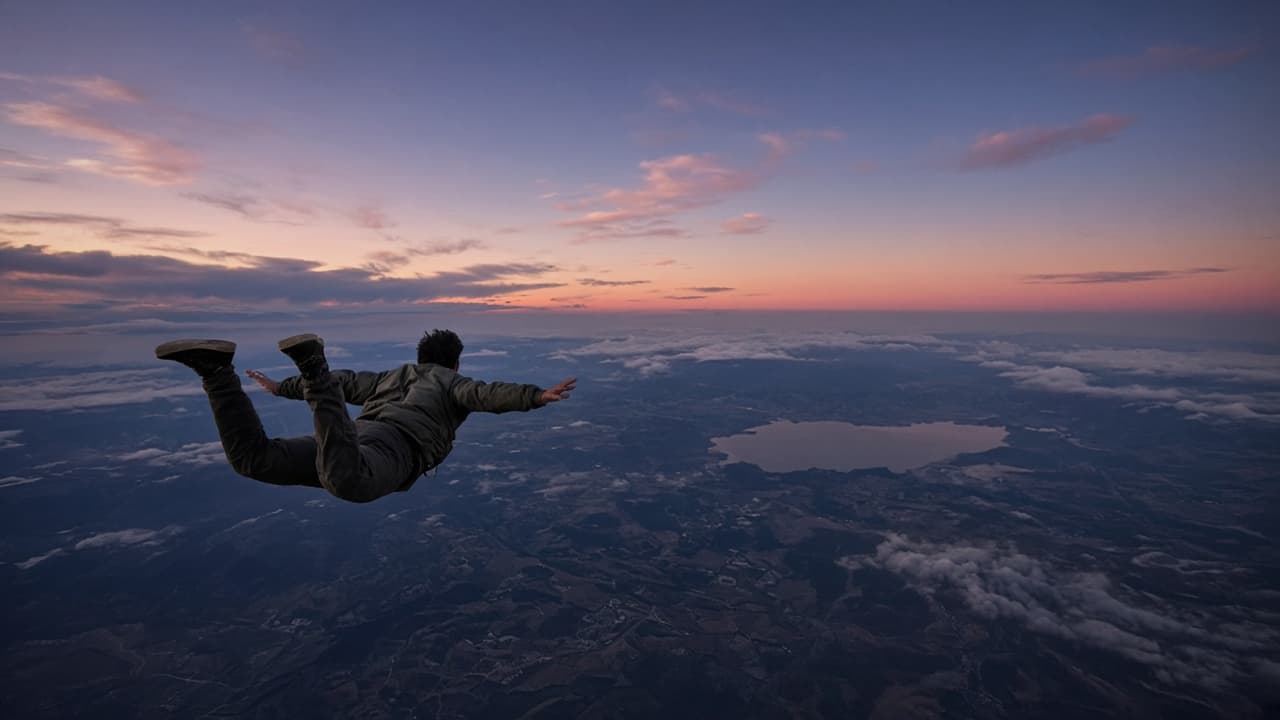
Soaring Effortlessly
The pleasant version: you are already up, the air holds you, steering is a thought rather than a struggle. Landscape unrolls. There is time to look.
These dreams tend to follow stretches where a skill became real rather than performed, after a period of training, after a hard conversation that went better than feared, after a move that finally felt like yours. Dreamers often wake with a residue of capability that lasts into breakfast.
Watch for the too-smooth variant. Flight that feels cinematic, audience-ready, slightly not yours, can accompany success you privately do not trust. That is closer to the crash dreams below than it first appears.
Flapping Hard to Stay Up
Arms, effort, altitude that leaks the moment you rest. This is work, not grace.
Laborious flight shows up when you are maintaining a position by extra output: covering for a team, performing wellness, staying "fine" in a family system that would drop you if you stopped. The dream is not accusing you of failing. It is itemising the calories.
Whether you stayed up is the split. Remaining airborne exhausted often means the current strategy still works and is unsustainable. Losing height despite the flapping usually means the extra effort has stopped buying altitude, which is useful information even when it stings.
Flying Low Over Streets
You are off the ground but not in the sky. Rooftops, traffic, people who could look up.
Low flight is social altitude, close enough to ordinary life that you can still be seen, judged, or pulled back. It clusters around promotions that have not quite taken, creative work that is public but not yet secure, and recoveries where you are mobile again without being free.
Obstacles matter. Power lines, bridges, and buildings you had to duck are often the specific constraints of the waking role. If you were enjoying the closeness to the street, the dream may be reporting that you do not actually want more height; you want movement without leaving your context.
Flying With Someone Else
Two bodies in air. The physics of the pair is the reading.
If they held you, you are currently borrowing lift, a partner's income, a mentor's reputation, a parent's plan. That is not automatically unhealthy; it is a fact to name. If you were matching them, the dream often tracks a collaboration that is actually sharing load. If they were heavier, slower, or pulling you toward a rooftop, recover the identity.
Children in your arms while flying is a distinct scene. It usually accompanies caretaking that has gone aerial: you are keeping someone else aloft, and your own flight path is secondary.
Have a Flying dream of your own?
Write what you remember and get a clear reading.
Being Seen or Chased While Flying
Altitude does not guarantee safety. Someone on the ground points. A figure follows you through the air. Searchlights. Comments.
Being seen while flying maps onto exposure that came with the new height, visibility at work, a relationship that became public, a body or talent that other people now have opinions about. The joy of lift collides with evaluation.
A chase in the air is still a chase. The pursuer is whatever is trying to pull you back to a previous altitude: an old role, a debt, a person who preferred you grounded. Whether you outflew them or were forced down tells you how much room the new position actually has.
Losing Altitude or Crashing
The lift fails. You drop toward streets, trees, water, or a runway that is not long enough.
Crashes in flying dreams are rarely about literal disaster. They track a height that could not be maintained, a job that outpaced skill, a story you told about yourself that met evidence, a body that would not do what the week required. The falling page covers unsupported drops; this version is specific because you had been flying. You had lift, and then you did not.
What you hit matters. A soft landing in water or snow often accompanies a loss that becomes survivable emotion. Hitting pavement or a building tends to accompany humiliation or a public consequence. Dreamers who walk away from the wreck are often already in the aftermath in waking life.
Unable to Take Off
You run, you jump, you almost leave the ground, and gravity wins. Sometimes the air is too thick. Sometimes your feet are glued.
Failed takeoff is a stall with a wish still attached. It shows up around visa delays, frozen hiring, a novel that will not start, a body recovering slower than the plan. You know the direction. The conditions are wrong.
Compare this with ladders and elevators: those are vertical movement with a structure. Flying without takeoff is vertical movement you are trying to authorise yourself. If someone in the dream told you that you could not fly, recover who has that veto in daylight.
Psychological Meaning
Freud, in The Interpretation of Dreams (1900), treated flying as a cluster of bodily and wishful meanings, levitation as pleasure, as erection in his more literal readings, as the child's memory of being lifted. Some dreamers still recognise a bodily thrill that is not about career. Most modern reports, though, describe agency: I could move in a way I cannot on the ground.
G. William Domhoff's continuity hypothesis is the cleaner frame for everyday flying dreams. People who have recently gained autonomy, leaving home, finishing training, ending a constraining relationship, fly more, and more easily. People whose altitude is fake or fragile flap, scrape rooftops, or cannot leave the pavement. The dream continues the waking physics of power.
Allan Hobson's activation-synthesis view is useful for the sensation itself. Vestibular noise in REM, a body that is paralysed yet generating movement signals, is readily storyboarded as flight. That does not empty the image of meaning; it explains why this particular metaphor is so available.
Ernest Hartmann's 2011 work on contextualising images helps when the flight is the emotional picture of a waking problem: "I am above this" or "I am barely staying up" rendered as weather. Ask which sentence the dream was acting out.
After a Night of Flying
Do not treat flight as a gold star. Effortless soaring can be accurate competence or a skip over a problem on the ground. Hard flapping is often the most honest dream in the set.
Write down the method: soar, flap, skim, carry, crash, fail to leave. Then name the waking altitude that uses the same physics. If you keep crashing, the question is not "why am I afraid of success" in the abstract. It is which height you are occupying without a structure, and what it would take to either build the structure or come down on purpose.