Quick Answer
A lizard in a dream is usually an image of watchful, low-cost survival. These are animals that hold still, sun themselves, and vanish at speed the moment attention lands on them, and that is generally what the dream is describing about you or someone near you. The scene narrows it down. Watching from a wall points at assessment, a dropped tail at sacrifice, a lizard indoors at something small that has moved into private life, and a bite at a warning you took lightly.
A Lizard Watching From a Wall
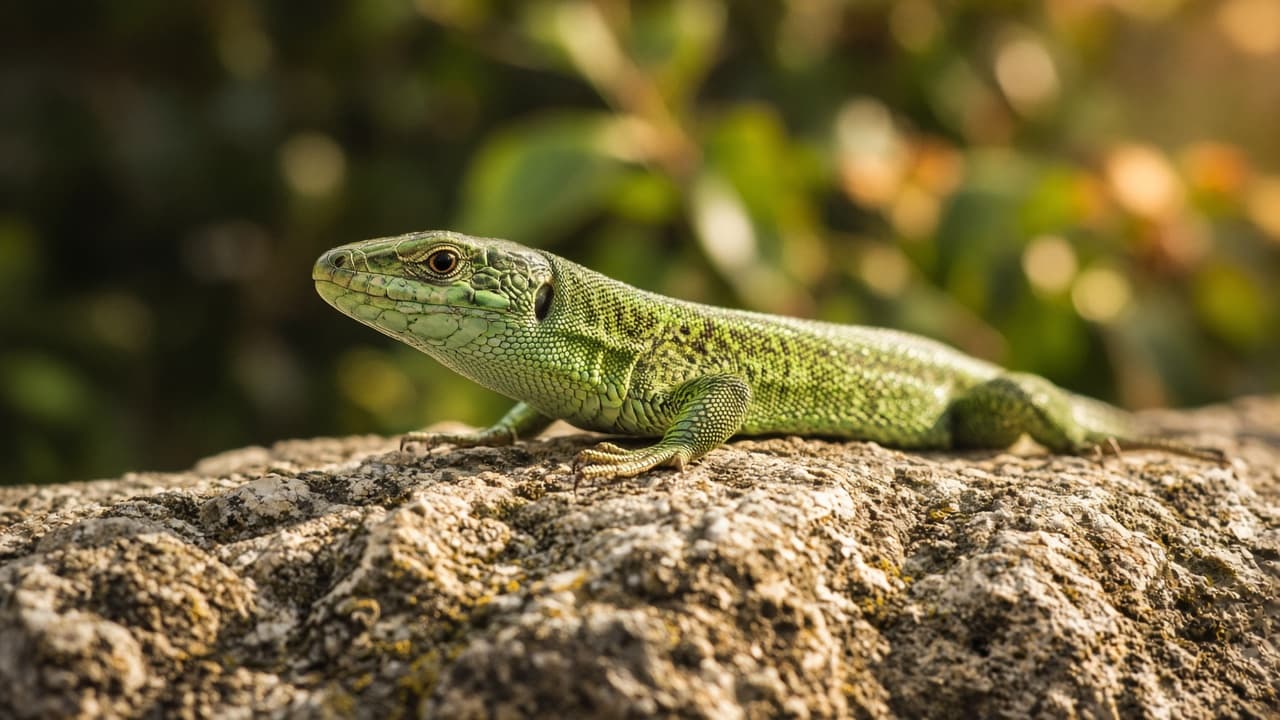
The classic setup: the animal is motionless on brick, plaster or stone, and its eye is on you. Nothing happens for a long time.
Stillness is the content here. These dreams tend to show up during periods of holding position, waiting out a decision at work, sitting through a family situation without intervening, keeping quiet in a group where speaking has a cost. The lizard is patience without passivity, which is a distinction most dreamers recognise immediately.
How you felt about being watched is the sorting detail. Comfort suggests the waiting is yours and chosen. Unease more often means someone else is doing the observing, and you can usually name them.
A Lizard Darting Across the Floor
Movement versions are fast and startling. The lizard crosses a room, runs over your foot, or disappears under furniture before you can react.
Speed dreams cluster around things that arrive and are gone before you can respond: a comment in a meeting that you let pass, a moment where you could have asked for something, a thought you meant to hold onto. The frustration dreamers report is usually about reaction time rather than fear.
If it ran over your body, note where. Contact in these dreams often marks a boundary crossed so quickly that you did not object in time.
A Lizard That Drops Its Tail
This is the most distinctive scene in the whole symbol, and it carries a built-in meaning that few dream images match: sacrifice for escape, followed by regrowth.
Autotomy dreams tend to arrive around costly exits. Leaving a role and giving up equity, ending a relationship and losing the friend group attached to it, settling a dispute by paying rather than fighting. What survives is intact; what was left behind was expensive but not vital.
Your feeling about the abandoned tail is worth recovering. Grief points at something you are not sure you should have given up. Relief usually confirms a good trade. And dreamers who notice the tail still twitching often have a situation that has not fully let go of them yet.
A Lizard Changing Colour
Chameleons and colour-shifting lizards make a different point: adaptation as camouflage.
These dreams surface for people currently adjusting how they present themselves, a new workplace with different norms, a family that requires a softer version of you, a social group where your actual opinions would not go down well. The dream rarely judges this. It simply shows the mechanism.
Where it turns uncomfortable is when the dreamer cannot find the original colour. That variant usually accompanies a stretch of adapting so long that you have lost track of your own defaults.
A Lizard in Your House
Indoors shifts the register from wild to domestic. In much of the world this is an ordinary event, and the dream may carry that ordinariness, a gecko on the ceiling, noticed and tolerated.
When it is unsettling, the reading is usually about something small and alert taking up residence in private space: a low-grade worry you have stopped trying to remove, or a person who watches family life more closely than you would like. Dreamers often report trying to catch it gently rather than kill it, which tends to mirror how carefully they are handling the real situation.
Room matters. Kitchens and living spaces suggest shared life; bedrooms point at rest and intimacy being observed.
Have a Lizard dream of your own?
Write what you remember and get a clear reading.
Being Bitten by a Lizard
Bites are uncommon and therefore meaningful when they appear. Real lizards bite defensively, and the dream generally preserves that logic.
These scenes tend to follow a situation where you pushed something small too far, kept pressing a quiet colleague, over-handled a fragile arrangement, ignored a mild warning until it stopped being mild. The injury is usually minor in the dream, which is consistent with the message: this is a correction, not a catastrophe.
Many Small Lizards
A wall or floor covered in them shifts the reading from a single concern to a distributed one.
Multiples tend to reflect an environment rather than a problem: a workplace where everyone is watching everyone, a family thread where each message is being read three times, a social scene full of people who are all being slightly careful. Nobody is dangerous; the whole room is alert.
Dreamers frequently report that the mass was not threatening, just impossible to keep track of, which is generally the accurate complaint about the waking equivalent.
Psychological Meaning
Reptiles hold a privileged place in human threat perception. Arne Öhman and Susan Mineka's 2001 review in Psychological Review set out the evidence for an evolved fear module tuned to snakes and other reptiles, quick to activate, slow to reason with, and capable of producing startle responses out of proportion to actual risk. A lizard sits at the mild end of that system, which is why these dreams are typically tense rather than terrifying.
Antti Revonsuo's threat-simulation theory (2000) explains why the tense version recurs: dreaming rehearses threat scenarios, and small, fast, unpredictable animals make efficient practice material. A lizard chase is low-stakes threat training.
For everyday content, Domhoff's continuity hypothesis remains the best guide. People who live in warm climates, keep reptiles, or grew up with geckos on the wall dream of lizards without any symbolic freight at all. If lizards are simply part of your environment, start with that before reaching for meaning.
The popular phrase "lizard brain" is worth flagging as a metaphor rather than neuroscience. The triune-brain model it comes from has been largely abandoned by researchers, so if your dream felt like a message about primitive instinct, treat that as an idea you already held rather than a fact about the animal.
Cultural and Regional Readings
Lizards carry real traditional weight in several cultures, and it is split.
In parts of South India there is a long-standing system of lizard omens, sometimes called Gowli Shastra, in which the meaning depends on where a house lizard falls or lands on the body. Across parts of the Mediterranean and North Africa, lizards around a home have been regarded as benign or protective. Other folk traditions read them as sly or unclean.
The contradiction is instructive. When a symbol is lucky in one region and unlucky a few hundred miles away, the omen is a local inheritance rather than a property of the dream. Where these traditions genuinely help is in telling you which reading you were already primed to have when you woke up.
If Lizards Keep Turning Up in Your Sleep
Repeat appearances usually mean you are in an extended period of watchfulness, a long assessment, a delicate arrangement, a situation where the safest move is to stay still. The dream is not asking you to fight; it is describing your current strategy.
The question worth sitting with is whether the caution is still earning its keep. Dreamers often find lizard dreams stop once they either act or consciously accept that waiting is the plan.
If the dreams are frightening enough to disturb your sleep rather than merely puzzle you, treat them like any recurrent nightmare and consider imagery rehearsal therapy, which has good evidence and a short learning curve. For larger reptile imagery, see alligators; for the closest relative in the dream dictionary, see snakes.