Quick Answer
Frog dreams sit at the crossing point between two states. A frog begins life in water, breathes differently, changes body entirely, and then lives on the boundary between pond and bank, which makes it an efficient image for a change you are in the middle of rather than one you are considering. Beyond that, three details reset the reading: how many there were, whether they touched you, and whether the water was clean. One calm frog and a bathroom filling with them are not the same dream at all.
One Frog, Sitting and Watching
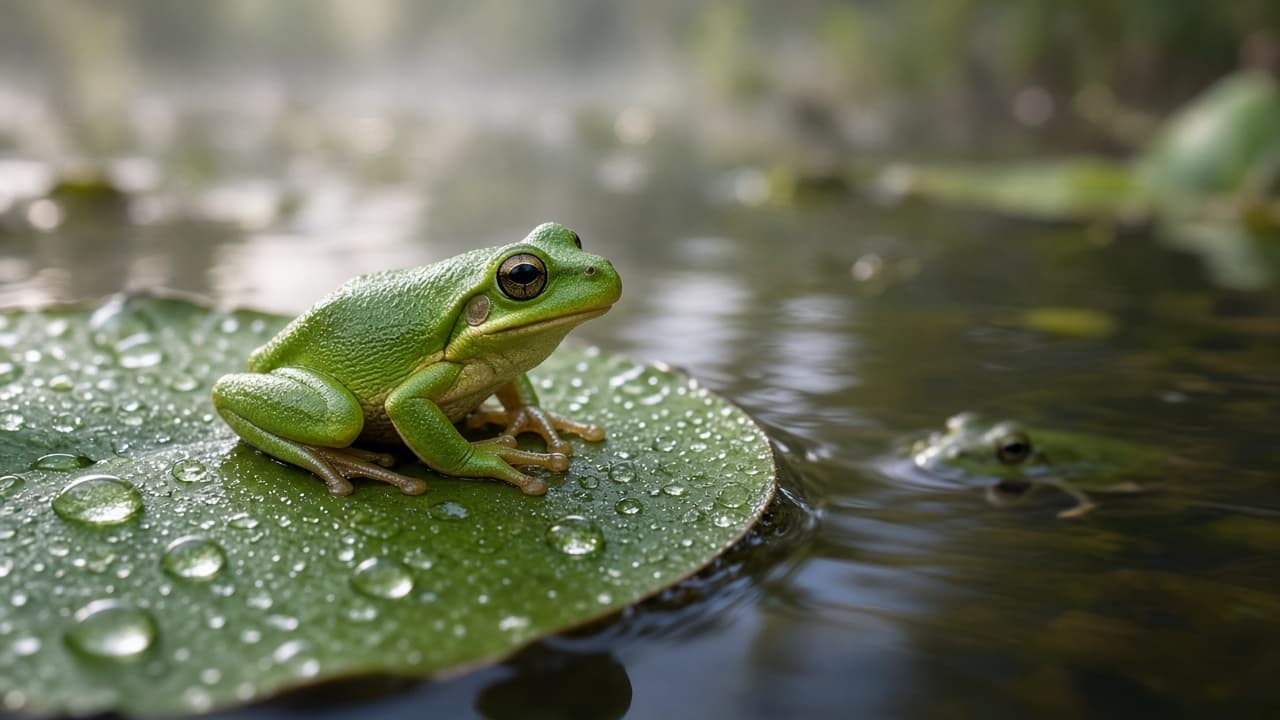
A single frog on a stone, a leaf, a step. It does not move much. You look at it for what feels like a long time.
These dreams tend to arrive at the front edge of a change rather than in the thick of it, a decision made but not announced, a pregnancy not yet shared, an application sent. The frog's stillness is the informative part. Nothing is happening yet, and something clearly will.
The setting adds detail. A frog beside clean water usually accompanies changes that feel healthy even if they are frightening. A frog in mud or stagnant water more often shows up when the transition is happening in circumstances you would not have chosen.
A Frog Jumping On You
The jump is what people remember. Frogs move suddenly, and the dream reproduces that: it is on your arm, your chest, your face, before you have registered movement.
This scene clusters around news and approaches that land personally without doing damage, someone declaring feelings, a job offer arriving out of nowhere, a relative announcing something at a family meal. Dreamers usually report shock followed by the realisation that they are not hurt, which is often exactly how the waking event went.
Where it landed can be worth keeping. On the chest tends to accompany emotional news. On the face or mouth more often shows up when the surprise involved something being said, or something you now have to say.
Frogs in the House, the Bath, the Sink
Frogs indoors carry the same logic as any wild animal crossing into domestic space: the outside thing has arrived where you rest.
The specific flavour here is dampness and multiplication. People report frogs coming up through drains, sitting in the bath, appearing under furniture, and the emotion is rarely terror, more a rising sense that this is getting out of hand. That fits waking situations where small living problems have quietly moved into your home life: work spilling into evenings, a relative's crisis becoming your household's routine, a renovation that never ends.
Bathrooms and kitchens recur in these reports, which makes sense. They are the wet rooms, and they are the rooms where private maintenance happens.
Dozens of Frogs Everywhere
Once frogs become a mass, the dream stops being about transformation and becomes about volume. A garden alive with them, a road you cannot walk down, frogs underfoot.
This version tends to accompany accumulation rather than threat: an inbox, a list of small chores, a series of minor obligations that individually cost nothing. The unpleasantness in the dream usually comes from being unable to move without stepping on something, which is a fair description of a week with no clear space in it.
Whether you tried to avoid harming them is a revealing detail. Dreamers who carefully picked their way through are often the people currently trying to meet every small demand without letting anyone down.
Catching or Holding a Frog
Holding one changes the dynamic, the transition is now in your hands, and it is slippery.
These dreams often accompany periods of trying to keep control of something that keeps shifting: a plan with moving dates, a child's changing needs, a business finding its shape. The tactile detail matters and people report it strongly: cool, damp, alive, wanting to be elsewhere.
If it escaped, note whether that felt like failure or relief. Both readings occur, and the emotion tells you whether you are actually trying to hold onto the situation or hoping it will get away from you.
Have a Frogs dream of your own?
Write what you remember and get a clear reading.
Tadpoles, Frogspawn and Half-Formed Frogs
Sometimes the dream is not about frogs at all but about what precedes them: jelly-like spawn, tadpoles in a jar, creatures with legs half-grown.
This is the most explicitly early-stage version of the symbol. It shows up around new ventures, early pregnancy, retraining, and creative work that has begun but is not viable yet. There is usually an accompanying feeling of vulnerability and abundance at once, many of them, most of which will not make it.
Watching them in a contained space, like a jar or a tank, often accompanies something you are deliberately protecting from open conditions until it is stronger.
Frogs Croaking in the Dark
A subset of frog dreams are almost entirely auditory. You cannot see them, and the sound is everywhere, steady, rhythmic, impossible to locate.
These tend to be less about change and more about ambient awareness of something ongoing: a diagnosis in the family, a workplace rumour, an unspoken problem in a relationship. Dreamers frequently report that the noise was not unpleasant, only inescapable.
Because frogs sing hardest in wet weather, these dreams sit close to rain and to the still edges of lakes in most people's memories. If the croaking stopped abruptly, that detail carries weight too. Sudden silence in a night landscape is what happens when something else arrives.
A Dead or Dried-Out Frog
The dead frog is a distinct and surprisingly common report: shrivelled on a path, dried out on concrete, still in the water.
It usually marks arrested change rather than bereavement. People describe it after a course abandoned, a move cancelled, a relationship that was mid-transformation and then simply stopped. Frogs die when conditions dry out, and that is often the honest reading, the thing was viable and did not get what it needed.
Psychological Meaning
Animals appear in a substantial share of dream reports, and their frequency is highest in children's dreams, a pattern documented in the content-analysis tradition established by Calvin Hall and Robert Van de Castle in 1966. That is worth knowing because frogs specifically carry childhood associations for many adults: ponds, jam jars, school science, a picture book. Where those memories are strong, the dream is often reaching for an early self rather than for the animal.
Most frog dreams also fit G. William Domhoff's continuity hypothesis, which holds that dreams carry waking concerns forward rather than encoding them. They cluster during real periods of transition, when change is the thing occupying the most attention. The image is chosen because it fits, not because frogs carry a fixed message.
There is also a useful negative finding. Research on prepared fears, notably by Susan Mineka and Arne Öhman, indicates that humans acquire fear of certain stimuli, snakes and spiders in particular, unusually easily, which explains the reliable dread those animals generate in dreams. Frogs are not in that category. So if a frog dream frightened or disgusted you, the reaction is likely personal or cultural rather than hardwired, and it is worth asking what frogs mean specifically to you. A dreamer who kept newts as a child is working with a different symbol from someone who once found frogs in a flooded basement.
Practically, the question that unlocks most frog dreams is: what stage am I halfway through and pretending I have finished?
Cultural and Biblical Meaning
Frogs carry heavier folklore than their size suggests, in two opposite directions.
On the auspicious side: in ancient Egypt the frog-headed goddess Heqet was associated with fertility and birth, the annual flooding of the Nile bringing frogs with new life. In Chinese tradition the three-legged money frog, jin chan, is a well-known prosperity figure still placed in homes and businesses. Across many farming cultures frogs signal coming rain, which in a subsistence context means survival. Frogs also anchor the transformation motif in European fairy tales, where the frog prince turns on the idea that something repellent contains something valuable.
On the ominous side, scripture is emphatic. The second plague in Exodus 8 fills Egypt with frogs, beds, ovens, kneading troughs, a picture not of danger but of unbearable saturation of ordinary life. Revelation 16:13 describes unclean spirits "like frogs." If you read dreams through a biblical lens, the Exodus image is the more useful one, and it is strikingly close to what modern dreamers describe: not attack, but too much of something small, everywhere, in the places you cook and sleep.
The two traditions do not really contradict each other. Rain is a blessing until it is a flood.
If the Frogs Keep Returning
Frog dreams are not omens of luck or plague, and they are not a message about your fertility or finances.
When they repeat, the most productive question is about stage rather than symbol. Something in your life is between forms, an identity, a job, a relationship, a body, and repetition usually means that stage is lasting longer than you expected. Naming where you actually are, rather than where you hoped to be by now, tends to settle the imagery.
If a swarm version keeps arriving and you wake up braced and tired, look at load rather than meaning. Reducing the number of small open items in your week is often what stops that particular dream, and if disrupted sleep is becoming the bigger problem, it is worth treating the sleep directly rather than the frogs.