Quick Answer
A praying mantis dream is almost always about attention held still. The insect does not scuttle or swarm; it waits, turns its head, and looks directly at you, the one insect that appears to return a gaze. That is why these dreams feel different from other bug dreams. They rarely carry disgust. Instead, people wake up with a sense of having been examined, or of needing to stop moving. What decides the reading is whose patience the mantis represents: yours, or someone else's aimed at you.
A Mantis That Turns Its Head Toward You
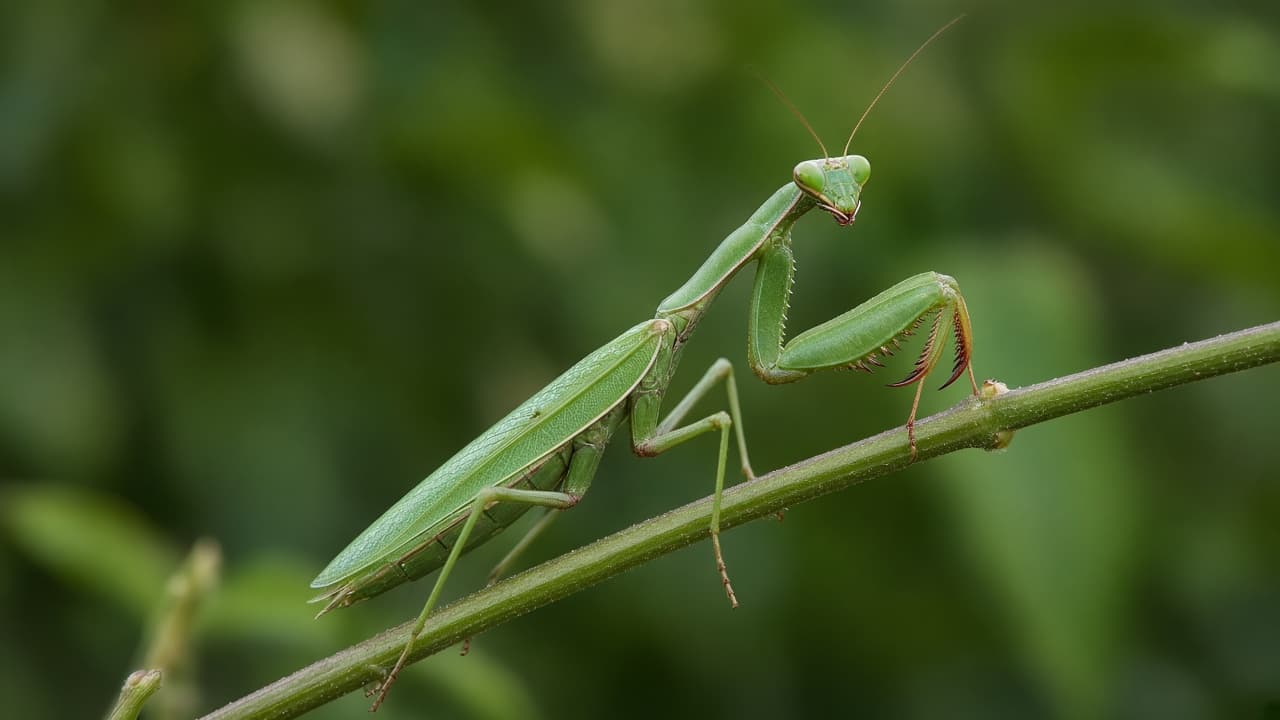
The detail dreamers report most often is the head rotation. The mantis is on a stem or a wall, it swivels, and then it holds your eye.
Being looked at by an insect is unusual enough that the dream often takes on a formal, ceremonial quality. It tends to arrive during periods of being evaluated where nothing hostile is happening: a trial period at work, an assessment, a first meeting with someone whose opinion matters. Nobody is attacking you; you are simply being seen properly, and that is its own kind of pressure.
If the mantis felt companionable rather than examining, the dream more often reflects your own watchfulness, a stretch where you have been observing a situation carefully and choosing not to intervene.
A Mantis Resting on Your Hand or Shoulder
Contact scenes read as personal rather than atmospheric. The mantis walks onto your finger, sits on your shoulder, or grips your sleeve, and the surprising part is how careful it is.
These dreams frequently appear around close scrutiny that carries no threat of harm: medical monitoring, a mentor paying attention to your work, a relationship where someone knows you very well. Because a mantis is delicate, dreamers often report anxiety about crushing it, which is worth noticing. That instinct usually belongs to a waking situation where you are handling something fragile and are afraid of doing it clumsily.
A Mantis in Your House
Indoors, the mantis behaves like a visitor rather than an infestation, and the dream normally reflects that. One insect on a curtain, a lampshade, the edge of a mirror.
The house is private space, so a watching creature inside it usually tracks self-observation: a period of taking stock, therapy, journaling, or the discomfort of noticing your own patterns. It can also point to a person who now has visibility into your private life, a new housemate, a partner who has moved in, a family member staying while things are difficult.
The room helps. Bedrooms lean toward intimacy and rest being observed. Kitchens and hallways lean toward daily routines suddenly being visible to someone else.
An Unusually Large Mantis
Oversized insects turn up regularly in dreams and the size is not usually about danger. It is about proportion, how much room the thing takes up in your head.
A mantis at the scale of a dog or a person tends to accompany situations where watching and waiting have become the entire experience. Waiting for test results. Waiting for a decision from a committee. Working under a manager who reviews everything. Dreamers usually report awe rather than horror, and often a strange politeness in the encounter.
Where the giant mantis blocked a path or a doorway, the dream is more likely about a delay you cannot get around than about a threat you must fight.
A Mantis Hunting, or Eating Prey
Some dreams show the other side of the animal: absolute stillness, then a strike too fast to see.
These are dreams about the moment patience converts into action. They often arrive shortly before or after you make a decisive move that had been preceded by a long quiet period, resigning, making an offer, telling someone the truth. The disquiet people report is usually about how ruthless the strike looked, which frequently mirrors a private worry about having been more calculating than they like to admit.
Watching a mantis eat, particularly when the prey is still moving, tends to accompany situations where you know something necessary is also unkind.
Have a Praying Mantis dream of your own?
Write what you remember and get a clear reading.
A Brown, White or Unusual Mantis
Colour and camouflage change the emphasis without inventing a new symbol.
A brown mantis, matched to dead leaves, more often accompanies concealment, being watched by someone who is not obviously present, or watching a situation yourself without declaring your interest. A vivid green mantis on green foliage carries the same logic in a healthier key: fitting the environment so well that you become invisible in it.
A white or pale mantis is a rarer report and tends to feel significant to dreamers regardless of interpretation. In practice it usually accompanies a moment of clarity rather than concealment: seeing something plainly that had been camouflaged.
Accidentally Killing One
Crushing a mantis by mistake, closing a window on it, stepping on it, brushing it away and finding it broken, produces disproportionate guilt in dream reports.
Part of that is folklore, since several cultures hold that harming a mantis brings misfortune. Part of it is the animal's fragility. Psychologically, this scene usually accompanies a suspicion that you have hurried something that required patience: pushed a conversation before someone was ready, made a decision without waiting for information, cut off a slow process because the waiting was unbearable.
The Same Mantis, Night After Night
When the insect recurs, dreamers often describe it as the same individual returning rather than a new one, an unusual feature for insect dreams and one that makes people reach for spiritual explanations.
More prosaically, recurrence usually signals unresolved waiting. The situation that requires patience has not concluded, so the image that means patience keeps being reissued. People frequently report the dreams ending abruptly once the decision, result or news finally arrives.
Psychological Meaning
Insect dreams are common, and their emotional tone varies enormously by species, a contrast worth holding in mind if you have also read the general insects entry.
Work on prepared fears, particularly by Susan Mineka and Arne Öhman, shows that humans acquire fear of some animals, notably snakes and spiders, far more readily than others. Mantises are not in that group, and dream reports reflect it: people describe fascination, unease, or reverence rather than the visceral revulsion that spiders reliably produce. If a mantis dream did frighten you badly, the fear is likely to be personal, a specific memory, or the general unease many people feel about being watched.
Why now, rather than in any other week? G. William Domhoff's continuity hypothesis suggests the answer is simply what you have been doing while awake: mantis dreams cluster in stretches dominated by observation and waiting. Antti Revonsuo's threat-simulation theory is less relevant here than in dreams of predators, precisely because so few of these dreams involve threat.
There is one further mechanism worth naming: motionlessness is a strong trigger for human vigilance. We track movement easily and find stillness that watches us far more unsettling. A dream image that combines an alien face, immobility and apparent regard is close to a purpose-built symbol for being under quiet examination.
Practically: name who has been watching, and whether the watching is protective or evaluative. Then ask what you are currently unable to hurry.
Spiritual and Cultural Meaning
Few insects carry as much explicitly spiritual weight, and much of it comes straight from the name. The genus name derives from the Greek mantis, meaning prophet or seer, and the folded forelegs gave rise to the common name in several European languages, including the French prie-Dieu.
In the mythology of the San peoples of southern Africa, the mantis figure Kaggen is a creator-trickster of real theological importance, not a minor omen but a central character. In parts of East Asia the mantis is admired for its martial stillness, and mantis-style movement was adopted into Chinese martial arts. Various folk traditions, including some in southern Europe and the Americas, hold that mantises can point the way for lost travellers or that killing one brings bad luck.
Contemporary spiritual writing tends to compress all of this into a single instruction: be still, pray, wait, trust the timing. That is a reasonable prompt and a bad prediction. If the dream leaves you with a genuine sense of being asked to hold your position, that is worth listening to on its own merits. Where the reading tips into claims about spirit guides delivering specific outcomes, treat it as folklore rather than forecast, and notice that even the traditions above are about attention and posture, not about the future.
When the Mantis Keeps Turning Up
Mantis dreams are not warnings, and they do not predict either fortune or misfortune.
If one keeps arriving, the useful move is to identify the waiting. Most dreamers who report recurring mantis dreams can name something that is unresolved and outside their control, a result, a decision, a slow negotiation, a person who has not answered. The dream tends to fade when that resolves, without any intervention.
If the being-watched quality follows you into the day, and you find yourself feeling monitored or examined when nothing is happening, that is worth mentioning to someone you trust. Persistent feelings of being observed are worth taking seriously as a waking experience, quite separately from what any dream symbol means.