Quick Answer
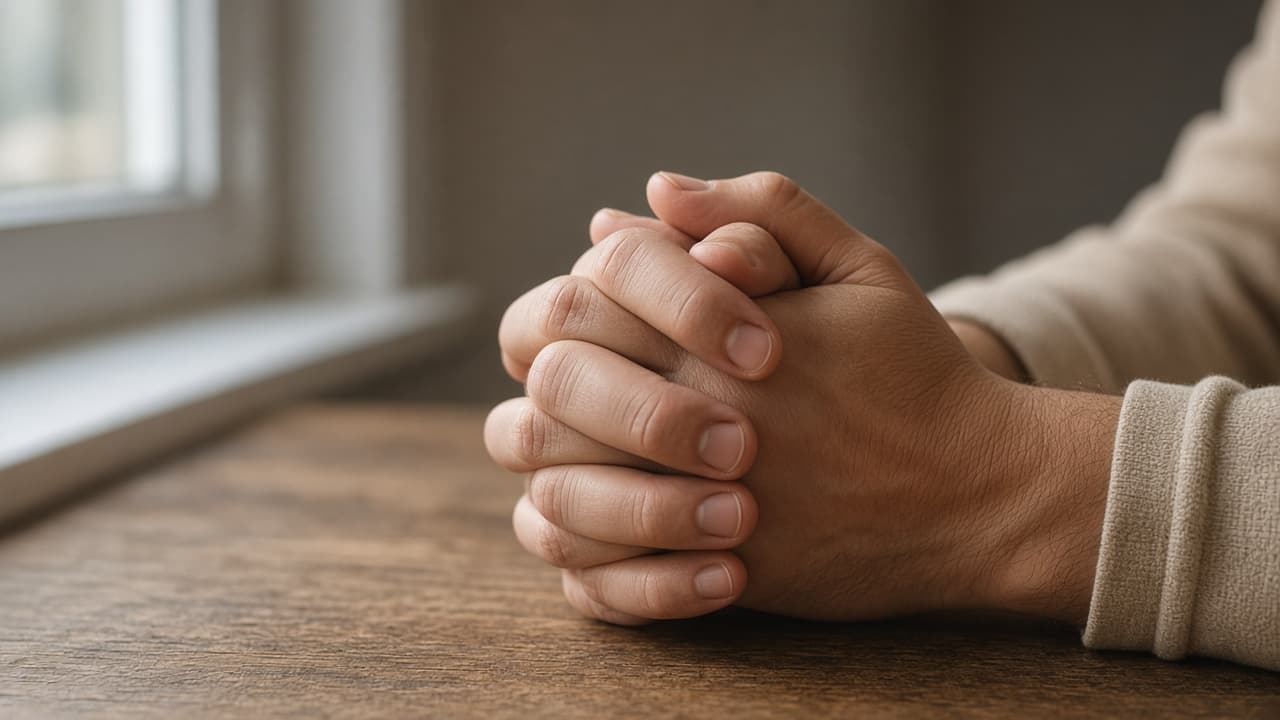
To dream of praying is to put yourself in the posture of not being the highest power in the scene. That can be devotion, desperation, habit, or a last tool when effort has failed. Asking, surrender, thanks, and bargaining are different jobs, and they map onto different waking weeks. You do not have to be religious for the image to work. Secular dreamers still kneel, still look up, still try to make a deal with luck. The figure on the other end may be God, a dead relative, the sky, or a [someone](/dreams/someone) who currently holds the outcome.
Asking and Being Answered
A voice, a warmth, a sudden knowledge, a door opening after the amen. Answered-prayer dreams are remembered as gifts, and they often arrive after a stretch of genuine petition in waking life, or after a decision you had already made and needed blessed.
The content of the answer, if you kept it, is usually short. Comfort ("you are not alone") clusters after grief, dying in the family, illness, or a crying season. Instruction ("leave", "stay", "call them") more often arrives when you already know and have been waiting for a permission slip.
If the answer felt too tidy, hold it lightly. Dreams are good at giving you the sentence you can bear. Check it against daylight consequences before you treat it as a plan.
Asking and Meeting Silence
You pray. The room stays a room. No voice, no shift, sometimes a sense of speaking into insulation.
Silence is not a cosmic insult in symbolic terms. It is often an accurate picture of a petition that has not moved: a waiting list, a person who will not change, a storm of circumstances that does not care about your timing. Dreamers report anger at God, embarrassment, or a flatness that lasts into the morning.
What you did after the silence is the reading. Getting up and doing a practical thing in the dream (packing, phoning, leaving the church) often means agency is returning through the back door. Staying on your knees until you woke more often means the situation still has you in petition-only mode.
Bargaining
If you heal them, I will... If I get the job, I will never... Contracts with a larger power are a recognisable psychological stage in fear of loss, described in grief literature as well as in faith practice.
Bargaining dreams cluster around outcomes you cannot force: a scan, a court date, a child's safety, a relationship on the edge. The dream is trying to restore a theory of control. That is human. It is also a sign that ordinary levers have already been tried.
If the other party in the bargain seemed to accept, you may be about to make a costly promise in waking life (overwork, self-erasure, a religious intensity that is mostly panic). If the other party refused the terms, the dream may be the beginning of a more honest surrender, not giving up, but dropping the fantasy of a deal.
Praying in Public, in Church, or on Your Knees at Work
Setting changes the social meaning. A private bedroom prayer is intimacy with whatever you pray to. A packed church is belonging, performance, or both. Kneeling in an office or a street is the collision of inner need with a world that may not share your language.
Public prayer dreams can mark a wish to be seen as good, or a need for a community's help that you have been too proud to ask. They can also mark feeling exposed in devotion, a convert, a returner, someone whose faith has become visible and therefore judgeable.
If you were leading the prayer, ask whether waking life has you holding other people's hope: the family chaplain, the optimistic one, the person who has to mean it when others cannot.
Have a Praying dream of your own?
Write what you remember and get a clear reading.
Cannot Find the Words, or the Prayer Will Not Start
Mouth full, liturgy gone, a language you used to know. You want the posture and cannot load the script.
Lost-words dreams appear at religious turning points and at secular ones that feel similar: the old sentences do not cover this death, this divorce, this failure. You still need to ask. You no longer believe the inherited formula, or you believe it and it will not come because emotion has jammed speech.
Someone else feeding you lines in the dream can be comfort (you are allowed help) or pressure (you are praying someone else's prayer). Whose voice it was matters.
Someone Praying Over You or For You
You are the object, not the speaker. Hands, a hospital chaplain, a parent, a stranger on a bus.
Being prayed for is a picture of needing to be carried. It shows up in illness, exhaustion, and in people who are usually the strong one. Relief in the scene often means you are closer to accepting help than your daytime identity allows. Suspicion, that they are praying at you, converting you, performing, maps onto help that comes with an agenda.
If the person praying was dead, the dream may be using that relationship as the larger-than-you figure. That can be grief's form of prayer.
Praying During Disaster
An earthquake of a plot: drowning water, a crashing vehicle, a war-like sky, and you drop to your knees because nothing else is left.
Last-resort prayer is not a personality flaw. It is what minds do when agency is empty. The dream is naming the size of the threat more than the quality of your faith. Afterward, the useful question is which waking problem has reached "only a larger power can" in your felt sense, and whether any earthly help has actually been asked for yet.
If the disaster stopped when you prayed, you may be in a week where meaning and safety feel fused. If it did not stop, you may be practising endurance rather than magic, which is a harder and more adult dream.
Psychological Meaning
Deirdre Barrett's studies of dream incubation (including her 1993 Dreaming paper on problem-solving in dreams) show that people can ask a night a question and sometimes receive a useful image by morning. Prayer in a dream is incubation made visible: the psyche kneels inside the story and poses the thing it cannot brute-force.
You do not have to accept a supernatural explanation to take that seriously. Asking, waiting, and bargaining are real stances toward problems that exceed willpower. The dream reports which stance you are in. Barrett's work also notes that incubated dreams are more likely when the question is personally urgent and somewhat open, exactly the conditions of genuine petition.
If you are a believer, you are allowed to receive the dream inside your tradition. If you are not, you are allowed to read the same posture as the part of you that knows effort has a ceiling. Both can lead to a next practical step: ask a human, rest, stop bargaining with a body that needs a doctor.
If You Keep Bargaining After the Lights Are On
Repeating prayer-dreams usually mean the unanswered part of the petition is still open by day. Write the ask in one sentence. Then separate what is yours to do from what is not. Do the first. Stop performing the second as a nightly contract.
Comforting prayer dreams during grief do not require a project. You can let them be companionship and still use ordinary support, people, meals, a clinician, because nights of kneeling are not a full care plan.