Quick Answer
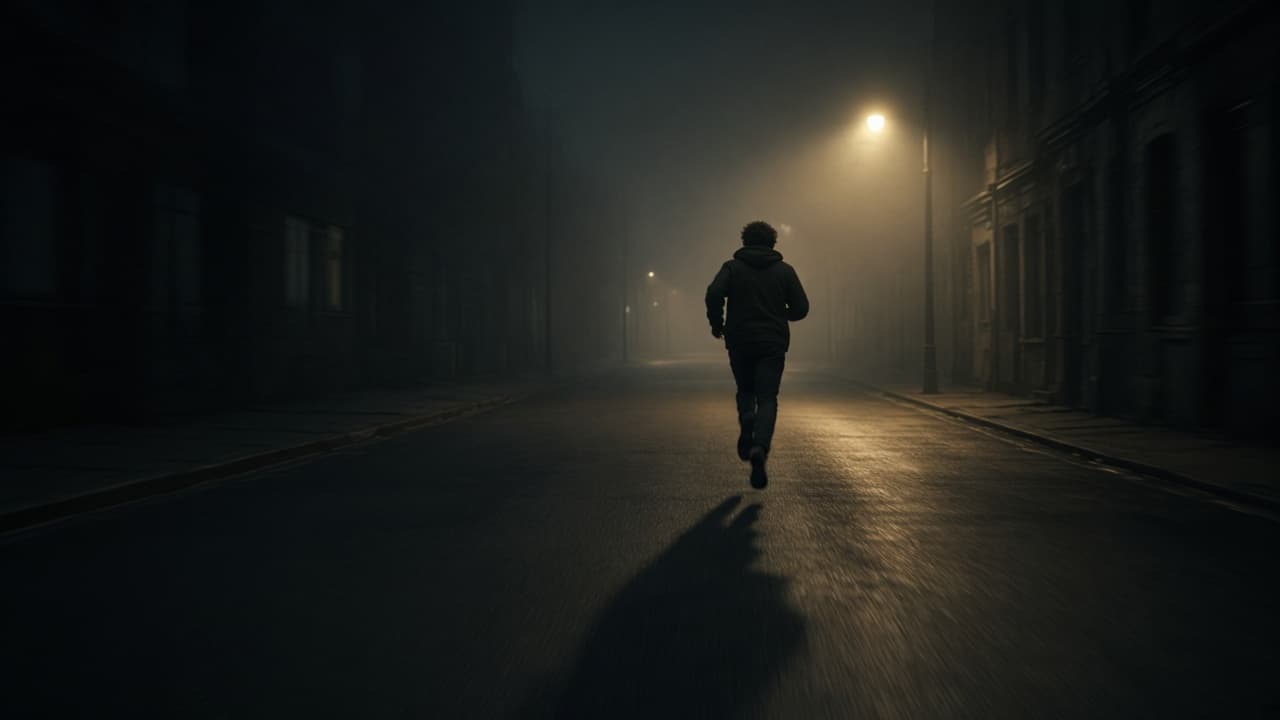
Being chased by a killer is a chase with a human attached. The hunter has intent, often a weapon, and the plot turns on whether you look back, hide, or freeze. Scene details decide the reading: a faceless stranger with a knife is not the same dream as a relative walking toward you with something in their hand.
This is educational imagery, not an omen. The dream is rehearsing interpersonal threat, not forecasting a crime.
A Human Hunter With a Weapon
The weapon is what separates this dream from being followed. Someone is not merely behind you; they have chosen a tool. Dreamers report a knife, a gun, a bat, or an object that should not be a weapon at all, a pen, a phone, a house key. The ordinary object is often the more accurate one: the waking injury is coming through a channel that was supposed to be safe.
Distance matters. A hunter far down a street still leaves you room to plan. A hunter in the same corridor has already collapsed that room. If you spent the dream trying to keep one extra doorway between you, the waking analogue is usually a conversation, a deadline, or a person you are managing by delay.
Turning Around to Look
Most chase dreams keep the pursuer off-screen. This one often does not. You turn, and the dream becomes about recognition.
What you saw is the payload. A blank face or a hood points at a threat you have not allowed yourself to name. A known face points at a relationship that still has hunting rights in your life. Some dreamers report looking and finding nobody there, only the feeling of being selected, which is a different scene: hypervigilance without a current opponent.
The look also changes your body in the dream. People who turn often stop running for a beat. That pause is worth recovering. In waking terms it is the moment you stop pretending the situation is ambient stress and admit it has an author.
Hiding in a House or Familiar Rooms
When the chase moves indoors, the hunter has entered territory that was supposed to be yours. Closets, bathrooms, under a bed, behind a sofa, these are childhood hiding maps, and they show up when adult options feel equally small.
Whether the killer knew the layout is a useful detail. A stranger who opens the right cupboard is the dream saying the threat already has inside information, a colleague who knows your weak day, a family member who knows which topic drops you. A stranger who blunders is closer to a general fear wearing a human costume.
Hiding that works (they pass the door) often accompanies a short-term coping strategy that is actually holding. Hiding that fails (the door opens anyway) more often tracks a strategy you already know is exhausted. Related indoor threat scenes live on home invasion.
Heavy Legs, Locked Doors, No Voice
The body failing is not a separate symbol from the killer. It is how the dream encodes that ordinary exits are offline. You run and the floor thickens. You shout and nothing comes out. You find a door and it has no handle.
Read the failure mode, not the monster. Legs that will not move often pair with jobs or relationships you cannot leave this month. A missing voice pairs with something you have already drafted in your head and have not said. A lock that will not open pairs with help that exists on paper, HR, a parent, a friend, and does not feel callable at 2 a.m.
If you also could not breathe, see not being able to breathe. The combination is still not a medical diagnosis from a dream; it is a body-state the nightmare is using as scenery.
Have a Being Chased By A Killer dream of your own?
Write what you remember and get a clear reading.
The Killer Is Someone You Know
A known hunter collapses the folklore. This is not "a bad man out there." It is a specific person, or a specific role: an ex, a parent, a manager, a friend who went cold.
Two readings compete, and the dreamer's waking relationship usually picks the winner. First, the person stands for themselves, a conflict that has teeth. Second, they are cast as the killer because they currently hold a power you experience as lethal to some version of you: the version that still lives at home, still works in that team, still hopes the relationship is repairable.
Tone on waking matters more than plot. Fury at a known killer often means you already know the grievance. Grief or confusion more often means the hunting is mixed with attachment, which is why the legs would not move.
Waiting It Out Instead of Running
Some versions barely involve running. You are in a room. You know they are coming. The dream is a clock.
Waiting is a bargaining-chip dream wearing chase clothing. It shows up around legal processes, medical results, performance reviews, and any stretch of life where someone else sets the next move. The killer's "intent" here is institutional as much as personal: a system that can end a role you occupy.
If you spent the dream listening for footsteps, recover what you were listening for in the day, a text, a verdict, a parent arriving. The sound is usually more specific than the face.
You Turn and the Hunt Stops
Occasionally the hunter drops the weapon, walks past, or becomes ordinary when you face them. That reversal is not a miracle ending. It is data.
Dreams that resolve on looking tend to arrive when avoidance has been the main strategy and a small piece of facing has already started, a conversation booked, a resignation drafted, a boundary half-said. The dream rehearses the rest.
If you fought, keep it non-spectacular in the retelling. What matters is whether fighting felt like self-defence or like becoming the thing you feared. The first tracks a waking line you are ready to hold. The second tracks a fear that assertiveness itself is contamination. For the broader attack pattern, see being attacked and someone trying to kill you.
Psychological Meaning
Katja Valli and colleagues, reporting in 2005 on threat content in dreams of traumatized Kurdish children and a Finnish control group, found that dreaming is densely populated with pursuit and aggression even in people who are not currently in physical danger. The killer chase is that threat-simulation system using a human antagonist instead of an animal or a storm.
A human hunter is a social stimulus. The dreaming brain can load a face, a tool, and a motive, which is why this plot feels more "about someone" than a tornado or a wave. Continuity still applies: people in conflict-heavy weeks, people consuming crime media, and people with a history of being followed or threatened will cast this script more readily. Media is props, not prophecy.
The useful question is not whether a killer is coming. It is which waking situation currently has a person, a tool, and a timeline.
If the Killer Chase Keeps Selecting You
Recurrence usually means the interpersonal file is still open. Name the hunter in daylight even if the name is a role ("the review," "the custody week," "the debt"). Then pick one concrete move that is smaller than the dream: a sentence sent, a lock changed, a session booked.
If the dream replays a real assault or stalking episode, skip amateur decoding. Imagery rehearsal and trauma-focused therapy are the evidence-backed paths, and a clinician can teach them without asking you to decide what the killer "means."