Quick Answer
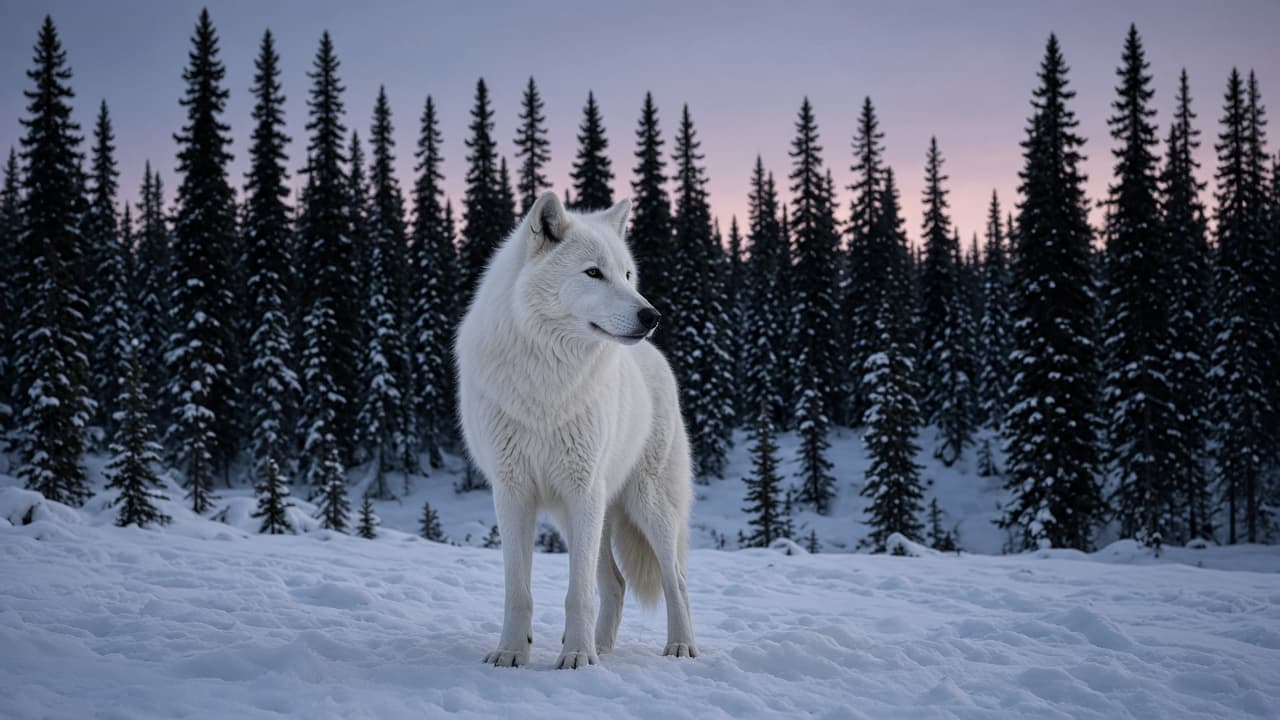
A white wolf is a wolf dream with the pack question painted in high contrast. Loyalty, hunting together, and the fear of being driven out are already in the species. White adds rarity and winter: you are visible against the group, or the group is a snowfield and you are the only figure. Whether you were accepted, hunted, or walking beside the animal decides the reading.
This is not a destiny badge. It is a social map wearing fur.
A Lone White Wolf Watching You
A single pale wolf at the treeline is the exile-or-sovereignty picture. Distance is the whole scene. The animal is not in your kitchen and not in a full pack. It is adjacent.
Dreamers report two opposite feelings that should not be collapsed. One is kinship: at last, something that matches. The other is appraisal: you are being sized as food or as rival. Kinship versions often arrive when you have been the odd one in a competent group, too intense, too quiet, too unwilling to play the local game. Appraisal versions are closer to being chased with the chase not started yet.
If you stepped toward it, you were testing belonging. If you backed away, you were protecting a life that cannot currently afford wildness.
White Wolf With a Grey Pack
This is the rarity scene the colour is for. One white body among ordinary wolves. The pack is the organisation, the family, the friend group. The white wolf is the member who does not match the coat.
Read who you were. If you were the white wolf, the dream is about visibility inside belonging, promotion, coming out, becoming the family truth-teller, being the only one who stayed. If you were watching from outside, you may be tracking someone else's difference, or rehearsing a role you have not claimed.
Pack behaviour around the white one is the tell. Grooming and travel-together is inclusion that costs the group nothing. Skirting and snarling is inclusion that is under review. A white wolf driven to the edge of the frame is already a story about exile wearing the aesthetics of uniqueness.
Winter, Snow, and Hunger
Snow is not decoration on a white wolf. It is the environment that makes the colour make sense: camouflage, scarcity, a season when packs either share or split.
Hunger in these dreams is often social. There is not enough of something, attention, money, status, parental approval, and the pale animal is either the one who still finds food or the one who will be left. Dreamers in lean professional seasons, or in families after a death or a divorce, report winter wolves without having any interest in wildlife documentaries.
If the wolf was fat and the snow was deep, the reading leans toward a competence that looks out of place in a hard season. If both of you were starving, the dream is less mystical: the system you belong to is not feeding its members.
Loyalty That Bites
Friendly white wolves get a lot of calendar-art projection. The attack versions are the corrective.
A white wolf that knocks you down is loyalty with conditions. Groups that pride themselves on being good, churches, activist circles, "we're a family here" workplaces, produce this image when you violate an unspoken rule. The paleness is the moral branding. You are not being chased by a dirty enemy. You are being chased by the thing that was supposed to be clean.
Keep the violence non-spectacular in memory. What matters is whether you were isolated from help (the pack watched) or whether a second wolf intervened. Isolation is the exile theme. Intervention is the reminder that packs are not unanimous.
For a heavier predator in the same wilderness register, see bears and lions.
Have a White Wolf dream of your own?
Write what you remember and get a clear reading.
Walking With the Wolf
Side-by-side travel is a belonging dream that does not require the pack. You and the animal share a direction.
These scenes often feel good, which makes people suspicious of them. They do not predict a soulmate or a supernatural guardian. They more often track a period when you have stopped apologising for a trait, appetite, ambition, grief, anger, that your current group treats as too much. The wolf is that trait given a body that can survive winter.
If other people in the dream were frightened of the animal and you were not, you have already switched allegiance. If you were frightened and walking anyway, the alliance is unfinished.
Exile From the Pack
Being driven off, left behind, or watching the pack recede into trees is the other half of loyalty. White makes the abandoned figure easy to find in the snow, which is both a mercy and a cruelty: you cannot hide the fact of being out.
Exile dreams cluster around actual group exits, quitting, divorcing, leaving a faith, being iced out of a friend circle, and around anticipated ones. The difference is in the weather of the feeling. Relief in the snow is an exit you have already half chosen. Panic is an exit you think is being done to you.
A white wolf howling after a departed pack is a specific loneliness: you still know the song. That is different from never having had a pack. People who grew up outside tight groups rarely dream this version.
A White Wolf in Town or in the House
Wilderness in a street or a hallway is the domestication question. Can this loyalty live where you actually sleep?
Indoor white wolves often stand for a wild standard you are trying to keep in a polite life, honesty that wrecks dinner, desire that does not fit the marriage, a protective instinct that scares the children. Compared with dogs, the wolf has not agreed to the house rules. If you fed it, you were negotiating. If you opened the door to put it out, you were choosing the house. If the wolf would not leave, the trait is not currently optional.
City-street versions (a white wolf crossing a car park) tend to be briefer and more startling. They often mark a glimpse of pack-logic in a place that pretends to be only individual: office politics, neighbourhood gossip, a team that hunts together after 5 p.m.
Psychological Meaning
Carey Morewedge and Michael Norton's 2009 paper in the Journal of Personality and Social Psychology showed that people treat dreams as meaningful information about themselves and others, sometimes more than they treat equivalent waking thoughts. A white wolf is catnip for that bias: rare, beautiful, already loaded with "spirit animal" merchandising. The experiment is a reminder to ask what the dream is using, not what the internet has pre-assigned.
Wolf imagery still tracks waking social life. People in tight teams, people leaving groups, and people who actually watch wolves will dream them more. Colour then does extra rhetorical work. White is a highlighter. It says: this member, this season, this visibility.
Read pack, winter, and exile before you read destiny.
If the White Wolf Keeps Crossing the Snow
A repeating pale wolf is usually a belonging problem that has not been named in daylight. Write down whether you were inside, beside, or outside the pack. Then name the real group, family, team, faith, friendship, in one ordinary sentence.
You do not need a totem. You need a clearer account of what loyalty is currently costing, and whether exile would be weather or a choice.