Quick Answer
Snow changes what a landscape will allow. Sound muffles. Edges soften. Walking costs more. Things look purified and become harder to use. A snow dream is usually about that combination: freeze, hush, stalled movement, and a beauty that is not the same as warmth. Distinguish a gentle fall from a whiteout, a snowed-in [house](/dreams/houses) from a walk you can still complete, fresh powder from slush. [Ice](/dreams/ice) is the hard version of the same family; [rain](/dreams/rain) is water that still moves.
Falling Snow
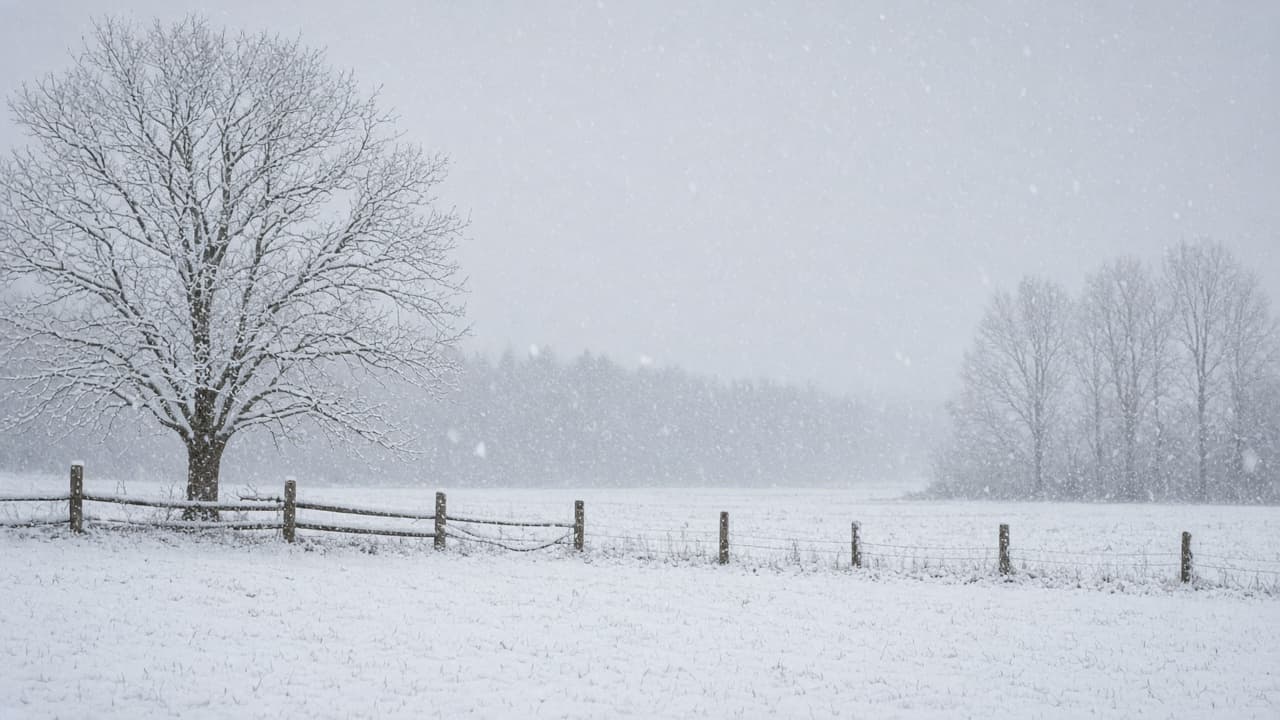
The air is full of it. The world becomes quieter while you watch.
Gentle snowfall often tracks a wish for reduced stimulation, after a loud week, a loud mind, a household that will not drop its volume. Dreamers describe standing at a window, holding out a hand, and the specific relief of a city that has been told to hush.
Heavy, driving snow is closer to a storm: input that blinds. If you were trying to get somewhere, the fall is an obstacle. If you had nowhere to be, it may be the psyche administering a rest you would not have scheduled.
Being Snowed In
Doors that will not open onto a usable world. A car buried. A village cut off.
This is stall with shelter. You are not in the open; you are in a container that has lost its exits. It shows up around delayed flights, frozen hiring, depression, caregiving winters, and conflicts everyone has agreed to pause until "the weather" changes. Sometimes the weather is a metaphor you are using to avoid naming a decision.
Who you were snowed in with is half the meaning. Alone can be peace or exile. With the wrong person is a trapped-together plot (see also trapped). With the right people, a snow-in can be an unlooked-for intimacy, the week’s only unhurried hours, staged as climate.
Walking Through Snow
Effort, tracks, cold in the shins. You can still go. It just costs.
Laborious walking maps onto progress that has become expensive, a job search in a dead season, grief work, physical recovery, a city you are new to. Tracks behind you can feel like evidence (I was here) or like exposure (anyone can follow).
Depth matters. Ankle-deep is inconvenience. Thigh-deep is a different life. If the snow crust held and then broke, you were on a surface that looked load-bearing. That physics shows up in relationships and plans that were "fine" until weight was applied.
Whiteout or Blizzard
No horizon. No landmark. Mountains and roads swallowed.
Whiteout is orientation failure in a cold medium, cousin to lost, with weather as the thief of cues. It clusters around overwhelm that has no edges: early grief, panic, a bureaucracy with no map, a spiritual crisis that erased the usual markers of who you are.
If you had a rope, a companion, or a fence line, you still have a method. If you were circling your own tracks, the dream is reporting that your current effort is not producing location. Stop walking in the same circle in daylight: ask one person, open one official letter, pick one landmark and go to it.
Have a Snow dream of your own?
Write what you remember and get a clear reading.
Playing in Snow, Children, a Beautiful Winter Scene
Joy is allowed. Not every snow dream is a freeze-out.
Sledding, snowballs, a first snow, a landscape that is simply handsome, these often continue actual pleasure, travel, or nostalgia. They can also be a compensatory picture: the psyche offering beauty in a week that had none.
Watch for the moment the game turned. A snowball that hurt, a child that vanished, a pretty street that emptied. Those turns are usually the waking mix: this is lovely, and it is also cold, and someone small still needs a coat.
Dirty, Melting, or Blood on Snow
The white does not last. Slush, soot, a stain.
Melt is thaw. Feelings returning, a numbness ending, a purity story meeting traffic and dogs. People who have been "holding it together" often dream slush in the week the holding starts to fail, which can be health rather than disaster.
Stains on snow are high-contrast conscience images, something that cannot be hidden on a white field. A fight, a sexual fact, a political shame, a private grief that has become visible. Blood specifically pulls toward injury and vitality at once; it is not a medical prediction.
Snow Inside a House or Melting on Skin
The outside climate in the inside rooms. Wrong place, like a bear in a kitchen.
Indoor snow means the freeze has crossed into the dwelling: a marriage’s emotional temperature, a depression using the living room, a family that speaks in hush. Wet socks, ruined books, a Christmas tree shedding, domestic costs of a climate that was supposed to stay outdoors.
Snow on skin, eating snow, a cold mouth, body-level versions. Numbness you can taste. A thirst you are trying to slake with the wrong form of water. If it burned like ice, the "purity" is already injuring you.
Psychological Meaning
Ernest Hartmann’s 2011 account of contextualising images fits snow unusually well. "Everything is muffled." "I cannot get traction." "It looks clean and I am freezing." The weather is the feeling’s picture.
G. William Domhoff’s continuity hypothesis (1996, 2018) explains geographic and biographical variance. People in actual winter dream snow more. People with a memorable childhood blizzard keep that prop. People in emotional shutdown dream freeze without needing a forecast. Allan Hobson’s activation-synthesis view is a minor note: a cold bedroom can get written into the plot as climate.
Jung’s associations of white with both purity and death-like stillness are culturally available and should be used as hypotheses, not stamps. A pretty snowfield can be peace. It can also be the world with the colour turned down because colour hurt.
Revonsuo’s threat-simulation theory applies to blizzards, exposure, and being lost in snow, genuine survival scenarios. A gentle window-snow is not a threat drill. Match the intensity.
Hush Versus Halt
Decide whether the snow was giving you quiet or taking your movement. Those are different gifts, and only one of them is optional.
If snow dreams keep returning in the same key, always snowed in, always whiteout, always slush, treat that key as the waking climate you are actually in. Add one source of heat or one piece of traction (a call, a walk that is allowed, a feeling named without poetry) and the weather in the dream often changes season without anyone needing to bless the storm.