Quick Answer
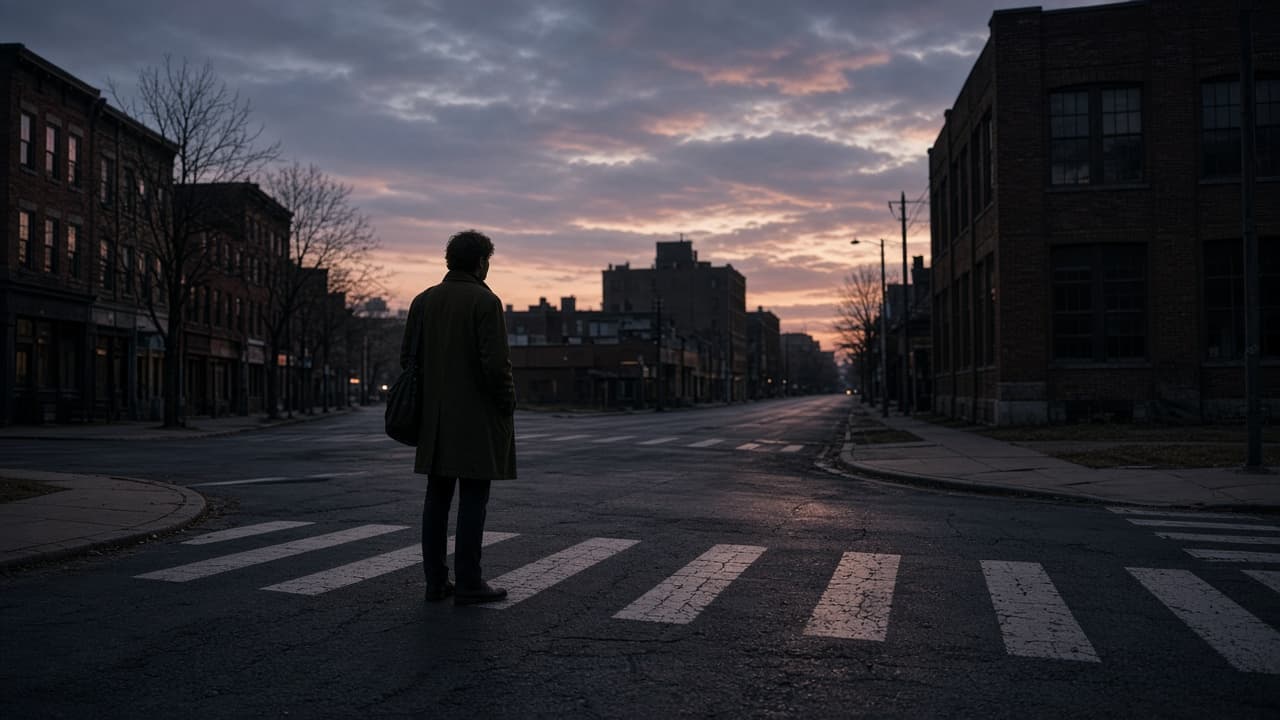
Being lost is an orientation failure. The map, who you are, where the meeting is, how this building works, what the city is called, has come apart from the territory under your feet. Typical extras do most of the work: a strange city versus a childhood [house](/dreams/houses), a forest versus a mall, whether you were [late](/dreams/late), whether you had a child with you, whether you asked [strangers](/dreams/strangers). Recover who you were supposed to meet. That appointment is often the whole dream.
Lost in a Strange City
Streets that almost make sense. Signs in a language you half know. A station you cannot find twice.
Strange-city loss clusters around actual newness and around life-stages that feel like immigration even when no border was crossed: first months in a job, a grief that has its own geography, a subculture, a medical world. You are competent in general and locally illiterate.
Cars that will not park, phones that will not load maps, keys to a room that is not on this block, those are prosthetic orientation failing. If night was falling, the time-pressure of late has joined the plot. If the city was beautiful and you still could not bear it, awe is not the same as knowing where you are.
Lost in a Forest or Wilderness
No grid. Trees as repetition. A path that is maybe a path.
Wilderness loss is orientation without institutions. There is no information desk. It shows up in spiritual crises, unstructured time after a role ends, creative work with no brief, and actual outdoor anxiety. Circling, the sun’s position, a stream you hope is the same stream, these are methods.
If someone was with you and you were responsible for not losing them, the dream is about leadership in an unmapped domain. If you were relieved to be lost, you may have needed the grid to fail. That relief is information.
Lost in a Building, School, Hospital, or Mall
Corridors, identical doors, a floor plan that rearranges.
Institutional mazes track systems that are supposed to be navigable and are not: hospitals, bureaucracies, schools you left twenty years ago (evaluation returning in old architecture), malls as consumer space with no centre. You keep almost recognising a junction.
Hospitals add the body. Schools add being tested. Malls add the fatigue of choice. If lifts and stairs disagreed about which floor you were on, see elevators. If you were running and the corridor lengthened, urgency is eating the map.
Lost in Your Childhood Home
The worst version for many people, because this was the first map.
Extra rooms, a wing that was never there, a kitchen that has moved. The house of origin has become a building you cannot finish knowing. It clusters around family secrets, inheritance, going back for a holiday, becoming a parent and finding the old layout will not hold the new role, and grief that has rearranged furniture.
Who else was in the house, alive, dead, still the age they were, is the family system. A home that keeps generating corridors is often a family that keeps generating unexplained space. You are not failing at a memory test. The territory changed.
Have a Lost dream of your own?
Write what you remember and get a clear reading.
Lost With a Child or an Elder
Your disorientation has a dependent in it.
This is a caretaking dream. The map failure is now an ethical problem: someone who cannot navigate is attached to your sleeve. Parents, adult children of ageing parents, teachers, and clinicians report it. Panic is proportional.
Whether you still had the small hand, whether they wandered, whether they were strangely calm, splits the scene. A calm child in a lost city can be a part of you that is not panicking; it can also be a child you are failing to take the panic seriously for. Elders who will not believe they are lost add a second map-conflict.
Asking Directions From Strangers
You use the social field to rebuild a legend on the map.
Kind, clear directions are a dream about help that exists, and perhaps about finally asking. Wrong directions are a dream about an advice ecology you already distrust (the internet, a family, a consultant). Incomprehensible answers, or answers in a language that slides, mean the helpers are not in your territory either.
If you would not ask, pride or shame is part of the lostness. People who wander for an hour in a dream rather than speak are often doing the same in a career or a grief. The stranger’s face, if you remember it, is sometimes a specific waking person in costume.
Finding the Way at Last
A landmark, a sudden grid, a person who says "it’s two blocks." The body drops a shoulder.
Arrival dreams after being lost are not trivial. They often follow a waking orientation that has begun: a diagnosis that at least names the district, a friend who explained the building, a decision that created a road. Dreamers report tears that feel like rest rather than sadness.
If the found place was not the one you were looking for, you may have oriented to a true location that is not the appointed one. That is a serious plot: the meeting you thought you had is not the life you can actually navigate to. Grieve the appointment if you need to. Keep the landmark.
Psychological Meaning
Tore Nielsen’s work on typical dreams places getting lost among the widely reported scenarios, alongside being late and being chased. Orientation failure is a human default plot, not a private defect.
G. William Domhoff’s continuity hypothesis (2018) predicts the scenery. Newcomers dream cities. People in medical systems dream hospitals. People going home for Christmas dream extra rooms. Ernest Hartmann (2011) would call being lost a contextualising image for "I do not know where I am in this." That sentence is allowed to be enough.
Freud (1900) sometimes read lostness as sexual or as searching for an object; it can be, when the appointment is a lover or a missing key. More often the object is a role. Jung’s labyrinth is available if the building was truly mythic; a mall is usually a mall.
Allan Hobson’s activation-synthesis view can account for the way space in dreams will not stay Euclidean. The choice of this non-Euclidean space, mother’s house, not the moon, is still continuity.
Revonsuo’s 2000 threat-simulation theory applies when being lost is dangerous (night, cold, a dependent, a pursuer). A mildly lost tourist dream is closer to problem-solving (Barrett) than to threat drill.
Map Versus Territory, and the Meeting
Write down the place-type and the appointment. City / forest / clinic / first house. Person / train / version of you / a door with a number.
Repeating lostness in the same architecture means that map is still wrong. The daylight experiment is one piece of legend: ask a specific person, visit the actual building, admit a family room you have never understood, put the meeting in a calendar with a pin. Dreams of being lost often end when a waking coordinate exists, even if it is not the coordinate you were promised in the old story.