Quick Answer
This is a public-place threat dream, not a private [being attacked](/dreams/being-attacked) dream and not a one-to-one [getting shot](/dreams/getting-shot) dream. The ingredients are a crowd, a building or street, confusion about where the harm is coming from, and a job: hide, run, shield someone, freeze. The sleeping mind is extremely willing to borrow this plot from news and fiction because it is a ready-made worst case for being among people. It does not predict an event. It does not mean you are "next." Treat the scene as simulation and then look at what *your* dream did with the exits.
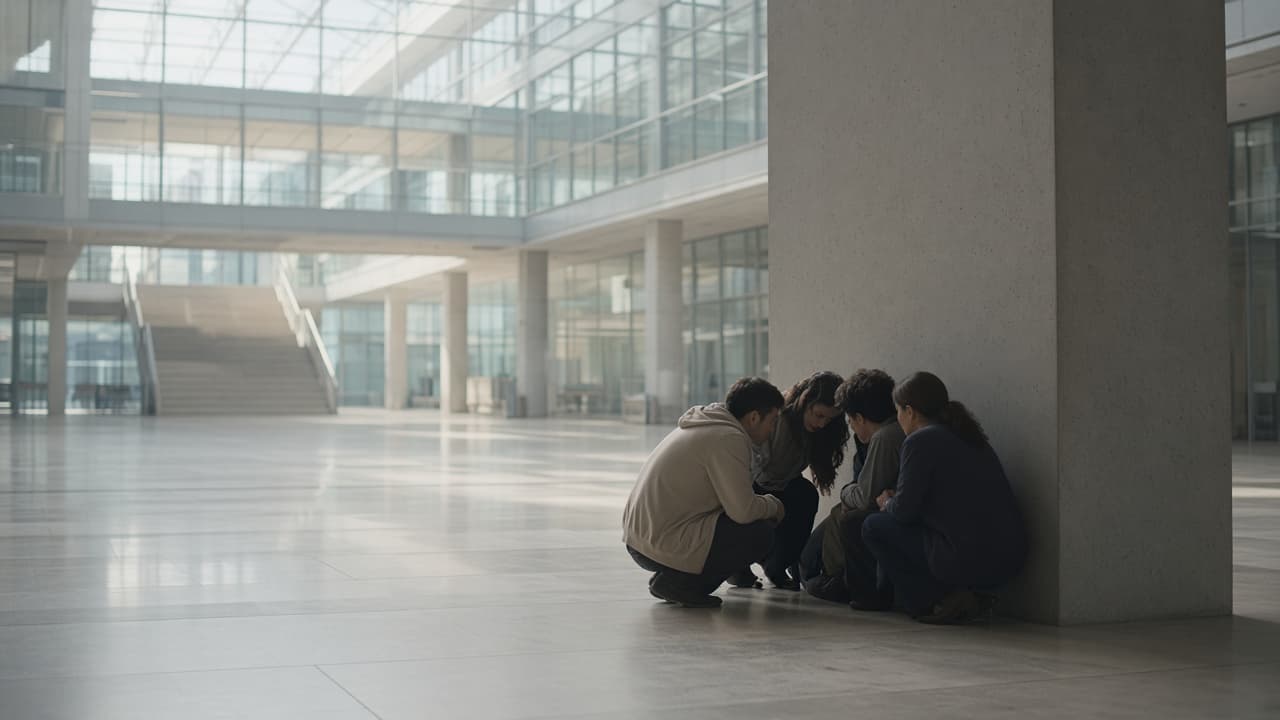
Hiding | a Pillar, a Cupboard, a Bathroom Stall
You are not fighting. You are making yourself small and waiting for information you do not have.
Hiding dreams emphasise powerlessness in a group space. They cluster after drills, after a week of headlines, after a film you could not switch off, and after ordinary days in open-plan offices or schools that already feel exposed. Dreamers remember the soundscape, muffled noise, their own breath, more than any picture of harm, which is how this page stays useful without becoming graphic.
Who you hid with matters. Alone is isolation. With a child or a partner is responsibility. With strangers who will not stay quiet is the social layer: other people's panic as a threat.
Running for an Exit That Will Not Open, or Keeps Moving
Corridors, car parks, a door you had yesterday, a fire exit stacked with chairs.
Failed egress is the personal signature inside a public plot. The attack supplies the why; the door supplies the what-in-your-life. People report this during restructures, visa problems, marriages they cannot leave, and cities they cannot afford to exit. The crowd-violence wrapper makes the stuckness feel like an emergency, which is sometimes fair (the waking situation is an emergency) and sometimes volume from the news.
If you found an exit and went back in, the dream is about duty, a person still inside, a role you would not abandon.
You Cannot See Where It Is Coming From
No clear figure. A direction that keeps changing. People running one way, then the other.
Unlocated threat is media-shaped fear: harm as weather, as something that could be anywhere in the civic landscape. It is also a fair picture of anxiety disorders, where the alarm has no object. Dreamers try to use phones that will not call, which is the modern helplessness detail, information should save you, and it does not.
Do not hunt for a perpetrator in the interpretation if the dream did not supply one. The absence is the meaning.
A School, a Mall, a Concert, Your Actual Workplace
Setting is continuity. The building is often one you use.
If it was your workplace, start with that workplace's current weather: a threat assessment email, a conflict, a feeling that leadership would not protect you. If it was a school and you have not been in one for years, leftover drills and old helplessness are enough. Concerts and malls are generic public-body fear, often after a specific story you consumed.
Your actual commute appearing is not a tip-off. It is the mind using a map it already has.
Have a Mass Shooting dream of your own?
Write what you remember and get a clear reading.
Shielding Someone, or Being Unable to Find Them
A child, a parent, a friend in another aisle. The plot becomes a search.
Protective versions belong to carers and to anyone who would be responsible in a crowd. They are love with a disaster overlay. Not finding the person maps onto ordinary separation panic as much as onto this news genre. Dreamers wake and text, which is allowed; then they should notice whether the text was about tonight's dream or about a distance that was already there.
If you shielded a stranger, the dream may be about civic identity, who you think you are in a crisis, rather than about a particular bond.
You Wake Before Anything Resolves
No ending. An alarm, a jerk, the room.
Aborted simulations are common because the fear itself interrupts sleep. An unfinished mass-threat dream is not "the universe cut the message." It is your brainstem choosing waking over more of that plot. The lack of resolution can leave a whole-day hangover. Name it as an unfinished stress rehearsal so it does not impersonate a premonition.
If you forced yourself back to sleep to "see what happens," stop. You do not need the rest of the film.
After a Real Event You Were Adjacent To | a Lockdown, a City, a Loved One's City
Proximity in waking life changes the category from media to processing.
People who have been in lockdowns, who heard real gunfire, who waited for a text from someone in a city on the news, get more literal, more repetitive dreams. That is memory and fear, not symbolism first. The useful moves are boring: reduce replay (news, video), restore sleep, use trauma-focused help if the dreams stay stuck for weeks and come with hypervigilance.
Interpretation dictionaries are the wrong tool for a rehearsal of something that already happened in the world. Care is the right one.
Psychological Meaning
Antti Revonsuo's threat-simulation theory (elaborated with Katja Valli in later papers, including their 2009 work on the idea that dreaming practises threat perception and avoidance) fits this genre with uncomfortable precision. The modern civic massacre is not ancestral, but the ingredients, a group, a hidden threat, hiding, fleeing, are. News footage is enough to load the simulator. The dream is doing a job that feels like prophecy because the job is rehearsal.
Michael Schredl's findings on nightmare frequency rising with stress and with media exposure to aversive content are the practical correction. A week of headlines plus poor sleep will generate this plot in people who have no personal risk story at all. The correction is not "never feel it." It is "do not treat volume as information about tomorrow."
G. William Domhoff's continuity hypothesis localises the building and the people you searched for. Your life supplies the set; the culture supplies the genre.
If you want the hiding-place, the failed door, and who you were with held as one scene, give those three to a personal reading in thirty seconds. If the dream is nightly, skip the reading and protect your inputs and your sleep. Nothing on this page is a warning system for a real crowd. It is a description of a mind that has seen too much of one kind of picture.