Quick Answer
Dreaming about dead fish usually means something has quietly stopped being alive: a plan, a habit, a relationship's momentum, a source of income, sometimes the whole environment you were counting on. Fish depend absolutely on their surroundings, so the dream often points at conditions rather than at the animal. The setting decides the reading. Fish dead in water suggest the environment has turned. Fish dead out of water suggest the wrong place rather than bad water. And a fish that dies while you are watching or holding it usually attaches to something you were personally trying to keep going.
Fish Floating in a Pond or Lake
The classic image: pale bodies at the surface of water that looks otherwise normal. Dreamers describe stillness first, then the slow realisation of scale.
When the water itself seems fine, the dream tends to be about something invisible having gone wrong. This matches waking situations where nothing looks broken and everything has stalled, a team where morale collapsed without a single incident, a marriage in which the arguments stopped and so did everything else, a business whose numbers are dropping for no reason anyone can name.
Count matters. A single fish tends to point at one specific loss. A surface covered in them usually reflects a systemic problem you have been treating as a series of unrelated disappointments. The wider material on lakes is worth reading if the water dominated the dream.
A Fish Out of Water on Dry Ground
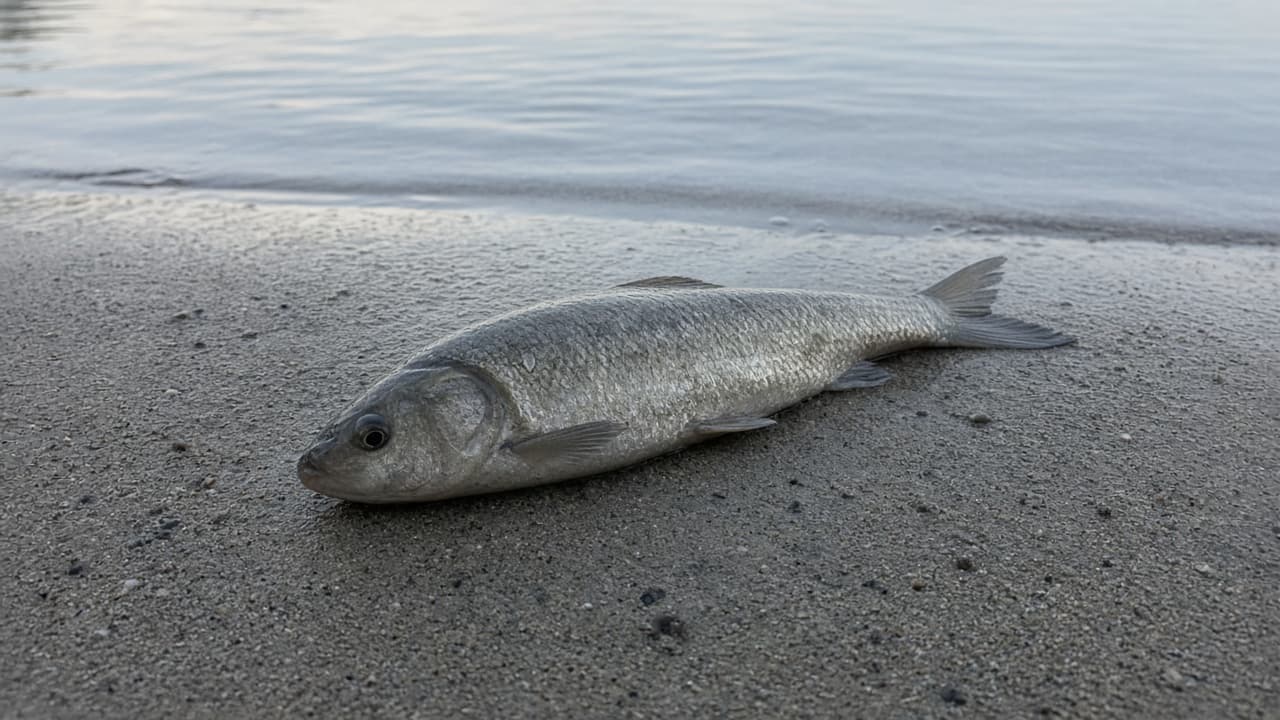
Here the fish is intact and simply in the wrong element. Sometimes it is still moving; often the dream lets you understand it will not last.
This version is about mismatch, not decline. It arrives during periods of being somewhere you cannot function: a role that requires a personality you do not have, a city where nothing fits, a social setting that leaves you gasping while everyone else appears to breathe fine. Dreamers frequently report an impulse to get the fish back to water, and how possible that felt in the dream tends to mirror how trapped they feel awake.
If the ground was hot, cracked, or far from any water, the dream is usually reporting how long the mismatch has gone on.
A Tank of Dead Fish
An aquarium changes the moral weight entirely, because a tank is a system somebody was maintaining. Dreamers describe an immediate, sinking recognition of responsibility.
These dreams cluster around neglect during overload. Something small and dependent got dropped while the large obligations were handled: a friendship that needed a phone call, a health appointment repeatedly rescheduled, a side project abandoned, a plant, a pet, a promise. Guilt in the dream is usually out of proportion to the real omission, which is itself a useful signal about how much you are carrying.
Note whether the water was cloudy. Cloudy tank water tends to accompany situations you knew were deteriorating and postponed dealing with; clear water with dead fish more often accompanies genuine surprise.
Buying or Being Given Dead Fish
A market stall, a wrapped parcel, a gift from someone in the dream. The fish is dead in the ordinary way, as food, and the emotion is suspicion rather than grief.
Transaction versions tend to track a deal or an offer you do not trust. Dreamers often report inspecting the fish, looking at the eyes or the smell, which mirrors a waking process of due diligence. If someone specific handed it to you, that relationship is usually the subject: an opportunity from a person whose motives you cannot read, or help that came with something attached.
Fresh, well-presented fish is a different dream from what follows. Where the fish looked good, the reading leans toward a legitimate opportunity you are needlessly suspicious of.
Rotten Fish and Eating It
Smell dominates this variant, which is unusual, most dreams are visual. Dreamers describe the specific revulsion of realising what is in their mouth.
Disgust dreams typically attach to something you have taken in that has gone bad: an arrangement agreed before it soured, advice you followed too long, a criticism you swallowed instead of answering. The physical rejection in the dream, spitting, gagging, being unable to swallow, usually matches a growing waking refusal to keep accommodating something.
Where the food theme is stronger than the fish theme, the patterns on food dreams may fit better.
Have a Dead Fish dream of your own?
Write what you remember and get a clear reading.
A Large Fish Washed Up on a Beach
Scale turns this into a different kind of dream. A whale-sized or enormous fish on the shoreline produces awe rather than disgust, and dreamers often describe standing with other people looking at it.
Big stranded creatures tend to accompany the collapse of something large and public: a company folding, an institution losing authority, a public figure's downfall, a family structure that finally gave way. The dream's crowd is part of the meaning, this is a loss with witnesses, not a private one.
A Fish Dying in Your Hands
The most intimate version. You caught it, or rescued it, or were carrying it, and it stops moving while you hold it.
These dreams usually follow direct effort that failed. Care given to someone who did not recover, a project you personally kept alive until you could not, a mediation attempt between people who separated anyway. The tactile detail is the point: dreamers remember weight and texture, and they wake with a sense of having been present at the moment something ended.
Guilt is common and rarely deserved. It is worth separating the fact that something died in your hands from the idea that it died because of them.
Dead Fish in Dirty or Poisoned Water
When the water is visibly wrong, oily, brown, foaming, the dream has already told you where to look. The fish are the consequence, not the subject.
This version turns up in environments that damage people slowly: a workplace with a bullying culture, a family system organised around one person's temper, a friendship group that has curdled into competition. Dreamers often report standing in or near the water themselves, which is usually an accurate statement of exposure.
Psychological Meaning
Fish are among the more emotionally loaded animals in dream reports, partly because water so often accompanies them, and partly because they are so vulnerable to conditions we cannot see.
G. William Domhoff's continuity hypothesis is the most useful research frame. Dream content tends to follow waking concerns and to use images the dreamer already holds, so someone in a stalling career, a dying relationship, or a poor living environment has the ingredients for exactly this dream. The image reads as sinister, but the underlying process is unremarkable: your mind reached for a picture of something that cannot survive its surroundings.
Michael Schredl's research on dream emotion is relevant to the strength of the reaction. Negatively toned dreams increase with stress and with poor sleep quality, and their emotional intensity broadly tracks waking distress. If dead-fish dreams have started appearing frequently, the more informative question is often what has changed in your week rather than what fish mean.
Jung treated water as an image of the unconscious and fish as contents rising from it, which is why some analysts read a dead fish as an insight or possibility that surfaced and was not used. That reading resonates with dreamers who recognise an abandoned idea in the dream, but it works best as a prompt rather than an answer.
One clarification worth making plainly. Dreams do not report on your body, a pregnancy, or anyone's health. If a dead-fish dream has frightened you along those lines, the fear is coming from folklore, not from information.
Cultural, Spiritual and Biblical Meaning
Fish carry unusually consistent symbolism across traditions, which is why a dead one feels like a reversal of something.
In Chinese culture the word for fish is a homophone for abundance, so fish imagery is associated with prosperity and plenty, a context in which dead fish naturally read as luck draining away. Several South Asian and Middle Eastern folk traditions link fish to fertility and provision. Across many coastal cultures, a die-off is a straightforward practical catastrophe, and that literal meaning sits underneath the symbolic one.
Christian tradition gives fish some of its densest associations. The ichthys was an early identifying symbol among believers; Jesus called fishermen to become "fishers of men" in Matthew 4:19; the feeding of the multitude in all four gospels turns loaves and fishes into an image of unexpected sufficiency. Revelation 16:3 describes every living soul in the sea dying as part of a judgement sequence, which is the passage readers sometimes have in mind when a dead-fish dream feels apocalyptic. Read alongside the abundance associations, the useful question for scriptural readers is usually about provision, what has stopped being fruitful, and what conditions caused it.
Your own history outranks the traditions. A dreamer who kept an aquarium as a child, worked in fishing, or grew up beside a polluted river brings a different symbol to sleep than someone whose only association is a supermarket counter.
If the Dead Fish Dream Keeps Returning
Recurrence here usually means the environment has not changed, rather than that the message was missed.
The most practical exercise is to write down what killed the fish in the dream, if the dream told you: the water, the air, the neglect, a person, nothing identifiable. That answer tends to point at whether your waking problem is a place, a relationship, an omission, or a straightforward run of bad luck, and those need very different responses.
Where the dream keeps showing you poisoned water, take the environment seriously. People stay for years in conditions that quietly cost them their energy, and dreams about surroundings are often blunter than anything they would say out loud. And if the dreams have become distressing enough to disturb your sleep, deal with the sleep first: rested people interpret their own dreams considerably better than exhausted ones do.