Quick Answer
To dream of fishing is to dream about patient pursuit: dropping a line into water you cannot see into, and waiting to find out what is down there. The activity itself suggests something you are trying to bring up from below, an answer, an opportunity, a feeling that has not surfaced yet. The outcome sets the tone. A full net, an empty afternoon, a fish that snaps the line, or something you did not expect at all each describe very different waking situations.
Catching a Big Fish
The dream everyone hopes for. The rod bends, the line runs, and something substantial comes up.
Big-catch dreams typically arrive alongside results, an offer coming through, a manuscript accepted, a house purchase progressing. They also show up in advance, as rehearsal, when you have put serious effort into something and are waiting to hear.
Landing it is the part to examine. Dreamers who struggle with a fish too big for the tackle often describe excitement mixed with alarm, which usually matches an opportunity that would genuinely stretch them. Wanting a thing and being ready for it are not the same, and this dream tends to know the difference.
Catching Nothing
Hours pass. The water stays flat. Nothing bites.
Empty-line dreams are far more common than the triumphant version, and they belong to phases rather than failures: applications with no replies, dating that goes nowhere, a quarter where the pipeline is dry. The dream reproduces the specific tedium of doing everything right with no feedback.
Your mood in the scene matters. Contentment in an empty afternoon usually signals acceptance of a slow period. Growing agitation more often means you are running out of patience with something that has not yet been given enough time.
The One That Got Away
The line goes tight, everything happens quickly, and then the tension is gone.
Loss-at-the-last-moment dreams tend to follow near-misses you are still turning over: a final-round interview, a deal that collapsed at signing, someone who withdrew just as things looked settled. The dream isolates the worst part, which is not the absence of the fish but the memory of having had it on.
Dreamers frequently report checking the line afterwards, looking for what failed. That instinct, searching for the mistake, is usually the real subject.
Fishing With Someone Else
A lot of fishing dreams are populated: a father, a grandfather, a childhood friend, a colleague sitting quietly in the same boat.
Fishing is one of the few activities where sitting in silence with someone counts as spending time together, and dreams use that. These scenes tend to arrive when you miss undemanding company, or when a relationship has become all logistics and no ease.
When the companion has died, the dream often takes on a gentler quality altogether. Grief dreams involving a familiar shared activity are widely reported and usually remembered as comforting rather than distressing.
Fishing in Water That Makes No Sense
Casting a line into a swimming pool, a flooded street, a puddle, a bathtub, or a river running through a house.
Displaced-water dreams point at looking for something in the wrong place. People report them while trying to extract emotional depth from a relationship that does not have it, hunting for career opportunities in a dying sector, or searching an old friendship group for support that has moved elsewhere.
Whether you caught anything in the strange water is worth noting. Sometimes you do, which tends to reflect an unlikely source that actually came through.
Have a Fishing dream of your own?
Write what you remember and get a clear reading.
Reeling in Something Unexpected
Instead of a fish: a boot, a key, rubbish, an object from your past, occasionally something alarming.
These dreams are about what surfaces when you go looking. Memory works this way, start dredging and unrelated material comes up with it. Dreamers who report pulling up something from childhood are often in the middle of therapy, a house clearance, or a family conversation that stirred more than intended.
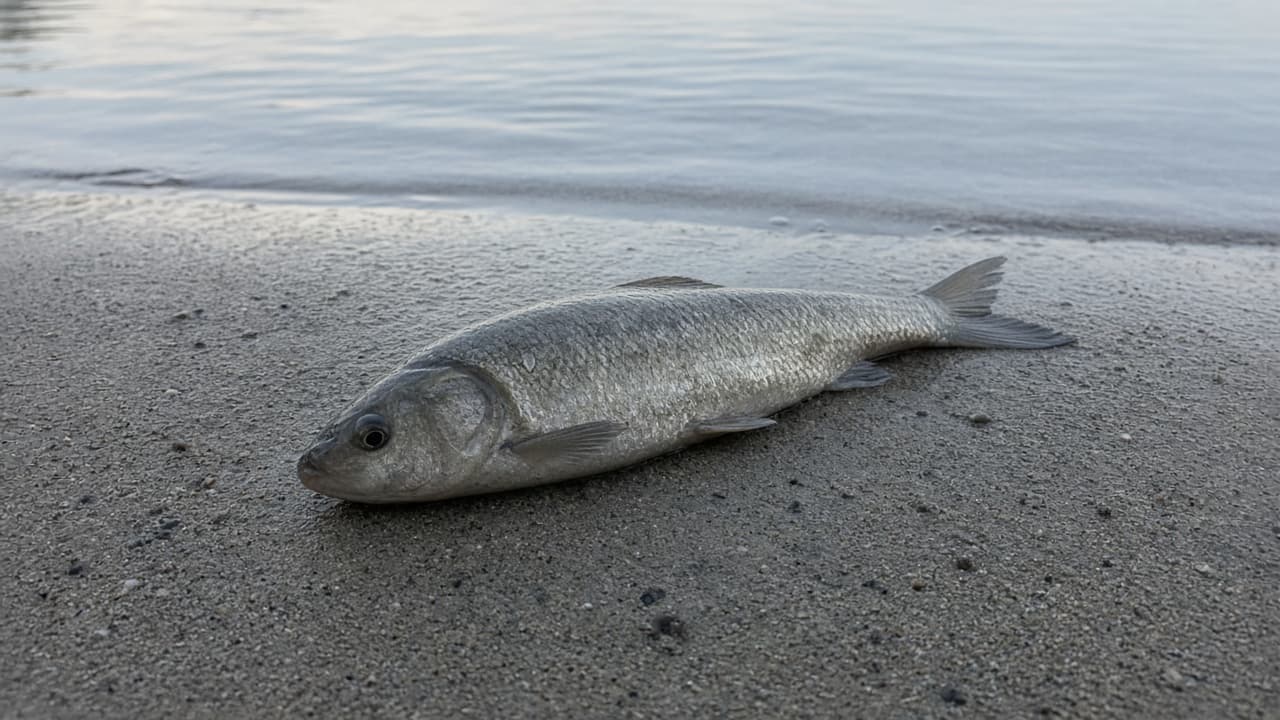
If what came up was distressing, treat that as the dream's actual content and the fishing as the frame. Related imagery appears on the dead fish page.
Letting the Fish Go
Catch and release has its own meaning: you got the thing and chose not to keep it.
These dreams cluster around deliberate renunciation, turning down a promotion that would cost too much, ending a flirtation that was going somewhere unwise, walking away from an argument you could have won. The emotional signature is usually quiet satisfaction rather than regret.
If you released it reluctantly, or someone in the dream made you, the reading tilts toward a sacrifice you have not fully agreed with.
Nets, Ice Holes, and Fishing at Night
Method changes the dream's texture. A net is indiscriminate and industrial; ice fishing is narrow and cold; night fishing is blind.
Net dreams tend to appear during mass efforts, sending fifty applications, running a wide marketing push, meeting many people quickly. Volume replaces precision, and dreamers often report catching plenty of things they did not want.
Ice fishing points at scarcity and persistence: a small opening, a long wait, a hard season. Night fishing usually accompanies pursuits you are conducting privately, before telling anyone what you are trying to do.
Psychological Meaning
Fishing gives dreams a ready-made structure, intention, patience, uncertainty, outcome, which is why it recruits so easily for anything you are waiting on. Domhoff's continuity hypothesis is the sensible starting point: people who fish dream about fishing, and people who are pursuing something uncertain borrow the image because it fits.
Carl Jung's treatment of water as an image of unconscious content is one of the few classical readings that holds up as a usable metaphor here. Under that frame, angling represents deliberate contact with material below awareness: you cannot see what is there, you can only put something in and wait. Jung's fish symbolism is worth taking as a lens rather than a rule, and it works best for dreams that feel exploratory rather than competitive.
There is also a straightforward attention story. Fishing requires sustained low-intensity focus, and people frequently describe real fishing as one of the few contexts where their mind quietens. If your waking life currently offers no such context, a dream that puts you on a dock for an hour may be doing exactly what it appears to be doing.
Hall and Van de Castle's 1966 norms are a useful reminder of scale: most dream content is ordinary activity in ordinary settings. A fishing dream is not automatically a symbol. Sometimes it is a memory of a good afternoon.
Biblical and Cultural Meaning
Fishing carries genuine weight in Christian tradition, which is why so many dreamers arrive here with a verse in mind. In Matthew 4:19 the call to the first disciples is "I will make you fishers of men", turning the trade into an image of persuasion and gathering. Luke 5 describes a night of catching nothing followed by a catch so large the nets begin to break, a passage that speaks directly to dreams about fruitless effort.
John 21 returns to the same water after the resurrection, with instructions to cast on the other side of the boat. For dreamers who read their dreams through scripture, that image of a small change in approach transforming the result is usually the one that lands.
Outside Christianity, fish carry abundance and fortune associations across many cultures, notably in Chinese symbolism where the word for fish echoes the word for surplus. Those traditions explain why abundance readings dominate old dream dictionaries. They are cultural inheritance rather than prediction, and your own history with the water outranks both.
When You Keep Going Back to the Water
Recurring fishing dreams generally mean you are still waiting. The image returns because the situation has not resolved, not because the dream is insisting on anything.
The question worth asking is whether you are fishing the right water. Long runs of empty-line dreams often coincide with effort pointed somewhere that has stopped producing, and dreamers frequently report the imagery changing once they change approach rather than intensity.
If the dreams turn anxious, tangled lines, rising water, losing the boat, that shift usually tracks pressure rather than patience, and it is worth looking at what deadline has entered the picture. For calmer water imagery, see lakes, or browse other action dreams.