Quick Answer
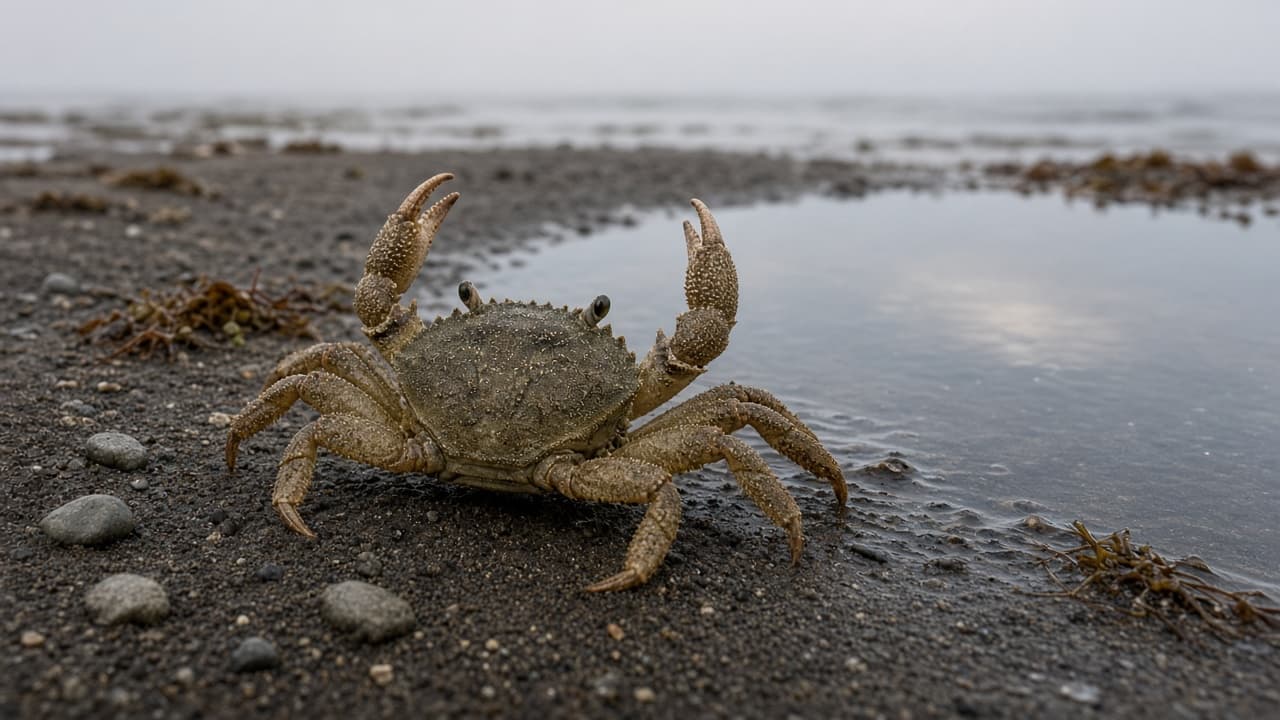
A crab is a small bundle of three ideas: armour, pincers, and sideways movement. Dreams use them for defensiveness, for a grip that will not let go, and for progress that is real but not happening in a straight line. The scene tells you which one is active. A pinch points at something minor that has hold of you. A crab watching from a tide pool points at wariness. Crabs indoors point at a defended, snappish quality that has crossed into private life. And a crab moving sideways while getting where it is going is often the most encouraging version of the dream.
A Crab Pinching or Gripping You
Almost nobody describes a crab bite as dangerous. They describe it as impossible to shake off, and disproportionately painful for its size.
That combination is the reading. These dreams tend to accompany small, tenacious problems rather than crises: an administrative error that keeps resurfacing, a relative who has fixed on one remark you made, a debt of a size that should not matter and does, a criticism that was almost nothing and has stayed for months. The dream matches the specific frustration of being held by something too small to fight properly.
Where the crab held you matters. A hand or finger tends to accompany something interfering with what you are trying to do. A foot or ankle more often accompanies something slowing you down, a commitment you cannot walk away from, or an old habit that catches you every time you try to move.
A Crab Sitting Still and Watching
Crabs in dreams frequently do nothing at all. They sit at the edge of water, claws slightly raised, and the dream is entirely about being observed by something armoured.
Wariness is the theme. These scenes surface during periods of guarded negotiation, a colleague who is polite and unreadable, a new stepparent, a landlord, an interview panel. Nobody has attacked, and nobody is relaxed either. Dreamers often report a mutual stand-off, and how close they got before the crab moved tends to describe how much trust has actually been built.
A Crab Chasing You Across the Sand
Pursuit by a crab is a strange sort of chase, and dreamers often mention feeling ridiculous as well as afraid. The animal is small, quick, and it moves in a way that is hard to predict.
This version tends to attach to indirect pressure. Not a confrontation, but a person or process that keeps approaching at an angle: gossip, passive-aggressive messages, a complaint that arrives through other people. The awkwardness of the chase mirrors the awkwardness of defending yourself against something that never quite declares itself.
Straightforward, overwhelming pursuit belongs elsewhere in the dictionary. What distinguishes crab chases is the sideways approach.
Many Crabs Moving at Once
A beach covered in them, or a floor that turns out to be moving. Dreamers describe the sound as much as the sight, and often a strong desire to keep their feet off the ground.
Volume converts the symbol from a single problem into an atmosphere. These dreams cluster around environments where lots of small defensive interactions are happening simultaneously, a team of people all protecting their own patch, a family event where everyone is slightly braced, a group chat where every message needs decoding. No individual crab is the threat, and that is precisely what makes the scene exhausting.
A Crab in Your House or Bed
Crabs belong at the waterline, so a crab under a duvet or scuttling across a kitchen floor is a boundary dream first and an animal dream second.
Indoor versions typically mean the guarded, pinching quality has reached your private life. Work politics that now shape your evenings, a defensive posture you needed at your job that has started running with your family, an argument that has moved into the bedroom. Dreamers often report trying to catch the crab in something, a bowl, a towel, which usually mirrors an attempt to contain a waking problem without escalating it.
Bedroom placements read as the most invasive, for the same reason they do in any house dream: it is the last private room.
Catching, Cooking or Eating Crab
A completely different genre. Here the crab is food, the setting is often social, and the dominant experience is effort, cracking, picking, working for a small amount of meat.
These dreams frequently arrive during periods of high effort for modest return: a job that pays adequately and takes everything, a course of study with a long payoff, a relationship that requires constant maintenance. Dreamers rarely describe the meal as unpleasant, which is part of the point. The reward is real; it is just laborious to get at.
If someone else did the work and handed you the meat, look at that relationship. It usually names a person absorbing the difficult part of something on your behalf.
Have a Crab dream of your own?
Write what you remember and get a clear reading.
A Soft Crab That Has Just Shed Its Shell
Molting is one of the more striking images in this part of the dictionary. The crab is intact but unarmoured, and dreamers instinctively understand that it is in danger.
These dreams tend to arrive in the days after a defence has been dropped. Telling someone the truth, ending a long performance of being fine, leaving a role that came with authority, early recovery from something. The vulnerability is not a warning, molting is how a crab grows, but the dream is accurate about the exposure that follows.
Handle the impulse in the dream as information. Dreamers who report hiding the soft crab are usually doing something protective in waking life that deserves credit.
A Giant Crab
Scale pushes this into the mythic register, and the fear is different: less irritation, more dread.
Enormous crabs tend to accompany defended institutions rather than defended people, a bureaucracy with no soft surface, a legal process, a family system whose rules cannot be argued with. Dreamers frequently describe trying to get past the creature rather than fight it, which usually matches a waking strategy of working around an immovable structure.
A Dead Crab or an Empty Shell
An empty carapace on the sand is not a corpse, and dreams distinguish the two. Dreamers report picking it up and noticing how light it is.
Empty shells often mark a defence you have finished with. The armour is still recognisable, you can see the shape of who you had to be, and there is nothing inside it any more. This shows up after leaving hostile environments, ending long conflicts, or recovering from a period when being guarded was necessary. A genuinely dead crab, still whole, more often accompanies the end of a specific standoff.
Psychological Meaning
Crabs are not common enough in dream reports to have their own research literature, so the useful frameworks are general ones applied carefully.
G. William Domhoff's continuity hypothesis suggests dreams continue waking concerns using imagery already available to the dreamer. A crab is a compact image for defensiveness and tenacity, and people reach for it when those qualities are live, in themselves or in someone they are dealing with. If you spent last week at the coast, that is also part of the explanation, and it does not make the dream meaningless.
Antti Revonsuo's threat-simulation theory helps with pinching and chasing versions. Dreaming appears to rehearse responses to threat, and small biting or grabbing animals are a recurring category in these simulations across cultures. The dream is running a drill against something that grips rather than something that overwhelms, which is a distinct and useful practice.
Jung discussed a patient's crab dream at length in "The Practical Use of Dream-Analysis" (1934), reading the creature that seized the dreamer's foot as an image of a backward pull, something ancient and instinctive resisting a step forward. That interpretation is not a general rule, but it maps unusually well onto the ankle-grip version of the dream, and it is worth testing against whatever you have been trying to move on from.
One thing to set aside plainly: the disease named after crabs has nothing to do with this dream. The word came from Greek physicians describing the shape of certain tumours, and the zodiac sign has the same linguistic root. A crab in your sleep carries no information about anyone's health. If health anxiety is what actually brought you here, that fear is worth addressing directly rather than through the animal.
Cultural and Mythological Meaning
Greek myth supplies the best-known crab story. Karkinos was sent by Hera to harass Heracles during his fight with the Hydra, was crushed underfoot, and was placed among the stars as the constellation Cancer, a small creature honoured for a nuisance attack on someone much stronger. That story captures the tone of many crab dreams remarkably well.
Japanese folklore includes the heikegani, shore crabs whose shell markings resemble angry human faces and were said to carry the spirits of drowned Heike warriors, an association of crabs with grudges that outlast their occasion. In several Pacific and Caribbean coastal cultures, land crab migrations are ordinary annual events, so dreamers from those places often bring a far less sinister set of associations than inland dreamers do.
Coastal dreamers in particular often find crabs turning up alongside the wider imagery of the beach, which softens the animal considerably. Astrological tradition, meanwhile, reads the crab as protective, home-oriented and emotionally armoured. You do not need to accept the system to notice that it lines up with what the dreams themselves keep showing: a soft interior with a hard exterior, and a preference for moving sideways.
Crabs That Keep Coming Back
Repeat crab dreams usually indicate that a defensive standoff is still running, not that anything is escalating.
The most useful thing to record is your own posture in the dream. Were you keeping your distance, trying to remove the crab, holding still, or hunting it. Dreamers who track this often find their posture changes before the waking situation does, a sign of a shift in how they intend to handle the person or problem involved.
If the dreams stay unpleasant, look at whether you are currently living behind more armour than you want. Long periods of guardedness cost energy quietly, and the sideways, pinching quality of these dreams is often the first honest report that you are tired of holding a position. Interpretation aside, dreams that repeatedly wake you are worth treating as a sleep problem in their own right.