Quick Answer
A mountain lion in a dream generally stands for power that watches before it moves. Cougars are solitary ambush hunters rather than showy pack animals, so the emotional signature of these dreams is being observed, tracked, or caught out, not being roared at. Two readings compete, and the scene decides which. Either something in your life is operating on you quietly and you have only just registered it, or the cat represents your own contained force: capability, anger, or ambition you keep out of sight. Distance, eye contact and whether it moved toward you are the details to recover first.
A Mountain Lion Watching You From a Distance
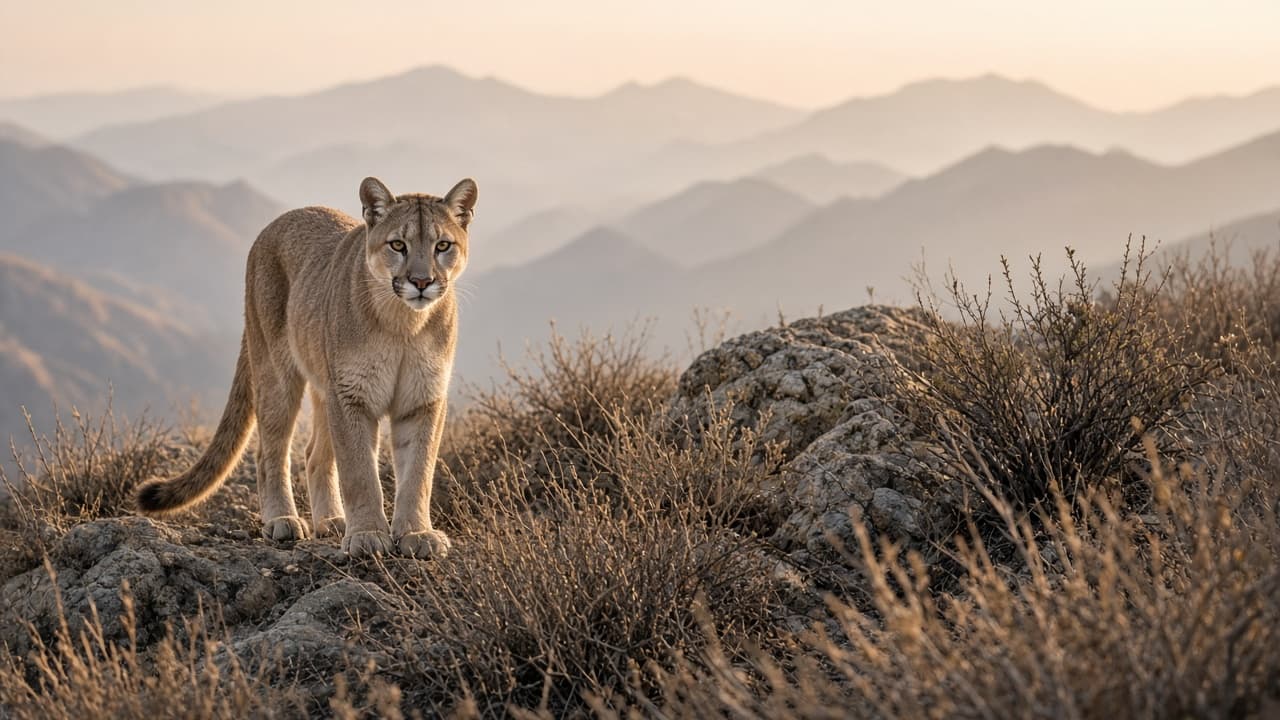
The most commonly reported version, and the one that lingers. The animal is on a ridge, a rock, or the far side of a clearing, entirely still, and the dream consists mostly of the two of you looking at each other.
Stillness with attention is the reading. These dreams show up when you have become aware of being assessed by something you cannot negotiate with, a regulator, a hiring panel, a new boss, a rival who says very little. Dreamers frequently note that the cat did not seem angry. That accuracy matters: what unsettles you is the calm, which usually mirrors a waking situation where nobody has threatened you and the power imbalance is obvious anyway.
Being Stalked Without Seeing It
A distinct variant with no visible animal for most of the dream. You know something is following you through trees, along a trail, behind a fence line. Sometimes you only find tracks.
Cougars are famous for being seen last, and that fact does the symbolic work. This version tends to accompany suspicion without evidence, sensing that a colleague is undermining you, that a partner is withholding something, that a decision has already been made about you somewhere you were not present. Dreamers often describe repeatedly turning around. That habit usually corresponds to a real pattern of checking, re-reading messages, and looking for confirmation.
Being Chased by a Mountain Lion
When the chase starts, cougar dreams accelerate hard. Dreamers describe speed and silence rather than noise, and a sense that running was never going to work.
The waking parallels tend to be fast-moving consequences: a deadline you misjudged, an unpaid obligation catching up, a mistake surfacing, a person you avoided finally reaching you. What is worth recovering is the moment you noticed. Most dreamers report a delayed realisation, and that lag is usually the real subject, not the pursuit but how long the situation ran before you saw it. Being chased covers the broader pattern of pursuit dreams.
A Mountain Lion Near Your House
Cougar-at-the-boundary dreams have a specific texture. The animal is on a deck, in a garden, in a driveway, and often there is glass between you.
That barrier is the key detail. Watching through a window generally accompanies a danger you are currently managing at a distance, an aggressive neighbour, a legal matter, a family member's addiction, a diagnosis under investigation. Dreamers frequently describe worrying about a door left open rather than about being attacked, which reliably points at a boundary they are unsure of in waking life.
A Mountain Lion Attacking
Attack versions are less common than watching and stalking, and they feel different: sudden, close, and physical. Dreamers usually report weight and proximity rather than pain.
These arrive during periods of genuine confrontation, a formal complaint, a breakup in progress, a family blow-up, a health crisis that has moved from monitoring to treatment. Whether you fought back is the split. Dreamers who resist often do so with surprising force, and that detail tends to follow a real moment of standing up for themselves. Passivity in the attack more often accompanies situations where fighting back would cost more than enduring it.
A Cougar That Simply Passes By
The quietly remarkable version. The mountain lion appears, notices you, and continues on its way without interest.
Indifference reframes the whole dream. These scenes often follow the resolution of something you had braced for: a meeting that turned out fine, an illness that came to nothing, a person whose hostility you had overestimated. Dreamers commonly report a strange residue of anticlimax. That feeling is worth trusting, because it usually means the threat you organised yourself around has moved on and you have not yet relaxed.
Have a Mountain Lion dream of your own?
Write what you remember and get a clear reading.
Protecting Children or Pets From a Mountain Lion
Here the danger is not aimed at you. You are positioning yourself between a cougar and someone smaller, a child, a dog, a younger sibling.
Guardian dreams tend to arrive when your protective role has expanded beyond what you can actually control: a child starting school or leaving home, a vulnerable parent, a friend in a bad relationship. The mountain lion suits this scenario because it targets what is isolated and small, which is precisely the fear these dreams handle. Note whether you succeeded. Partial success, getting them inside but leaving the door open, is extremely common and usually describes real, imperfect protection accurately.
A Caged, Injured or Dying Mountain Lion
Confinement changes the animal from threat to subject. The cougar is behind bars, hurt at the roadside, thin, or dying, and dreamers usually report pity where they expected fear.
These versions often concern power that has been contained, sometimes someone else's, more often your own. They arrive during stretches of suppressed anger, unused ability, or a role that requires you to be smaller than you are. If you were the one who caged it, look at what you have deliberately shut down in yourself and whether the reasons still hold.
Killing a Mountain Lion or Being the Hunter
Reversal dreams put you in charge. You track it, corner it, or kill it, and the emotional aftermath ranges from triumph to something closer to grief.
Relief usually accompanies a real threat you have neutralised, a contract signed, a person removed from your life, a fear faced directly. Guilt more often tracks the destruction of something valuable in the process: a friendship ended to win an argument, an instinct overridden, a part of your own drive shut down because it frightened people. The cat's death is rarely the point; the cost is.
Psychological Meaning
Predators are among the oldest and most persistent inhabitants of human dreams, and the research explains why they keep arriving even in cities where nobody is at risk from a large cat.
Antti Revonsuo's threat-simulation theory holds that dreaming is biased toward rehearsing dangers that shaped human survival, with predatory animals featuring far more prominently than modern risks. On that account a mountain lion is not commentary on your life so much as a well-worn simulation asset your brain reaches for when the alarm system is active.
Arne Öhman and Susan Mineka's 2001 account of an evolved fear module supports the specificity. They argued that humans learn fear of certain ancestral threats, snakes, large predators, unusually quickly and unlearn it slowly, which explains why a stalking big cat produces such disproportionate dread in someone whose actual risks are traffic and email.
G. William Domhoff's continuity hypothesis then supplies the trigger. These dreams cluster around waking situations with the same structure as ambush: being watched, being assessed, sensing hostility that has not declared itself. The cougar is a good match because its defining trait is patience, which is exactly what makes certain human threats hard to handle.
There is a Jungian reading worth mentioning as a hypothesis rather than a diagnosis: large cats often stand for instinctual power that a person has not integrated. Where this fits, the dream tends to feature a cat that is contained, injured, or oddly familiar, and the dreamer usually recognises the description of themselves without prompting.
Practically: decide whether the cat is arriving at you or arriving from you. Then name the situation in your life where somebody is watching and nobody is talking.
Spiritual and Cultural Meaning
Few animals carry as many names as this one, mountain lion, cougar, puma, panther, catamount, and the sheer number of names reflects how many cultures have had to reckon with it.
Across a range of Indigenous North American traditions, the mountain lion appears as a figure of leadership, stealth and self-reliance, sometimes as a guardian associated with particular directions or clans. These traditions are distinct from one another and not interchangeable, so treat generalised "cougar spirit animal" lists with caution; the specific meaning belongs to specific peoples rather than to a pan-Indigenous symbol set.
In the Andes the puma has a long ceremonial presence, appearing in Inca iconography alongside the condor and the serpent, and according to a widely repeated tradition the layout of Cusco was designed in the shape of a puma. That lineage frames the animal as earthly power and territorial authority rather than as menace.
Contemporary spiritual readings usually settle on a consistent set of themes: patience, decisive timing, and the confidence to act without announcing yourself first. Those readings map surprisingly well onto the psychological picture, since both point at the relationship between waiting and striking.
If the dream felt sacred rather than frightening, an encounter more than a threat, that atmosphere is worth taking seriously on its own terms. Just keep the interpretation anchored to what the animal actually did. You can compare how other predators behave in animal dreams, because the differences between them carry most of the meaning.
When a Cougar Keeps Returning to Your Dreams
Recurring mountain lion dreams usually mean a situation involving unspoken power has not resolved. The animal tends to keep appearing while you are still being watched, or while something in you is still caged.
Three questions get most dreamers further than a symbol list. Who in your life currently holds power they have not had to use? What have you sensed without being able to prove? And what capability of your own have you kept out of sight because using it would change how people treat you?
If these dreams arrive as full nightmares, waking you, repeating nightly, making you afraid to sleep, treat the sleep problem as its own issue rather than a puzzle to solve. Recurrent nightmares respond well to imagery rehearsal therapy, where you rewrite the ending while awake and practise it, and most people see change within a few weeks.