Quick Answer
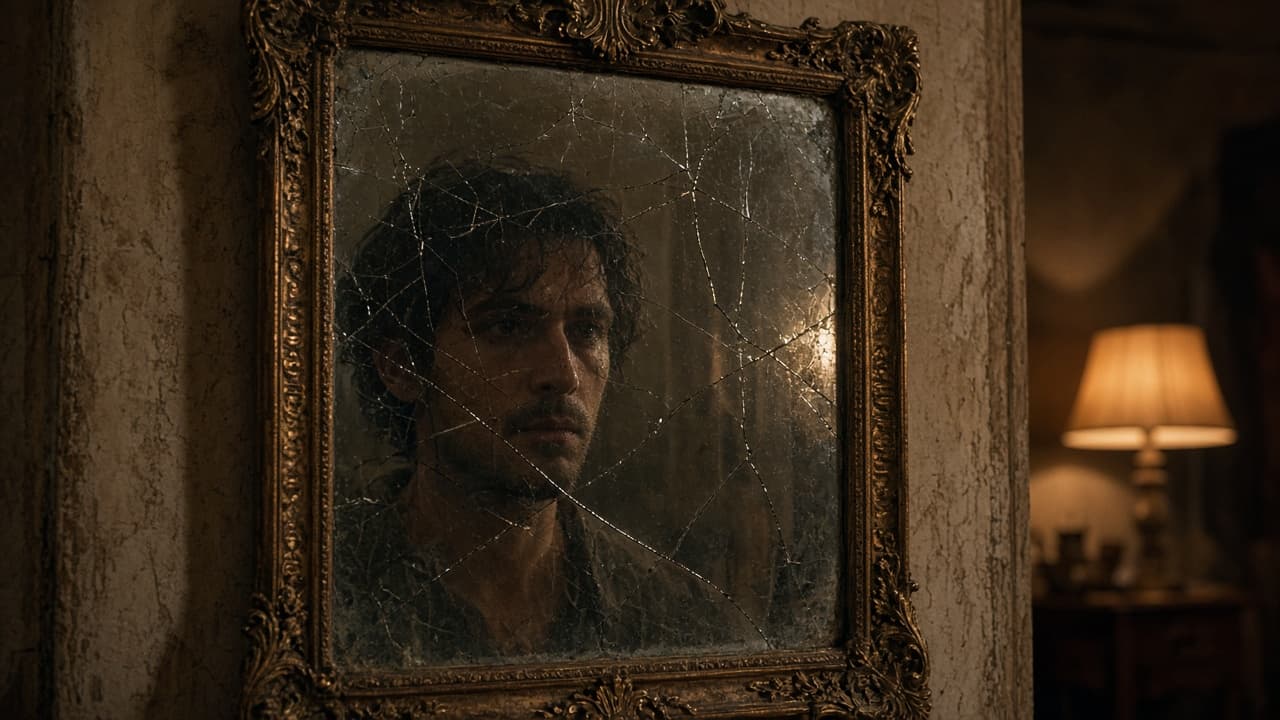
A mirror is a machine for returning a self. Dream mirrors usually test whether that return still works: the face matches, the face lags, the face belongs to someone else, the glass is broken, the glass is a [window](/dreams/windows) you could fall through. Self-image here is not only vanity. It is role, body, moral picture, the version a family installed, the version a camera wants. Recover what you saw, whether you could look away, and what you did with the glass. Those three usually locate the waking mismatch.
Not Recognising the Face
You lean in. The features are wrong, aged, younger, another ethnicity, blank, animal, too perfect.
Misrecognition is a change the inner portrait has not filed. Illness, a haircut, a role, sobriety, parenthood, a public story, grief that took a facial expression you used to think of as yours. Horror means the mismatch is experienced as threat. Curiosity means you might be able to live here. Relief, rarer, means the old face was the costume.
If other people in the dream recognised you and you did not, the social world is ahead of your self-file, or behind it. If nobody else could see what you saw, the mismatch is still private. Hair and teeth often join these scenes because they are the parts of the face that advertise change.
Distorted, Funhouse, a Delayed Reflection
The physics of return is sick. Waves, stretch, a lag of a second, a reflection that keeps moving after you stop.
Distortion is a warped gaze. Families that needed you to be a certain shape. An industry. A diagnosis you have started to see yourself through. Social media as a pane. The dream is often accurate about which warp if you remember the kind of stretch (wider, older, dirtier, sexier).
Delay is asynchrony. You have moved (gender, class, recovery, a job) and the image is still rendering the previous frame. People in transition dream this constantly. A reflection that anticipates you, moves first, is a different unease: a self, or a story, that is pulling you.
Broken Mirror, Shards, Blood on Glass
The pane cannot do one image anymore.
Breakage is folklore-loud and psychologically simple: a unified self-story cracked. Infidelity (yours or someone else’s), a diagnosis, a public failure, an adolescence that ended in a fight with a bathroom mirror. Luck-talk about seven years is cultural debris. Cuts on the hands are about what it costs to keep handling the pieces.
Trying to reassemble the mirror is a restoration plot. Using a shard as a tool (to see, to cut, to threaten) means you are working with a fragment of self-image on purpose. Leaving the mess for someone else is a policy toward who has to live with the break.
Someone Else in the Mirror
You are in front of it. They are in it. A parent, a lover, a stranger, a younger you, a corpse.
This is identification made visible. Heritage ("I have my father’s face") can be tender or a sentence. A partner in the glass can be merger or takeover. A stranger in the glass is an unknown occupant of the self-slot, Jungian language fits if you want it, and so does "I do not know who I am in this role."
If they spoke and you did not, the other has the voice. If you could overlay and then separate, you still have a removable persona. If you were naked and they were dressed, or the reverse, the mismatch includes what is allowed to show.
Have a Mirrors dream of your own?
Write what you remember and get a clear reading.
No Reflection, Vampire Logic, a Blank Pane
The machine returns nothing.
Missing reflections show up in invisibility plots, in shame ("I should not take up image"), in depressions where the self has gone thin, and in people who have been treated as functions. Vampire folklore is available and usually decorative; the feeling is more often "I cannot find the evidence that I am here."
A mirror that shows the room and not you is a dream about being written out of the domestic picture. A mirror that shows only eyes or only a mouth is a reduction of self to one function: looking, speaking, consuming.
A Mirror as Door, Window, or Pool
The glass is not only returning. It is a threshold.
Stepping through is a change of world that uses self-image as the gate, a role, a look, a decision that starts with "if I appear as." Windows that turn out to be mirrors (you thought you were looking out and you were looking at you) are a joke the psyche tells about rumination: you were not seeing the street.
Water as mirror (a still lake, a bathroom cabinet over a sink) joins the water family: self-image in an emotional medium. A cracked phone screen as mirror is the contemporary pane; do not ignore it because it is unmythic.
Watching Someone Else Look in a Mirror
You are not the subject. You are the witness of their self-relation.
This scene is about another person’s image-work, a teenager, a partner, a parent ageing, a public figure. Your feeling (tenderness, disgust, rivalry, protectiveness) is the relationship. If they asked you how they looked, you are in the job of supplying someone else’s pane, which is a tiring vocation.
If you were hiding and watching, the ethics of the gaze are the subject. If the other smashed the glass, you may be watching a self-story end from the doorway.
Psychological Meaning
Freud (1900) placed the double, the reflection, and the uncanny near one another: the self as object, the childhood belief in doubles, the shock of the ego seeing itself. When a mirror dream is uncanny rather than merely vain, that lineage is earned.
Jung treated the mirror among images of self-confrontation and, sometimes, of the persona, the face arranged for the collective. A too-perfect dream face is often persona. A monstrous one is often what the persona was holding off.
G. William Domhoff’s continuity hypothesis (2018) predicts the rest. People in body-change, people who work on camera, people with a parent who commented on looks, people after infidelity, dream glass. Ernest Hartmann (2011) would call the broken mirror a picture of "the image of myself will not hold as one thing."
Hobson’s activation-synthesis account is relevant because faces in dreams are unstable; a mirror is a plot device that forces the dream to render a face, and the rendering often fails. That failure can be physiology. When the dream then comments on the failure, the comment is psychological.
Deirdre Barrett’s problem-solving dreams sometimes use a bathroom mirror as the overnight attempt to see a change the day has been arguing about. Revonsuo’s threat-simulation theory applies mainly when the reflection attacks, when glass cuts, when someone else takes the face, threats to bodily and social identity.
Which Reflection You Refused
Name the pane: bathroom, phone, shop window, family story, a camera. Then name the mismatch: age, role, gender, morality, a parent’s face, absence.
If the same glass keeps returning, the self-file is still open. One waking update that is not aesthetic, a sentence about who you are now, a photograph you can stand, a boundary with someone who supplies your image, does more than another night of leaning in. You do not need the mirror to become kind. You need the return to be usable, even if it is not flattering, and even if it is not yet the face you were promised.