Quick Answer
The [snakes](/dreams/snakes) page covers colour, houses, killing, and watching. This page is only the vernacular: you got bit. The strike is a clock starting. Where it landed (ankle on the path, hand when you reached, face when you were close), whether you saw the snake, and whether anyone helped are the scene-deciders. A bite is small and then outsized, which is why it is such a good picture of a remark, a diagnosis scare, a boundary crossed, or a fear that was in the grass.
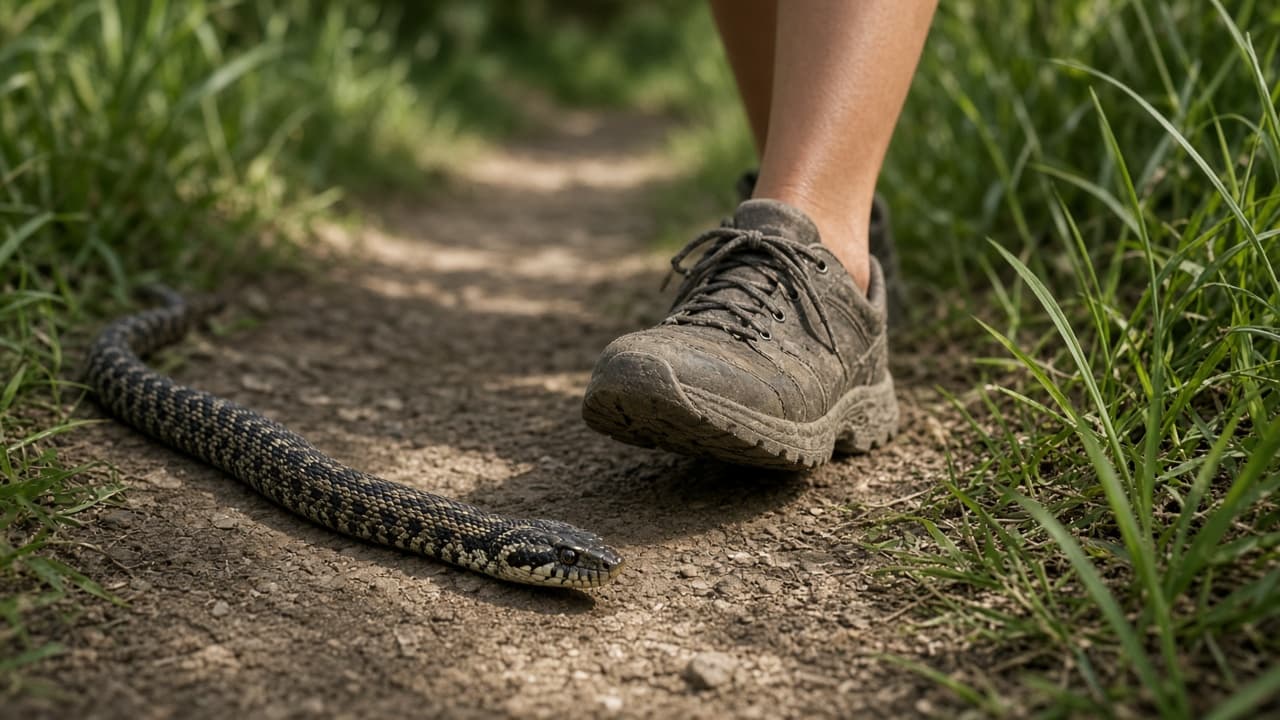
Bitten on the Ankle or Foot While Walking
You were going somewhere. The path had an occupant.
Ankle bites are about progress interrupted from below, the thing you did not inspect because you were moving. They cluster around new jobs, new cities, new relationships, any forward motion that assumed the ground was empty. Dreamers describe looking down too late, which is the whole interpretation in one gesture.
If you kept walking, the waking analogue is minimising. If you sat in the dirt and stared at the mark, you are in the taking-it-seriously chapter.
Bitten on the Hand or Arm While Reaching
You put a limb into the problem. A hole, a bag, a cot, a bush you moved.
Hand bites punish curiosity, care, or work. They follow reaching toward a person who then snapped, toward a project that then harmed you, toward a truth you poked. Compared with the ankle, agency is higher: you approached. Dreamers often feel foolish as well as hurt, which is the "I knew better" hangover.
A finger bite is even more precise, a small tool of yours taken out. Typing, making, touching, pointing: pick the verb you actually live in.
Unseen versus Seen
The fork this page insists on.
A strike you watched is a threat you had a second to name. You may still have been too slow; you were not ignorant. These dreams follow situations with a rattle you ignored, a tone of voice, a rumour, a symptom.
A strike from a snake you never saw, or found only as two points in the skin, is harm without a face. It maps onto politics at work, onto health anxiety, onto a slight that reached you second-hand. People search "snake bite" after this version because the animal was barely there. Believe the absence. Do not invent a villain to complete the folklore.
The Venom Starts Working | or Does Not
Spreading heat, a line up the limb, a calm doctor, a kit you cannot open.
Aftermath is illness-time. It can be pure medical dread (you have been reading about bites, infections, blood). It can be the delayed effect of a psychological strike: the meeting was at 2pm and you fell apart at 9pm. Dreamers who remain oddly able to talk while the venom moves are often describing a competence they actually have in crisis.
If the bite did nothing, the dream may be testing whether you still have to treat this person or this fear as lethal. Nothing happening can be a relief or a frustration (the drama did not justify itself).
Have a Getting Bit By A Snake dream of your own?
Write what you remember and get a clear reading.
You Kill It After, or You Cannot Find It After
The animal's fate post-bite.
Killing after you are already bitten is closing the barn door, and dreamers know it. It still does something: it ends the ambiguity of whether the snake is still around. Not finding it is the worse living situation, the source is at large in the house, the office, the body.
If someone else killed it for you, help arrived, with whatever strings your helper-figure carries.
A Snake You Knew Was There, and You Stepped Anyway
The path, the dare, the "it probably will not."
Consent-adjacent bites are not about sexual consent unless the rest of the dream is. They are about risk you took with your eyes open: sending the message, taking the job, going back to the person. The bite then feels unfair and fair at once. That mixed feeling is the waking one.
If a child or an animal was about to step and you took the bite, you are in a protective story. The snake is still the threat; you chose the placement.
Bitten on the Neck, Face, or Torso
Closer, more intimate, more about how you are seen or how you breathe.
Facial bites are humiliation and visibility, a mark people would notice. Neck bites mix vulnerability with the vampire-adjacent (intimacy that injures). Torso and belly bites pull toward gut fear and, for some dreamers, toward pregnancy and body-dread. Stay non-graphic and specific: which room of the body, and what that room does in your actual week.
If the snake was in a bed, the snakes house-and-bed reading applies, with the bite as the moment the unreadable thing stopped being theoretical.
Psychological Meaning
Susan Mineka and Michael Cook's observational-learning work (Cook & Mineka, 1990, Journal of Abnormal Psychology) showed that fear of snakes can be acquired rapidly by watching another animal react, and does not acquire as readily to fear-irrelevant objects. Arne Öhman and Mineka's 2001 fear-module review sits on top of that. Together they explain why a snake-bite is a cheap, loud image for "something struck me." The loudness is not a measure of the waking danger's size. It is a measure of how easy the picture was to generate.
G. William Domhoff's continuity hypothesis then attaches the limb and the path to your week: where were you going, what did you reach for, what did you not see. Freud's phallic-snake reading is optional and often unhelpful at 4am; skip it unless the dream was already erotic.
Revonsuo's threat simulation explains the rehearsal of stepping carefully and of seeking help after a strike. It does not predict a literal snake or a literal betrayal.
If the limb, the seen-or-unseen, and the aftermath (venom, help, the snake still lost) are all recoverable, those three are the interpretation. Drop them into a personal reading in thirty seconds rather than stopping at "snakes mean hidden enemies." Hidden enemies are one script. An ankle on a path is another.