Quick Answer
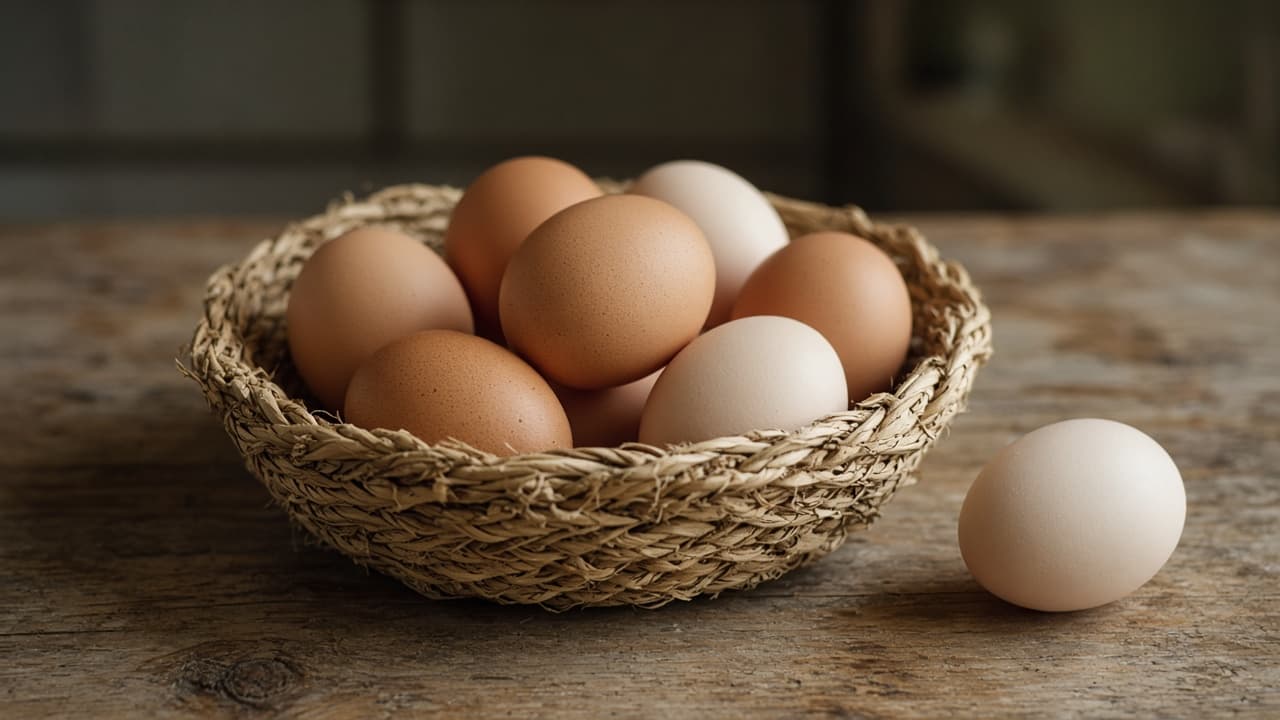
Dreaming of eggs usually means you are handling something that is not yet a creature or a meal: a possibility with a shell. Potential and fragility share the object. Protecting a nest is one stance. Cracking for breakfast is another. Finding rot is a third. Hatching is the moment latency ends and care begins. Your kitchen history and your fertility history both colour the image. Neither owns it.
Finding Eggs, a Nest, a Hidden Clutch
Discovery without a plan. In a drawer, in grass, in a colleague’s office, under a floorboard. You were not hunting, or you were.
Found-egg dreams mark potential you have just admitted is there. A talent. A pregnancy possibility. A political opening. A child’s need you had filed as fine. Related having a baby imagery may be literal or may be the mind’s favourite picture of “this will require feeding.”
Whose nest it was matters. Taking eggs from a nest you do not own is a different ethic from finding them in your own coop. Dreamers who hesitate are often already in a moral conversation about other people’s beginnings.
Cracking Eggs on Purpose
Intention. Breakfast. Baking. A recipe that requires breaking.
Deliberate cracking is the conversion of potential into use. You are willing to end the unhatched state in order to nourish something, a household, a project that needs ingredients, a truth that will not remain oval. Satisfaction in the dream usually means you accept that cost. Squeamishness usually means you are not sure the meal is worth the lives of the alternatives.
If a chick looked out at the last moment, the dream is accusing you of a more serious ending than cooking. Listen only if that matches a waking choice that still has a pulse.
Dropping Them, Breaking Them by Accident
The floor, the sound, the spread. Irreversible yellow.
Accident dreams attach to clumsiness with beginnings: a rushed email that exposed a draft, a fight that wrecked a fragile peace, a forgotten appointment that collapsed a chance, carelessness with someone else’s hope. Grief out of proportion to breakfast is the tell. The object was never only food.
If someone else dropped them and you cleaned, you are in aftermath labour again. If you laughed, you may be defending against a loss you do not want to rank as serious.
Rotten Eggs, Sulphur, a Bad One in the Carton
One egg looks like the others. It is not. The smell arrives late.
Rot is latency past its date. A project you keep calling early-stage in year five. A relationship that is still “undefined.” A family story that should have been cracked and cooked years ago and is now a health hazard in the fridge. The carton is social: most of the eggs are fine, which is why you did not check.
If you threw the whole box away, the night may be arguing for a broader cull than you have allowed. If you tried to cook it anyway, you already know the waking habit.
Eggs Hatching
Motion from inside. A hole. Something with a mouth.
Hatching ends the comfortable theory of potential. You now have a creature: a job that has gone live, a child (or a child-equivalent), a rumour that has become a person with needs, a book that will be reviewed. Panic and wonder are both reasonable.
If you were not ready and the hatch would not wait, that is the whole reading. Timing belongs to the egg more than to you. If you helped it out of the shell, you are already in midwifery toward some waking thing.
Have a Eggs dream of your own?
Write what you remember and get a clear reading.
Golden, Giant, or Impossible Eggs
The folk object arrives. A goose-egg of metal. An egg the size of a room. An egg with a map on it.
Wonder-eggs mark potential that has been inflated by story: a windfall fantasy, a once-in-a-generation chance, a child loaded with the family’s gold, a startup myth. Awe is allowed. So is suspicion. Golden eggs in tales usually come with a cost to the goose.
If you guarded it rather than hatching or cracking it, you may be in a season of protecting a myth instead of living a process. If it was too heavy to carry, the night is already doing the critique.
Eating Eggs, Being Fed Eggs
Ingestion. Ordinary scramble, or something ceremonial.
Eating potential is a particular transformation: you take the unhatched into the body and it becomes energy, not a creature. For some dreamers this is simply leftover supper. For others it is a picture of metabolising an opportunity rather than raising it, taking the job instead of founding the thing, ending a maybe-relationship by absorbing the lesson, eating your words in the form of a peace offering.
If the eggs were forced on you, ask who wants you to swallow a beginning that was not yours to digest.
Eggs Inside the Body, or Laying Eggs
The image can startle people who do not think of themselves as animals. You produce. You carry. You are a nest.
Body-egg dreams attach strongly to fertility, but they also attach to creative labour that feels bodily: a book, a company, a grief that has to be laid before it can be left. Shame is often cultural. The dream may be ruder and more accurate than your professional language.
If laying hurt, the production is costing. If it was easy and slightly comic, you may be more ready than your self-concept. This is not a medical diagnosis of pregnancy or illness; it is a metaphor the body found.
Psychological Meaning
Carl Jung returned often to images of the unborn and the vessel, the egg as a picture of a psychic content that is not yet in air (see discussions of rebirth and the vessel in Symbols of Transformation and later essays on the child archetype). You do not need to adopt his whole alchemy. The observation is homely: some things in a life are still in shell, and treating them as omelettes or as children are different errors. Jung’s useful caution is that forcing a hatch to serve the ego can wreck the animal, and refusing to hatch anything is its own sterility.
G. William Domhoff’s continuity hypothesis will explain the kitchen. If you are trying to conceive, avoiding conception, launching a product, or sitting on a secret, eggs are lying around in the culture and the fridge. The dream uses them because they are true, not because they are mystical.
Deirdre Barrett’s problem-solving view helps when the dream is instructional: do not drop this; this one is rotten; this one needs warmth not talk. Incubation often looks like a kitchen. That does not make it trivial.
Practically: say whether the egg was food, child, or project. Then say whether you were guardian, cook, or klutz. Those labels are ruder and clearer than “new beginnings.”
When Nothing Will Hatch, and Nothing Will Cook
Egg dreams process latency. They do not diagnose pregnancy, and they do not guarantee a windfall.
If the same nest returns untouched, you may be in love with potential as a lifestyle. Pick a verb in daylight: warm, crack, or throw away. Recurrence loves the unchosen carton.
If you keep dropping them, slow the hands, fewer simultaneous beginnings, less rush, an apology where a fragile thing was yours to carry. The shell was always going to be weaker than your calendar. That is not a moral failure. It is physics, and physics is allowed to instruct you.