Quick Answer
Dreaming of your childhood home as an adult is rarely empty nostalgia. That house, flat, or street is the first map of who you were allowed to be, who had the keys, and whether care arrived. When adult life asks a similar question, a new role, a failing role, a parent growing old, the sleeping brain often rebuilds the original set. Layout, occupants, and your age in the dream decide the reading. A longer essay lives in [dreams about your childhood home as an adult](/blog/dreams-about-childhood-home-as-adult). This page is the dictionary hub.
You Are Adult-Sized in an Accurate House
The kitchen is right. The stair creak is right. You are your current age, filling a chair that used to be huge.
This version is a status meeting between then and now. It often arrives when you are being treated as the child you were: a parent still directing, a sibling conflict that never updated, a hometown visit. It also arrives when you have become a parent and suddenly understand the house from the other side of the table. Competence in the old rooms can feel like winning. Shrinkage, even if your body is adult, can feel like the old rules still apply.
If you were kind to a younger sibling or harsh to a parent, notice which role you chose. The dream is rehearsing a rewrite.
You Are a Child Again in the House
Small hands, a bedtime, a height of doorknobs. Current problems are nowhere in the plot, and everywhere in the feeling.
Age-regression in the original house is one of the most common typical-dream cousins of "being a child again." It visits when current life has reactivated helplessness, play, or a wish to start over. Illness, a boss who feels like a parent, a relationship that punishes independence, all cast this. If the house was safe, the dream may be a refuge. If the house was not safe, the dream may be a rerun, and reruns of real harm deserve trauma-informed care more than a floor-plan reading.
Children as characters in an adult body are a different night. Here you are the child. The grammar is first person.
Rooms Are Wrong: Extra Wings, Missing Doors, Wrong Colours
The bones are yours. The details are vandalised. A corridor that never existed. A bathroom in the wrong place.
Distortion is usually the present tense. Hall and Van de Castle treated dwellings as among the most common dream settings; the childhood house is that finding with a date stamp. Alterations are how the dreaming mind files new material into an old schema. A new baby becomes a nursery that was a junk room. A divorce becomes a wall where a door was. A career you did not have at twelve becomes a study.
The change that bothers you is the change that is not yet integrated. Curiosity about extra rooms is closer to unused potential, the classic "discovering a new room" typical dream wearing your actual address. See houses for the wider building vocabulary.
Someone Else Lives There
Strangers, a nicer family, a worse family, your parents still there but you have to knock.
Replacement occupants are about reassignment. The old life has been given to someone else, or you fear it has. Kind new people can mean the past can be visited without being reclaimed. Hostile new people can mean you are trying to re-enter a system that has recoded the locks. If your family still lives there in waking life and the dream puts strangers in, the emotional ownership may already have moved even if the deed has not.
Knocking on your own door is a precise humiliation. It often maps onto adult visits that require permission.
Have a Childhood Home dream of your own?
Write what you remember and get a clear reading.
The House Is Empty, For Sale, or Being Torn Down
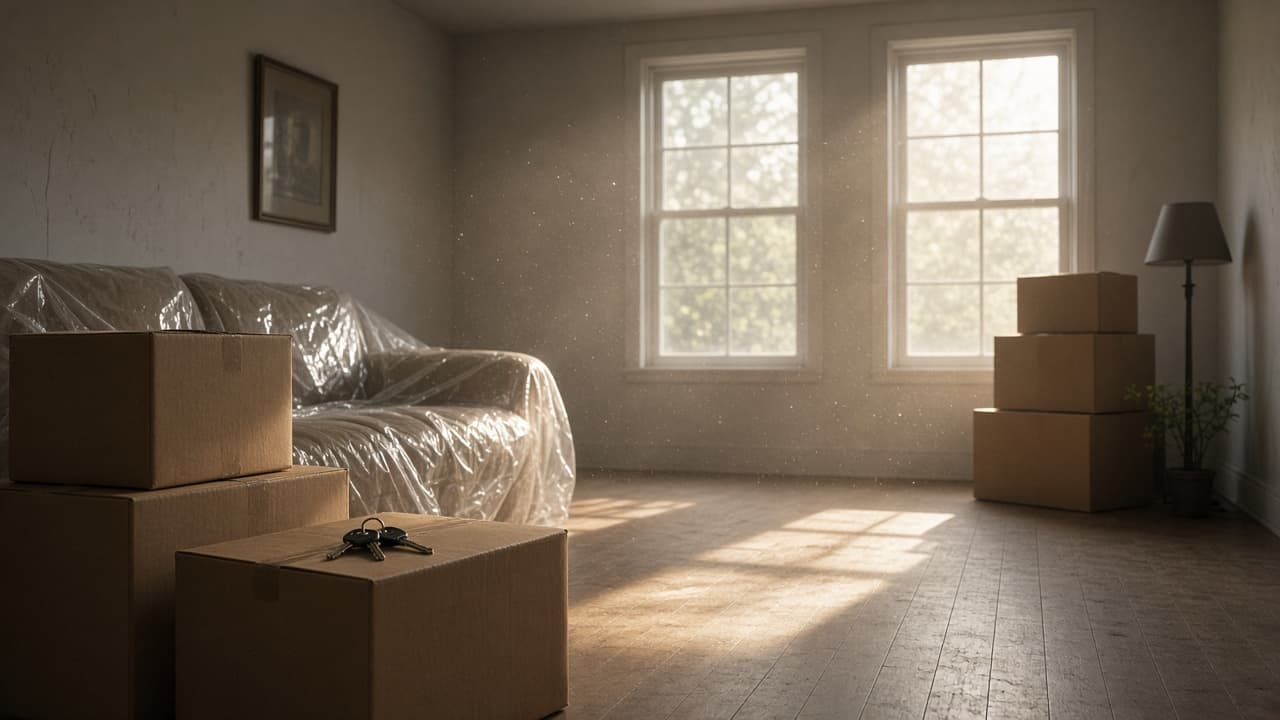
Dust, an estate agent's board, a wrecking ball, your things in boxes that are not yours.
End-of-house dreams cluster around actual sales, deaths, and moves, and also around identity endings that have no skip. Empty rooms can be grief or relief. A demolition you watch without stopping can be a decision you have already made privately. Trying to save one object, a photograph, a toy, a pan, is the psyche naming the piece that still has to come with you.
If you could not find the house at all, the map itself is failing. That is closer to lost than to interior design.
A Parent, Sibling, or Old Self Is in a Particular Room
The living room is mother. The garage is father. Your bedroom is a time capsule with a current laptop on the desk.
Room-plus-person is often the cleanest reading. Families store functions in spaces. Who is allowed in which room in the dream is a map of current access and old rules. A parent in your childhood bedroom can mean they still have a key to your privacy. A sibling in the kitchen can mean they still run the emotional meals. You, watching from the garden, can mean you have already left and are checking whether the system survived.
Family dreams without the building are more about the people. This page is about the set those people still own in you.
The House Was Unhappy, and the Dream Knows It
You are looking for an exit. A fight is happening in another room. The wallpaper is the colour of a year you do not brag about.
Not every childhood home is a soft landing. Returning to an unhappy house can be mastery (you walk through and leave), warning (a current relationship has the same weather), or incomplete leaving (your body left, your nervous system did not). If the dream is documentary of real harm, skip the charming metaphor and use support built for that. Symbolism is for metaphorical nights.
If you were protecting a younger child in that house, including a younger you, the dream may be asking for a boundary in the present that the original house never taught.
Psychological Meaning
Calvin S. Hall and Robert Van de Castle's 1966 content analysis put dwellings near the centre of dream settings even when questionnaires did not list "house" as a theme. The childhood home is that finding made autobiographical. G. William Domhoff's continuity hypothesis then says the people and conflicts of waking life will keep using the old set if the old set is still the best stage.
Ernest Hartmann, in 2011, described dreaming as contextualising emotion in pictures. A first house is a dense picture: safety or its absence, hierarchy, smell, the route to the toilet in the dark. When adult emotion rhymes, the picture rebuilds. You do not need Jung's house-as-psyche model to use the vertical axis, attics and basements still behave like stored and buried material on this particular lot, but you can read more of that vocabulary on the houses hub.
Nostalgia is real and it is not the whole story. Adults also dream this building when they are about to become someone the original house has no furniture for.
When the Same House Keeps Returning
A repeating accurate house usually means a family role is still being cast. A repeating distorted house usually means the present has not been given a room yet. A repeating demolition usually means an ending is underway and you are still bargaining with the wrecking ball.
Practical moves beat omen talk. One conversation with a parent that is adult-to-adult. One object from the past put in a box on purpose. One current home ritual that does not copy the old weather. If you want the slower read, the childhood home blog guide stays useful. If last night had a specific stair, smell, or occupant,