Quick Answer
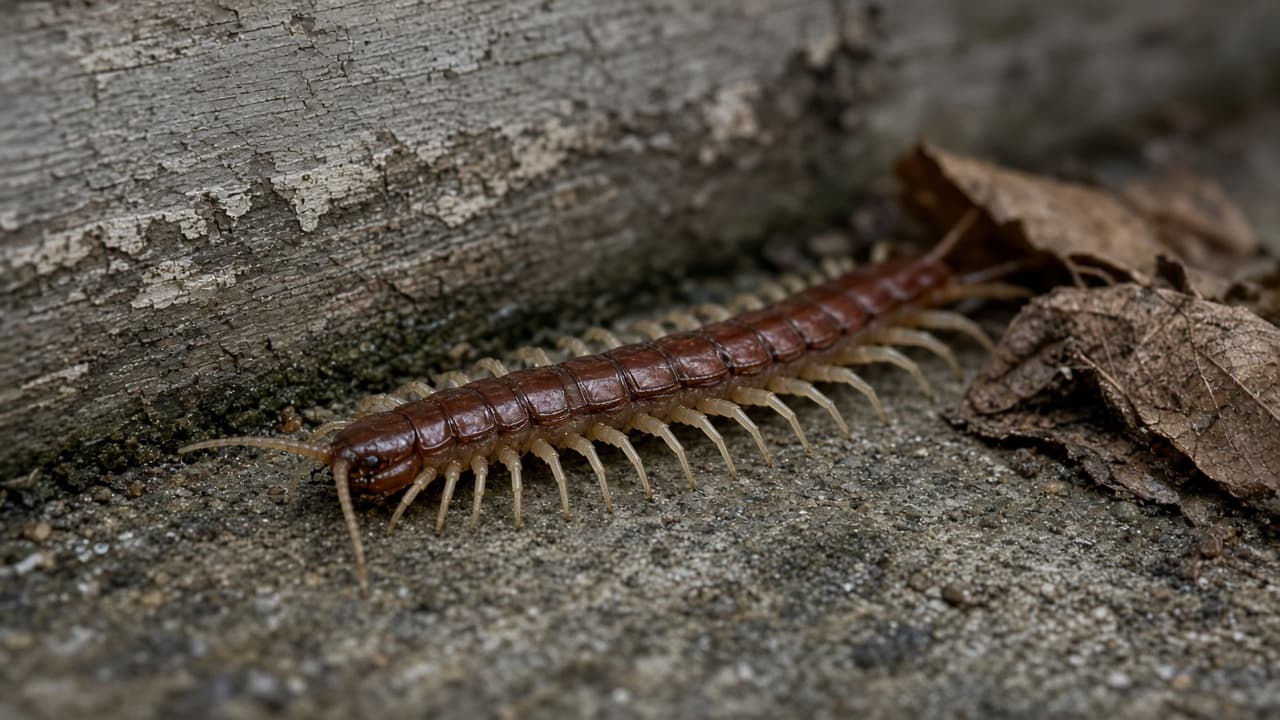
Centipede dreams turn on two features of the animal: the legs and the speed. Many small parts moving at once, in a creature that appears from a crack and vanishes into another one. Dreams reach for that image when you are dealing with something fragmented, a pile of unrelated obligations, a problem with too many components to hold in your head, or a nasty surprise from a corner of life you had stopped checking. Where the centipede was decides most of the reading. On your body it becomes a boundary dream; in your bed, a safety one; behind a wall, a maintenance one.
A Centipede Crawling on You
The version dreamers describe most physically. It is on an arm, a neck, a back, often felt before it is seen, and the legs are the detail people remember.
Contact turns any insect dream into a boundary dream. This one tends to arrive when something intrusive has stopped being theoretical and reached you directly: a demand that used to go to someone else, a relative's crisis now landing in your week, a work problem that finally has your name on it. The sensation of many small points of contact is a surprisingly exact image for being touched by lots of small obligations at once.
Whether you could get it off matters. Brushing it away cleanly suggests the intrusion is manageable. Not being able to find it after feeling it is often the more anxious dream, and it tends to track a worry you cannot locate precisely enough to solve.
A Giant Centipede
Scale changes the genre. A centipede the size of an arm, or longer, moves the dream from disgust into threat, and dreamers often report freezing rather than recoiling.
Enlarged versions of small creatures usually indicate that something you were treating as a minor nuisance has grown past that description. Debt that has compounded, a health issue postponed for a year, a family tension nobody names. The dream is not being subtle: the thing you were flicking away is now bigger than you.
If it moved slowly, the dream may be tracking something you can still see coming. Speed is what makes this version frightening, and it usually reflects how much control you feel you have over the timing.
A Centipede in the Bed or Bedroom
You pull back a sheet, or a pillow, and it is there. Some dreamers report having already been lying down for a while before noticing.
Bedrooms carry rest, intimacy and defencelessness, so an intruder there is rarely about general stress. It usually points to something disturbing the one place you are supposed to be able to stop monitoring, a partner's habit you have not raised, a phone that never goes on silent, worry about the household's money that surfaces only at night.
The delay is the detail worth keeping. Realising it had been there for a while often accompanies the discovery that a problem you have just noticed has actually been present for months.
Killing a Centipede
Dreamers usually report effort: several attempts, an object grabbed in a hurry, a mess afterwards. Rarely does one blow settle it.
That struggle is the meaning. This version arrives when you are trying to end something small but resilient, a recurring argument, a bad habit, an unreliable supplier, a person who keeps re-entering a group you belong to. Needing multiple attempts in the dream typically mirrors having tried before in waking life.
If you felt guilty afterwards, note that separately. Sometimes what is being killed is a scattered impulse of your own, a habit of taking on too much, a way of working that you know is unsustainable but that has kept you afloat.
Being Bitten by One
Real centipedes deliver a painful bite rather than a dangerous one, and the dream version keeps that proportion: sharp, sudden, not fatal.
Bite dreams tend to accompany a specific small injury from something you had underestimated, a comment from a colleague you did not think mattered, a fee you missed in a contract, a piece of admin whose consequence turned out to be real. The disproportion between the size of the creature and the sharpness of the pain is usually the accurate part.
Where it bit you can be worth reading literally. Hands lean toward work and capability, feet toward direction and progress, face toward reputation.
Have a Centipede dream of your own?
Write what you remember and get a clear reading.
Centipedes Coming Out of a Wall or Drain
Emergence dreams put the emphasis on the gap rather than the creature: a crack in plaster, a plughole, a gap under a skirting board, a vent.
Real centipedes live in damp, undisturbed places, and the dream tends to use that faithfully. It arrives when something neglected has begun producing consequences, an unresolved leak in the actual house, an unopened backlog, a relationship that has been quietly damp for a while. Dreamers often report watching the gap rather than the animal, which is usually the right instinct about the waking situation too.
Many Centipedes at Once
A floor of them, a wall of them, several crossing a room in different directions.
Multiplicity here reads differently than it does with ants or bees, which move as organised groups. Centipedes are solitary hunters, so a mass of them tends to represent unrelated problems arriving simultaneously rather than one coordinated pressure. That distinction matters, because the waking situation calls for triage rather than a single solution. Dreamers describe not knowing which one to watch, which is a fair account of a week with six unconnected urgent things in it. Compare with insects for how swarming imagery reads when the creatures are working together.
One You Cannot Catch
It darts under furniture, into a crack, behind a bath panel, and the dream ends with you knowing it is still in the room.
This is the version most likely to recur, and it usually tracks an unresolved suspicion rather than a problem you can name: something is wrong with a set of accounts, someone in a group is not being straight with you, a symptom you cannot pin down. The dream does not resolve because the waking question does not yet have an answer.
Psychological Meaning
Two mechanisms explain why a small, harmless animal produces such a strong dream.
The first is disgust. Valerie Curtis's research on disgust as a disease-avoidance system identifies a consistent set of triggers, including small many-legged creatures associated with damp and decay. Centipedes hit several of those cues simultaneously, so the reaction is fast and out of proportion to any real danger, which is exactly the sensation dreamers describe.
The second is threat simulation. Antti Revonsuo's 2000 theory proposes that dreaming rehearses responses to ancestrally relevant dangers, and venomous arthropods have been a genuine hazard for a very long time. That helps explain why centipedes and scorpions appear in dream reports far more often than modern risks of comparable severity, such as traffic.
For the timing and the specifics, Domhoff's continuity hypothesis does the work: dreams continue waking preoccupations. Centipede dreams tend to cluster in fragmented periods rather than uniformly stressful ones, several small things going wrong at once, rather than one large crisis. Dreamers often confirm this immediately when asked whether the past fortnight has been "one big problem or twenty small ones".
There is also a plain physical possibility worth naming. If you have recently seen a real centipede in your home, or you live somewhere they are common, the dream may be doing nothing more mysterious than reusing yesterday's image. Recent, emotionally charged experience is well established as dream material.
Cultural Meaning
The centipede has a much richer place in East Asian tradition than in Western dream folklore, and it is more interesting than a bad omen.
In Chinese tradition the centipede is one of the wu du, the five poisonous creatures, alongside the snake, scorpion, toad and spider or gecko. Crucially, these were often embroidered on children's clothing and charms around the Duanwu festival, using the image of the poison to repel it. The creature functions as protection as much as danger, which makes any flat "centipede equals harm" reading unreliable.
Japanese folklore has the Ōmukade, a giant centipede defeated by the archer Fujiwara no Hidesato in a well-known tale, and centipedes were also associated with the war god Bishamonten, an emblem of a warrior that never retreats, because a centipede's legs all move forward. If your dream featured a large centipede and left you feeling braced rather than repulsed, that association fits the experience better than a disgust reading does.
Nothing in either tradition licenses treating the dream as a prediction. What they offer is a wider set of associations than "pest": poison, protection, and forward motion, all attached to the same animal.
If Centipede Dreams Keep Returning
Recurring centipede dreams usually mean a fragmented backlog rather than a single unresolved crisis, which is good news, the remedy is triage, not revelation.
Make the list. Dreamers frequently report these dreams thinning once the scattered obligations exist somewhere outside their head, because much of the dream's charge comes from tracking many small things at once with no system.
Where the dream carries real fear rather than distaste, and especially if the sight of insects genuinely distresses you in waking life, it is worth knowing that specific animal fears respond well to short, structured treatment. That is a more efficient route than interpreting the same dream a dozen times.