Quick Answer
Cockroach dreams almost always concern something you consider unclean, hidden, or impossible to get rid of. Roaches live in gaps and behind appliances, they appear when the lights go off, and they survive treatment, so they make an efficient image for a problem that has been festering out of sight and refuses to die properly. Two details do most of the interpretive work: where they were, and whether you could kill them. Roaches in a kitchen mean something different from roaches in a bed, and an infestation you cannot clear reads very differently from one you stamp out in a second.
Cockroaches in the Kitchen
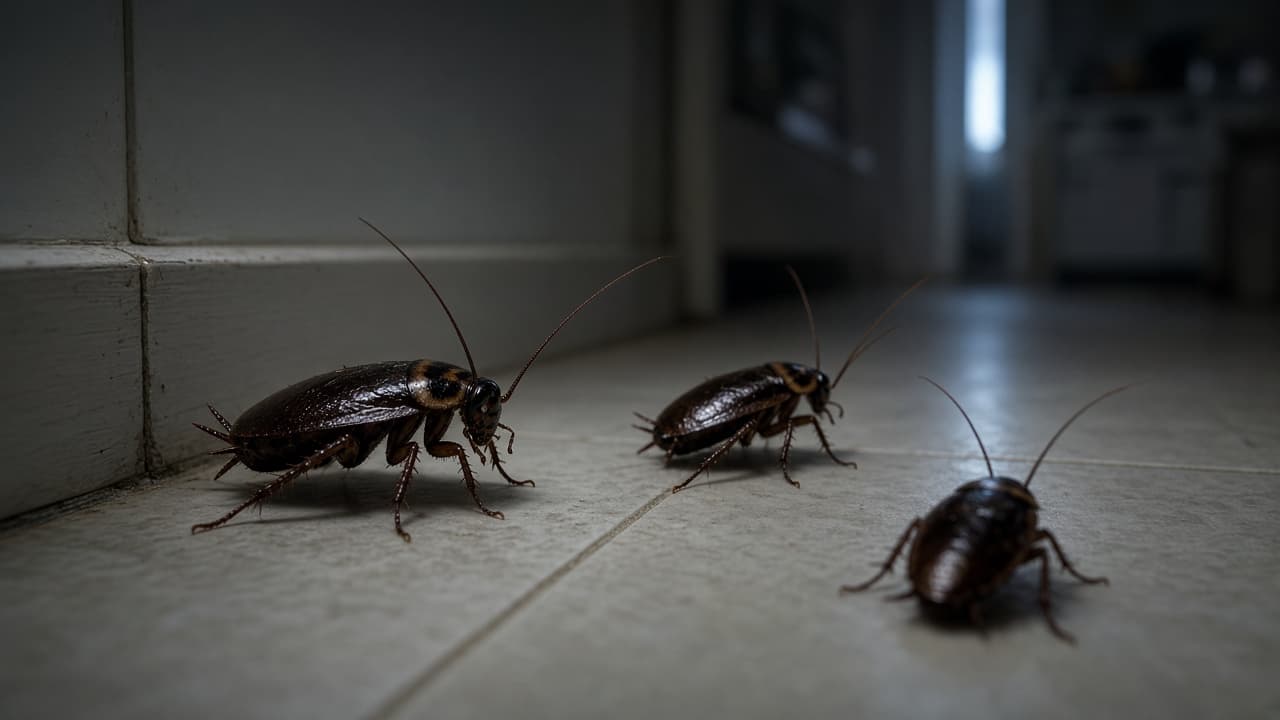
The kitchen is the most commonly reported setting, and it is the most legible. It is the room where food, cleanliness and household care all converge, which makes it the obvious stage for neglect.
Roaches here tend to arrive during stretches when something that sustains you has been left unmaintained: meals skipped for months, a home nobody has time to look after, a relationship running on takeaways and logistics. Dreamers frequently describe opening a cupboard and finding them established, and that word, established, is usually the point. The neglect has had time.
One Cockroach Versus an Infestation
Number changes the entire scale of the reading. A single roach crossing a floor is a small, specific irritation: one awkward email, one unresolved comment, one bill.
A swarm pouring from a gap is a different dream. Infestation versions cluster around problems that have multiplied past individual handling, accumulated admin, several small debts, a group of people all wanting something, symptoms that keep adding up. What dreamers usually report is not fear but overwhelm, and the shift from one to many is worth recovering precisely, because it often matches the week a manageable situation stopped being manageable.
Cockroaches Crawling on You or in Your Bed
Contact dreams are the most distressing version, and the bed makes them worse. Roaches on your skin, in your hair, under the sheets.
These scenes tend to be about shame that has reached the body. Dreamers describe feeling contaminated rather than endangered, brushing at their arms, showering, checking themselves in mirrors. That maps onto waking situations where something has attached itself to your reputation or self-image: gossip, a public mistake, an association with someone you now regret, or a private habit you feel dirty about. The bedroom placement usually indicates it has followed you into rest and intimacy.
Cockroaches You Cannot Kill
Here is the variant that unsettles people most. You crush one and it keeps moving. You spray, and they scatter and return. You clear a room and they are back before you leave it.
Indestructibility is not a message about hopelessness. It generally accompanies a problem you have genuinely attempted to solve more than once: the same argument with the same person, a habit quit and resumed, a financial hole refilled and reopened, an illness that recedes and returns. The dream is reporting the pattern accurately. What it usually means practically is that the approach, not the effort, needs changing, because you have been treating symptoms in a room with an entry point nobody has found.
Roaches Coming Out of Drains, Walls or Behind Appliances
Concealed origin points give these dreams their particular flavour. They emerge from a plughole, a crack in plaster, the gap behind a fridge, somewhere structural you cannot easily see into.
Hidden sources tend to point at problems with roots in the fabric of a situation rather than in one event: a family dynamic that produces the same conflicts each year, a workplace culture generating the same complaints from different people, a health issue with a cause nobody has located. Dreamers often report knowing there are more inside the wall than they can see. That intuition usually corresponds to something real they have not yet been able to name.
Flying Cockroaches
Flight escalates the dream, and dreamers who have met real flying roaches usually say so immediately. The insect stops being containable at floor level and becomes unpredictable.
These versions arrive when a contained problem gains reach, a private complaint that becomes public, an issue that has moved from one department to the whole company, a family matter that has got out to relatives. The specific horror is loss of predictability rather than increased danger. If the roach flew at your face, note it: dreamers commonly report that detail during periods when something they hoped to keep at a distance came directly for them.
Have a Cockroaches dream of your own?
Write what you remember and get a clear reading.
Cockroaches in Food or in Your Mouth
An especially unpleasant variant with a fairly consistent meaning. A roach appears in a meal, a drink, a packet you had already opened, or worse, in your mouth.
Ingestion versions tend to track something you have taken in and now feel repelled by: information you wish you had not been told, an agreement you accepted and now regret, money from a source you are uneasy about. Dreamers often describe spitting or retching, which usually corresponds to wanting to un-know or un-accept something. It is a rejection dream rather than a contamination one.
Cockroaches in a Clean or Beautiful House
Contrast makes this version stand out. The house is immaculate, new, or somewhere you are proud of, and there are roaches under the sink.
These arrive most often for people managing a good-looking situation with something wrong underneath: a successful career with a serious problem inside it, a marriage that photographs well, a renovated home with rot in the structure. The strongest tell is the dreamer's concern about visitors. If most of the dream was spent worrying that someone would see, the reading is about appearances rather than hygiene. Houses covers how buildings tend to stand in for the self.
A Dead Cockroach
Dead roaches read differently from live ones, and dreamers are often surprised by how unbothered they feel. A shell on its back, dried out, in a corner.
This tends to be an aftermath dream. It arrives once a grim stretch has ended, a treatment finished, a bad job left, a habit genuinely dropped, a house finally dealt with. The dead insect is evidence rather than a threat. Where the emotion in these dreams is sadness rather than relief, it often accompanies grief for how long you tolerated the situation.
Psychological Meaning
Cockroach dreams sit at the intersection of two well-studied systems: disgust and threat detection.
Disgust is the more relevant. Paul Rozin and April Fallon's 1987 work on the psychology of disgust established that contamination judgements are largely symbolic rather than rational, a single insect renders an entire meal inedible, and contact spreads impurity in one direction only. That is precisely the logic of these dreams. A small roach ruins a whole kitchen in the dream, exactly as a single episode of shame can feel like it ruins a whole reputation.
G. William Domhoff's continuity hypothesis explains where the image comes from. If your waking concerns involve neglect, hidden problems, or feeling tainted by something, your dreaming mind will reach for whatever your culture has already loaded with those meanings. In most urban environments, the roach is the highest-value symbol available for filth that survives.
The vigilance is better accounted for by Antti Revonsuo's threat-simulation theory. Insects are among the most frequent animals in dream reports, and dreaming appears biased toward rehearsing ancestral threats, including contamination and infestation, which mattered enormously before modern sanitation.
There is also a plain physical possibility worth checking. If you are actually dealing with pests, itching skin, or bites, the dream may be recruiting real sensory input. Michael Schredl's research on dream content and physical stimuli supports the general principle that bodily signals get woven into imagery, so rule out the boring explanation before pursuing the symbolic one.
Practically: name the thing you have been leaving in the dark. Then note whether the dream had you cleaning, killing, fleeing or hiding it from visitors.
Spiritual Meaning
The spiritual reading of cockroaches is more generous than most dreamers expect, and it is worth stating because so many people arrive here braced for a curse.
Across a wide range of contemporary spiritual traditions, the cockroach is read primarily as an emblem of survival and adaptability. It is one of the oldest surviving insect lineages, it endures conditions that kill almost everything else, and it persists without needing anyone's approval. Read that way, a cockroach dream during a punishing period is often taken as recognition of your own endurance rather than as an accusation.
A second common reading treats the roach as a summons to clear out. Because they thrive on what has been left to rot, their appearance is interpreted as a signal to deal with the neglected corners, literal, relational or emotional. That framing has practical value, since it points at the same neglect the psychological reading identifies.
It is worth untangling one frequent confusion. People sometimes connect cockroach dreams to the Egyptian scarab, a beetle associated with rebirth and the rising sun. The scarab is a different insect entirely, and the resurrection symbolism does not transfer, though the mix-up persists because both are dark, hard-shelled and ancient. If your dream carried an atmosphere of renewal rather than dread, trust the atmosphere; just do not build it on the scarab.
Where dreamers report a genuinely uncanny quality, a roach that seemed deliberate, or arrived at a meaningful moment, the useful move is to treat it as a prompt to look at what you have been avoiding, not as a verdict on your soul. You will find similar territory across other animal dreams.
Biblical Meaning
Scripture does not name cockroaches, so anyone quoting a specific roach verse is improvising. What it does contain is a substantial framework about creeping things and infestation, which is where these dreams tend to be read from.
Leviticus 11 classifies swarming and creeping creatures as unclean, establishing a boundary between what may enter the body and household and what may not. That is a purity framework rather than a moral one, and it maps closely onto the contamination logic of the dreams themselves. The plagues of Exodus 8 and 10 supply the infestation image, swarms as an overwhelming, uncontainable consequence, which is why swarm dreams so often feel biblical in scale even to people who are not religious.
Read through that lens, the practical question is not whether the insect is evil but what has been allowed to swarm: which small tolerated thing has multiplied while you attended to something else.
When Roach Dreams Keep Coming Back
Repeat cockroach dreams usually mark an unfinished clear-out rather than a spiritual problem. The most useful question after waking is which specific corner of your life you have been treating as tolerable because you cannot see all of it.
Try three concrete moves. Deal with the smallest visible version of the thing, the actual cupboard, the actual unopened envelope, because these dreams respond well to real action on small scale. Look for the entry point rather than the insects, since problems that regrow usually have a source nobody has addressed. And check whether the shame in the dream is proportionate, because roach dreams tend to exaggerate self-disgust considerably.
If they are frequent and distressing, or if the disgust follows you into your waking day and you find yourself cleaning compulsively or unable to eat, that combination is worth raising with a clinician. Persistent nightmares are treatable, and intrusive contamination fears have specific and effective therapies.