Quick Answer
Dreaming of ants usually means the problem is not one large thing. It is many small things acting together: chores, messages, duties, errands, a workplace that runs on uncredited labour. The scene tells you how you relate to that load, as a householder finding them in the sugar, as a body they are already walking on, or as a worker inside the hill. If you live with a real infestation, check the kitchen before you interpret your soul. Literal ants produce literal dreams more often than people want to admit.
Ants in the Kitchen or on Food
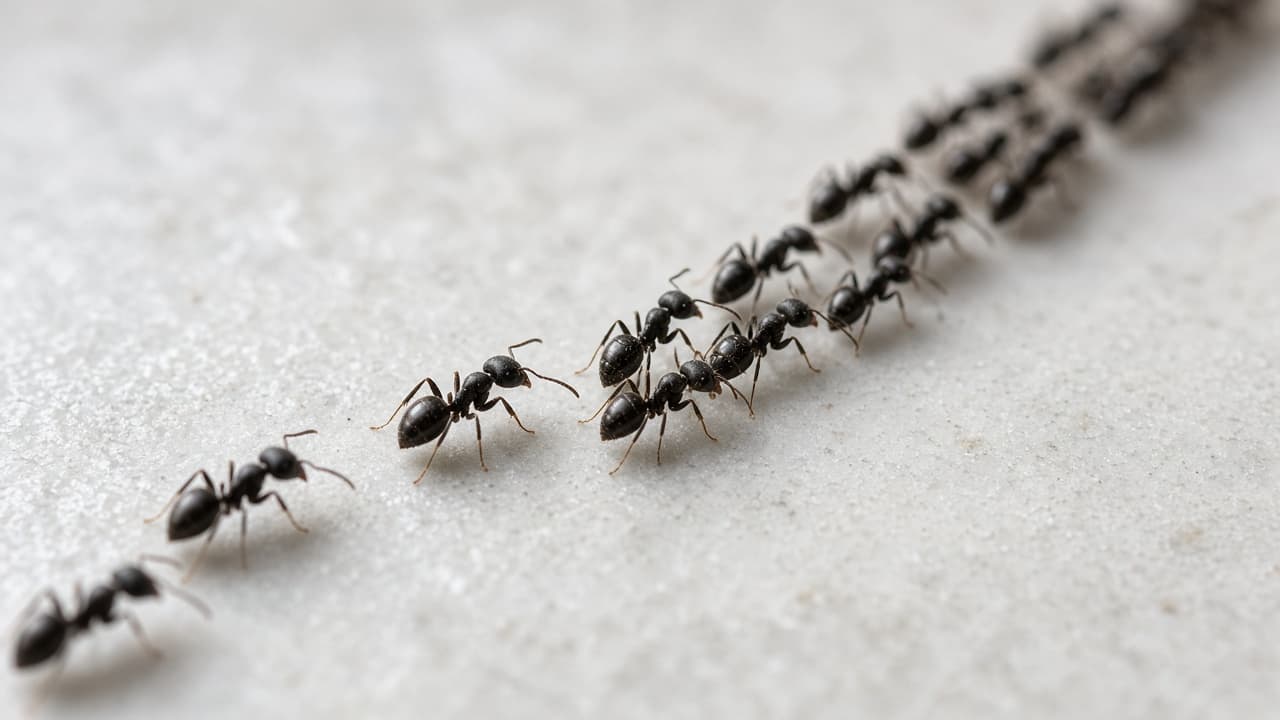
The domestic trail is the most common version. A line of ants to a crumb, a jar, a child’s plate, a sink that was supposed to be clean.
This is a resource-and-maintenance dream. Something edible, valuable, or shared is being quietly reduced by traffic you did not invite. Money leaks that never look dramatic. Food labour that falls on one person. A household in which “who deals with it” is always the same answer.
Where the trail started is worth recovering. Ants coming from a crack in the wall usually map onto a structural source, a policy, a relative, a habit, rather than a one-off mess. Ants that appeared only on one plate more often track a single neglected task that has begun to advertise itself.
Ants Crawling on Your Body
Skin contact means the colony has stopped being an environmental fact and has become a sensory one. Dreamers describe wrists, scalp, the small of the back, and the particular panic of not being able to see all of them at once.
These dreams arrive when obligations have reached the body: sleep shortened by logistics, a job that follows you into the shower, a family calendar that lives in your nervous system. Brushing them off in the dream and finding more is the emotional signature of a to-do list that regenerates from a source you have not named.
If the crawling concentrated on one area, treat that as emphasis rather than medical news. Hands often attach to work. The face attaches to how you are seen while you are busy. The dream is not diagnosing skin disease.
An Ant Hill, Nest, or Colony
Here you are looking at organisation. A mound, a cutaway of tunnels, a pavement boiling with coordinated motion.
Colony dreams are about systems. A workplace. A family that functions like a department. A volunteer world. A project whose real product is meetings. You may have been impressed, appalled, or both. Ants are excellent at what they do; the question is whether you wanted to be inside that excellence.
Size of the hill relative to you is the proportion cue. A hill you could step over tends to mark a team or a household. A hill that fills the horizon more often marks an institution or a phase of life in which your labour is real and your name is not the point.
Being an Ant or Working With Them
First-person colony life is a scale shift. You carry a crumb that is a boulder. You know the route. You do not know the queen.
These dreams cluster around roles where interchangeability is the unofficial job description: junior teams, new parenthood, disaster-response weeks, any stretch in which the work is objectively needed and subjectively uncredited. Peace in that role usually means you currently accept being part of a larger body. Distress usually means the larger body is using you as furniture.
If you could see the purpose of the carrying, the dream is often less bleak than it felt. Meaning inside labour is a different night from labour without a picture of the hill.
Ants Infesting Walls, Beds, or Electronics
When ants occupy structure rather than food, the dream is about infrastructure being colonised. Walls, sockets, laptops, mattresses, the things that should be inert.
These scenes show up when small processes have got into the supports of a life. Admin that now lives in every app. Family politics in the group chat that was supposed to be logistics. A grievance that has nested in the place you sleep. You cannot put the food away and solve it; the trail is in the building.
Dreamers who report ants in a phone or a computer are often describing attention itself as the resource being farmed.
Have a Ants dream of your own?
Write what you remember and get a clear reading.
Killing Ants, Poison, or Watching Them Die
The method is more informative than the morality play.
A finger or a shoe is local and personal: you are trying to stop the one in front of you. Bait and poison are systemic: you have admitted there is a colony. Flooding or burning the hill is the nuclear version, and it tends to accompany a wish to end a whole arrangement, a job, a group, a way of keeping house, rather than a wish to be tidier.
Futility is common and honest. If they kept coming, the waking analogue is probably a demand stream, not a demand. The dream is reporting that individual heroics will not clear a trail.
Flying Ants or a Sudden Swarm
Wings change the timing. Flying ants are a nuptial pulse: a lot of movement at once after a long underground preparation.
These dreams often attach to a week in which many small things hatch on the same day, emails, bills, school forms, a cluster of social obligations. The swarm is simultaneity. It can also mark a brief season of pairing and expansion: a team suddenly hiring, a family suddenly full of events, a project suddenly public.
Whether you were covered or merely watching from a doorway splits overwhelm from observation. Watching can be a useful night: you are seeing the pulse as a pulse, not as a personal attack.
Ants Carrying Something Enormous
The folk image is accurate and the dream uses it. A leaf, a crust, a shiny object, sometimes something that does not belong in an ant’s world, a ring, a key, a photograph.
Cooperative carrying usually maps onto a load that is only possible because many people (or many of your own hours) are under it. Admiration in the dream often tracks respect for a team, a family, or your own stamina. Horror more often tracks the recognition that the object is your life and the carriers do not know what it is.
If you recognised the object, that is the whole interpretation. The colony is organised around whatever you saw them take.
Psychological Meaning
Ants are almost too good at picturing what Ernest Hartmann called the contextualising image: a picture that holds the emotion of waking life in a single, felt metaphor. In Dreams and Nightmares (1998) Hartmann argued that dreams weave recent emotional residue into a scene the dreamer can actually inhabit. A line of ants to the sugar is a precise picture of many small, hungry claims. A body covered in them is a precise picture of a nervous system that has run out of off-duty skin.
That sits next to G. William Domhoff’s continuity hypothesis without competing with it. If your days are made of micro-tasks, your nights will not usually invent a dragon. They will invent traffic. Ants are traffic with a will.
Michael Schredl’s work on dream content and daily hassles is the empirical cousin of the same idea: low-grade, repeated stressors show up in dreams at least as reliably as single traumas, especially when the dreamer is trying to stay high-functioning. The colony does not need you to be in crisis. It needs you to be busy.
Practically: follow the trail, not the individual insect. Ask what in your week regenerates after you squash it.
When the Hill Is Still There in the Morning
Ant dreams process load and belonging. They are not a verdict on your importance, and they are not a forecast of infestation unless you actually have one.
If the same kitchen line returns, change one structural thing in daylight rather than becoming a more dedicated swatter. Unsubscribe, delegate, put a real boundary on a channel that behaves like a crack in the wall. Recurrence here is usually a trail problem.
If you wake still brushing your arms, treat the body as part of the data. Shorten the day. Eat. Ask whether you have been living as interchangeable labour and whether that is still a bargain you accept. The hill will still be a hill tomorrow; you do not have to carry the boulder in your sleep as well.