Quick Answer
Being late is a time-and-belonging dream. A start exists (a curtain, a gate, a vow, a bell), and you are on the wrong side of it. [Missing a flight](/dreams/missing-a-flight) is one famous set. [Exams](/dreams/exams) are another. This page is the general case: any start, any clock, any door that closes because you were not there when the thing began. Shame is the usual weather. Terror is extra, and usually means the start was something you cannot get back.
A Clock You Can See, and It Is Already Too Late
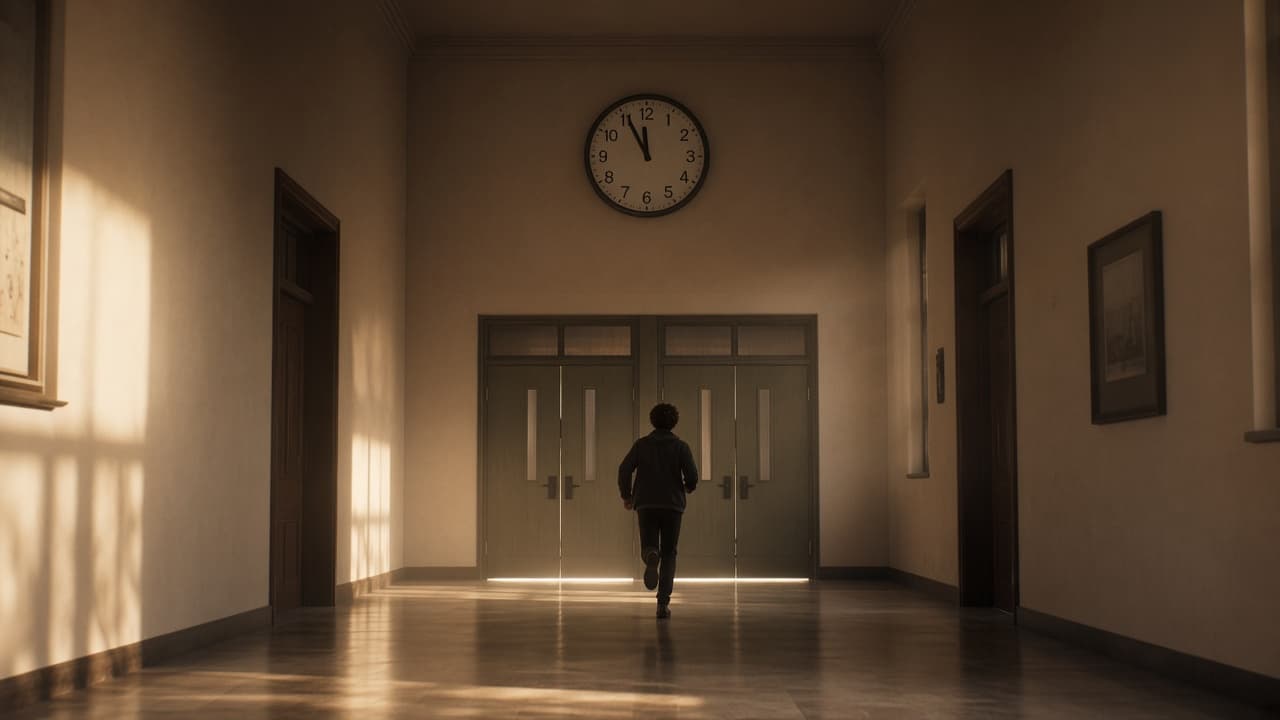
A wall clock, a phone, a station board. The numbers are cruel and clear.
Readable lateness is a known deficit. You can quantify the failure. These dreams follow actual rushed weeks and also follow personalities that live in self-accusation about time. Dreamers do maths in the dream (if I skip breakfast, if I run) and the maths never quite closes, which is the rumination loop.
If the clock jumped forward while you watched, the problem is not your pace. It is a world whose timetable you do not control, bureaucracy, other people's crises, a body that takes longer than it used to.
Doors, Gates, a Theatre, a Church | Already Shut
You arrive. The start has a physical seal.
Closed-door lateness is exclusion, not only delay. Something began, and the beginning created an inside. Weddings, funerals, openings, first days, a child's concert: the dream uses events that are socially unrepeatable. Work meetings that "start without you" belong here when the meeting is really about whether you still belong.
If people inside looked through the glass and did not open it, the social layer is harsh. If they were sorry and the lock was automatic, the system is the agent, not a particular cruelty.
You Cannot Find the Place | Late and Lost
Corridors, a campus, a hospital colour-coding, a city that rearranged.
Lateness plus lost is competence plus orientation. You would have been on time in a building that made sense. These dreams spike in new jobs, new schools, medical campuses, and grief (the world is familiar and not). Running through them is effort that does not convert into arrival.
If you had been there before and still could not map it, something about the role has changed enough to make old knowledge useless.
Getting Ready Forever | Clothes, Teeth, a Bag That Will Not Pack
The delay is in the house. You never even leave.
Preparation traps are perfection and avoidance. The event is not the problem yet; the threshold of being presentable is. Dreamers who were bullied for appearance, and dreamers with actual executive-function struggles, both produce this, for different reasons. The bag that empties itself is a fair picture of a to-do list that refills.
If someone was shouting at you to hurry while you fussed, the shouter is often a parent-introject, not last Tuesday's manager.
Have a Being Late dream of your own?
Write what you remember and get a clear reading.
The Event Was Not Work: a Birth, a Funeral, a Date, a Match
Believe the genre.
A birth you are late for (as parent, as helper, as the one giving birth and somehow also travelling) is about missing a once-only bodily or family start. A funeral you miss is about a goodbye you fear you will mishandle. A date you miss is about being the person who cannot show up for intimacy. A match or performance is about a peak you trained for and then sabotaged with time.
Work-sets are allowed to be work. Non-work sets are allowed to not be "really about your job." Flattening everything to productivity is how people miss their own dream.
You Arrive, and It Has Not Started | False Alarm
A mercy ending. The room is empty, or they waited.
False-alarm lateness is reassurance rehearsal, or a comment on your anxiety's accuracy. Sometimes you are not as late as you feel. Dreamers wake almost disappointed, because the shame had nowhere to land. That disappointment is interesting: part of you may be attached to the identity of the person who messes up time.
If they waited and were kind, you may be starving for a world that can tolerate you. If they waited and were icy, you arrived into a debt.
Recurring Lateness with Different Events, Same Feeling
The plot rotates. The shame does not.
Then the subject is the feeling, not the venue. Chronic time-shame shows up in people who were punished for slowness, in ADHD, in depression (everything takes longer), and in carers whose time is not their own. The dream will use whatever start is available this week. Treating each venue as a separate omen is a way to avoid the through-line.
A through-line you can act on: more margin in the real morning, less self-talk that you are the kind of person who is always the problem, help with the actual scheduling if the actual scheduling is broken.
Psychological Meaning
Antonio Zadra and D. C. Donderi's 2000 research on nightmare frequency (Journal of Abnormal Psychology) sits beside a larger typical-dream literature in which being late for an important event is among the most commonly endorsed scenarios. The exam set is famous; the underlying structure is broader, which is why this page refuses to be only school. A start time plus a self who cannot meet it is a human default for performance anxiety and belonging anxiety.
Michael Schredl's continuity work predicts the specific venue: you dream the clock that currently owns you. Calvin Hall treated being on time as a competence theme in social interaction. None of them treated the dream as a timetable for tomorrow's train.
If the clock, the sealed door, and the actual event-type (not "work" unless it was work) are recoverable, those three are the reading. Offer them to a personal reading in thirty seconds. Being late is ordinary as a dream and loud as a feeling. The loudness is about how much the start mattered, not about a future you have already failed.