Quick Answer
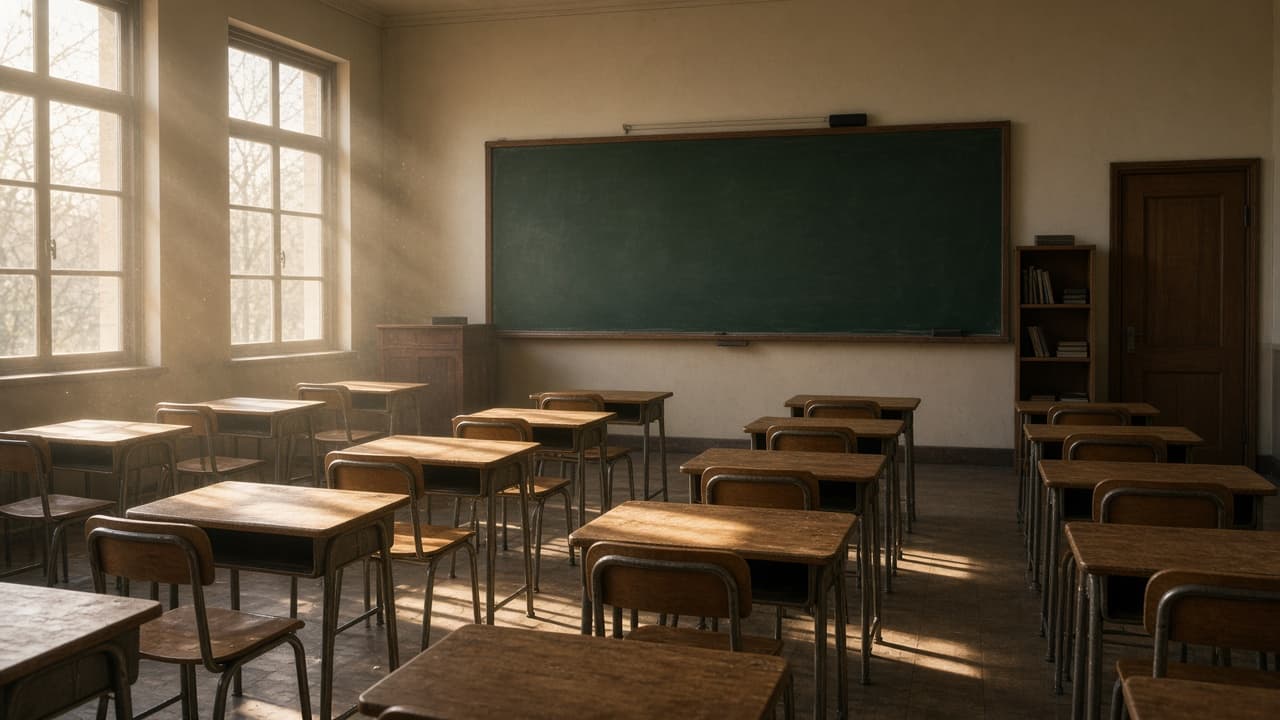
School dreams in adulthood are almost always about evaluation, not about education. The building, the timetable, the [teacher](/dreams/teachers), the test you have not revised for, these are a ready-made stage for being measured. They return when waking life has started grading you again: a new job, a review, a relationship that suddenly has standards, a skill you are supposed to already have. Two details do most of the work. Were you the age you are now, or back in a former body? And were you unprepared, [late](/dreams/late), or simply in the wrong room?
Being Unprepared for an Exam
You sit down. The paper is in a language you half remember. You have the wrong notes, or no notes, or you realise you never took the course. This is one of the most frequently reported typical dreams across cultures, which should already tell you it is not a personal omen.
It maps onto any situation where competence will be inspected and you cannot quite believe the preparation you did is the preparation that will be asked for. Job interviews, driving tests, first presentations in a new role, meeting a partner's family: the exam is a compressed image of "they will find out I do not belong here."
Whether you started writing anyway is useful. Dreamers who freeze are often in a waking freeze. Dreamers who invent answers, badly, are often already bluffing in daylight and know it. Dreamers who walk out have sometimes already decided the test is not theirs.
Going Back as an Adult
You are your current age in a secondary-school corridor. The lockers are too small. Former classmates are somehow still seventeen, or they are also adults in uniform. The mismatch is the meaning.
This version tends to arrive when a current demand has reactivated an old self, the pupil who was praised, the pupil who was overlooked, the pupil who survived by being funny. You have been called back into a role you thought you had left. A manager who talks to you like a child will do it. So will a parent. So will a professional body that requires you to prove basics again.
If you felt humiliation, ask which waking room currently has that temperature. If you felt a surprising tenderness for the building, the dream may be grief for a version of belonging that adult life has not replaced.
The Wrong Classroom or Lost Timetable
You cannot find the room. The timetable is in a code. Corridors multiply. This is a navigation dream wearing school colours, close cousin to losing things and to being late for something that will not wait.
It clusters around transitions: first weeks, new software, a family system you married into, a city whose rules you have not learned. The school is simply the place where, historically, not knowing the schedule had consequences.
A helpful split: searching while panicked usually means you still believe there is a correct room and you are failing to reach it. Searching with a growing sense that the school itself is wrong, the building has no logic, more often means the institution you are in does not actually have a place for you, and the dream is beginning to admit that.
Old Classmates and Unfinished Rankings
The people are the point. A bully, a best friend you dropped, the person who was better at everything, someone you liked and never told. School reunites a cast that waking life scattered, and it often does so when a current social field has a similar shape, a new team, a wedding party, a neighbourhood.
Rankings return with them. Who sat where. Who was chosen. Dreamers are often surprised by how much the old hierarchy still has charge. That charge is information. If a particular classmate still has the power to shrink you in a dream, some current comparison is using their template.
Kindness from someone who was unkind in real school is a repair dream. Cruelty from someone who was kind is a warning that a current ally may be occupying that old shape, fairly or not.
Have a School dream of your own?
Write what you remember and get a clear reading.
Being Naked or Wrongly Dressed at School
The naked-at-school dream is famous enough to be a cliché, which does not make it empty. Exposure plus evaluation is the combination. You are being seen in a setting that already had rules about how you should appear.
Wrong uniform, forgotten trousers, a costume from a different era: these are slightly gentler cousins. They tend to accompany first days, video calls you were not camera-ready for, or a workplace whose dress of competence you have not yet learned. The body is the evidence that you did not get the memo.
If nobody else noticed, that is a different dream from one where the class laughed. Private shame versus public shame. One is impostor feeling. The other is a fear of actual social consequence, and it is worth asking whether that fear is current or leftover.
Teaching Instead of Being Taught
You are at the front. The class will not settle, or you do not know the subject, or you know it too well and they are bored. Authority has rotated, and the dream is testing whether you believe you hold it.
This arrives around promotions, parenting, mentoring, and any moment you have become the person who is supposed to know. Panic at the blackboard usually means the authority is new and not yet inhabited. Calm, even boredom, more often means you have been in the teacher role long enough that the dream is processing the labour of it rather than the fear.
A class that already knows more than you is a specific humiliation, and it often tracks expert environments, medicine, law, tech, academia, where you are surrounded by people who started earlier.
The School Has Changed or Is Abandoned
You go back and the building is wrong. Wings have been demolished. Your classroom is a storage room. The place is empty, flooded, or open to the weather. Time has happened to the set.
These dreams are closer to grief and to houses than to exams. The institution that formed you is no longer available as it was. That can be literal, your school closed, your town changed, or psychological: the rules you learned there do not apply to the life you have now, and the dream is showing you the ruin of the old rulebook.
Wandering an abandoned school with curiosity rather than fear often accompanies a genuine graduation: you can visit the old evaluation setting without being captured by it.
Psychological Meaning
Calvin Hall and Robert Van de Castle's 1966 content analysis remains the backbone for this theme. When they coded thousands of dream reports, school and examination settings showed up as a stable, high-frequency location for anxiety dreams, especially those involving self-consciousness and judgement by others. The school is not a random backdrop. It is one of the few places in a modern childhood where evaluation is the official purpose of the room.
Tore Nielsen and colleagues' 2003 typical-dreams research put the unprepared-exam scene near the top of the list, alongside being chased and falling. That prevalence matters. A dream this common is not a coded message about your specific education. It is a shared script the brain reaches for when competence is about to be inspected.
G. William Domhoff's continuity hypothesis then personalises the script. Your school, your teachers, your particular shame or pride, get cast because they are the memories that already know this plot. A new performance review does not need a new theatre. It borrows the old one.
So: school dreams are evaluation dreams with a childhood set. Ask what is currently grading you, whether the test is real, and whether you are still sitting it in a building you left years ago.
When You Keep Going Back
Recurring school dreams usually mean the evaluation is still open. The course was never formally ended, a career that still feels like a test, a family in which you are still the pupil, a skill you use daily without believing you own it.
Two practical moves help. First, name the current exam in daylight: interview, marriage, visa, diagnosis, first quarter in the job. Second, notice whether you are still using school-era strategies, cramming, hiding, charming the teacher, disappearing in the back row, on adult problems that need a different method.
If the dreams are nightmares that replay actual humiliation, bullying, or assault from school years, that is memory, not metaphor. It is workable in therapy, and you do not have to keep sitting the original test in order to understand it.


