Quick Answer
Zombies are not quite [dead bodies](/dreams/dead-bodies) and not quite living people. They continue. That continuation is the meaning: a routine, a role, a hunger, a crowd that keeps walking after the animating purpose has gone. Contagion is the second plot. Numbness spreads. A workplace mood. A family’s way of not feeling. A media diet. You do not need an apocalypse in the future for the image to be accurate about a present climate. Recover whether you were fleeing, hiding, fighting, bitten, or already one of them.
A Slow Walker in Ordinary Places
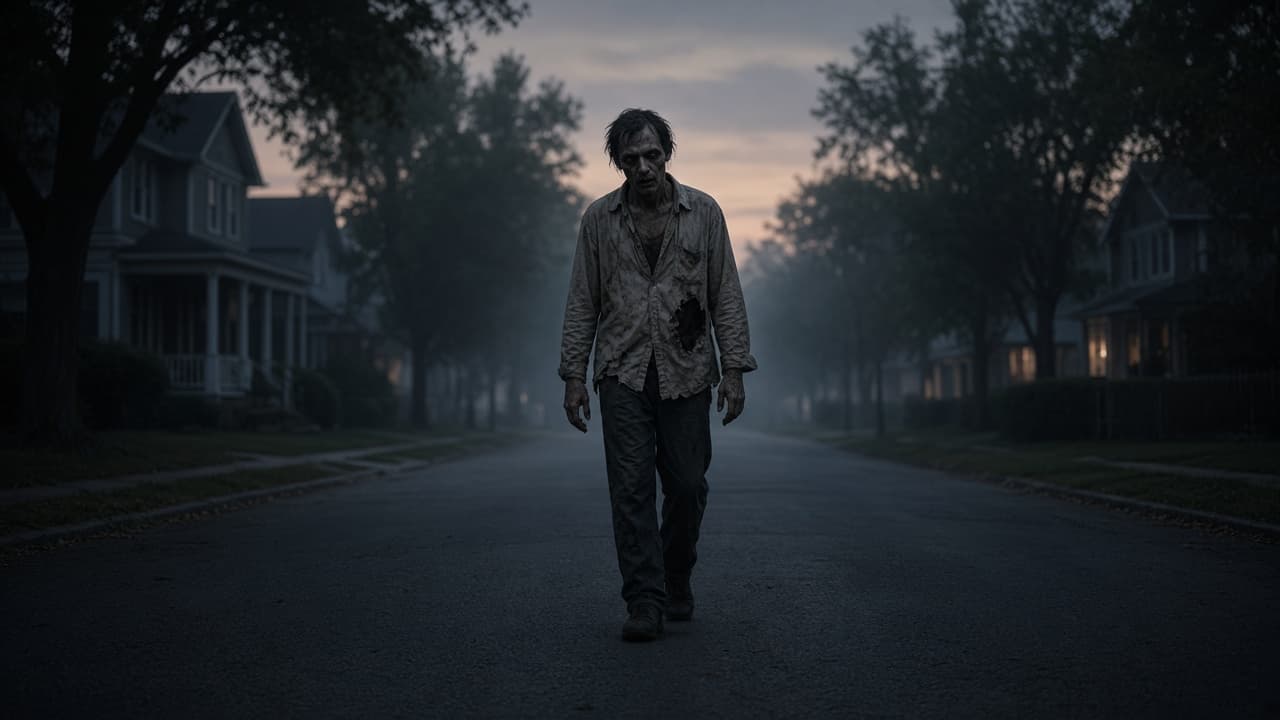
One figure. A car park, a kitchen, a school corridor. The wrong kind of occupancy.
A single zombie in a familiar place often marks one dead process you are still stepping around, a project that will not be declared finished, a relative who is gone in all but body, a standing meeting. The slowness is important. This is not a monster that leaps. It is something you could outwalk if the layout allowed, and the layout often does not.
If you recognised the face, the undeath is personal. If you did not, it is the function that has outlived its use.
Zombie Apocalypse, Cities Empty, Everyone Turning
The landscape has converted. Shops, motorways, a sky that looks like news footage.
Apocalypse-scale dreams are about climate rather than one corpse. Burnout as weather. A country, a company, a friend group performing life. Dreamers describe the particular exhaustion of having to stay alert in a world where most people are no longer reachable as people.
Your survival genre is the personality test. Barricading is withdrawal. The road-trip is search for a still-living enclave. Becoming a ruthless scavenger is a values shift you may already be ashamed of. Each of these maps onto a waking strategy for a numb environment.
Being Chased by Zombies
The chase is made of many slow bodies rather than one fast one.
That geometry matters. You can outrun a single walker and still lose to a crowd, a cul-de-sac, a locked door. These dreams cluster around accumulations: tickets, emails, family obligations, patients, customers, demands that are individually manageable and collectively inescapable.
If they were fast (the modern movie variant), the numbness has speed. Something you thought was lumbering has learned to sprint: a rumour, an illness anxiety, a political panic, an addiction. Match the gait to the waking thing.
Being Bitten or Turning
The boundary fails. Teeth, a scratch, a countdown.
A bite is how the climate gets inside you. Cynicism you swore you would not catch. A job’s dead language appearing in your mouth. A family’s emotional freeze becoming your freeze. Dreamers often know, in the dream, how long they have. That clock is worth taking as a feeling about runway, not as a medical fact.
Turning is identification completing. You join the walkers. Sometimes there is relief, the effort of staying "the alive one" was the actual torture. Sometimes there is horror. Both are information about how much it currently costs to remain distinct from a dead routine.
Have a Zombies dream of your own?
Write what you remember and get a clear reading.
Someone You Know Is a Zombie
A partner, a parent, a colleague, still wearing their clothes.
This is a relationship reading. You are in contact with someone whose aliveness you cannot find, depression, burnout, addiction, a role that ate the person, or your projection onto a change you have not accepted. It is cruel as an image and often sadly precise as a description of a dinner table.
What you did is the ethic. Feeding them, tying them up, killing them, trying to talk, those are waking policies toward a person who is not currently reachable. If you became desperate to "cure" them, you may be in a caretaker loop that the dream is showing you from outside.
You Are the Zombie
Hands, hunger, a thought that will not form, other people screaming at you as if you could still choose.
This identification is more common than people admit in daylight. It names a week of going through the motions: parenting on rails, a job performed without inner consent, grief that has flattened affect. Dying dreams still have a plot of ending; zombie-self dreams have a plot of continuation without you.
Hunger in this version is often the leftover drive, for food, for contact, for the old life, operating without a person at the wheel. What you reached for while undead (a child, a house, a phone) is usually the value that has not quite died.
Killing Zombies, Headshots, Mercy
The violence is a decision about what may continue.
Relief after killing anonymous walkers often means you ended a set of empty obligations, or want to. Guilt, especially if the zombie had a face, means you are attacking a person or a part of yourself that is still in there. Video-game fluency can make this imagery cheap; still notice who you hesitated on.
Mercy, a clean ending for someone already gone, shows up in caregiving and in long goodbyes. It is not a wish for literal harm. It is a wish for a process that has already ended to be allowed to stop walking.
Psychological Meaning
Zombies are a modern typical image rather than an ancient one, which is itself informative. The culture supplied a figure for undeath-as-crowd, and dreaming borrowed it. G. William Domhoff’s continuity hypothesis (2018) predicts that people steeped in the genre, people in institutional grind, and people watching a loved one’s personality recede will use this prop more.
Antti Revonsuo’s 2000 threat-simulation theory still applies: contagion, pursuit, barricade, protection of the uninfected. The ancestral threat is epidemic and raid; the costume is cinema. Michael Schredl’s work on media and dream content supports the costume half, you dream the monsters you have seen, without emptying the emotion.
Ernest Hartmann (2011) would read the zombie as a contextualising picture of "dead but still moving" or "this numbness is catching." That sentence is often closer to the week than a graveyard omen. Freud is less necessary here except as a reminder that the dead who walk can be wishes and fears about people who will not stay in the past.
Hobson’s activation-synthesis account explains the shuffle and the difficulty running (REM paralysis written as heavy bodies). The plot still chooses this heavy body rather than another.
Which Routine Is Still Walking
Pick the process that has outlived its life: a job title, a friendship script, a news habit, a household chore chart, a version of you that other people still address.
If the apocalypse keeps repeating, you are probably still in that climate, still spending energy on being the last awake person. The daylight experiment is smaller than a genre movie: stop one dead routine on purpose, or have one conversation that requires a living answer. The night-time crowd often thins when something in the day is allowed to actually end.