Quick Answer
A plane crash in a dream is a journey that was supposed to stay up: ambition, a tightly scheduled life-stage, a relationship that had altitude, a plan that required trusting a machine larger than you. When it fails, it fails from a height, which is why the image is so loud. It is not a forecast of [dying](/dreams/dying) in the air. People dream this before interviews, launches, moves, and medical results because those are the waking weeks in which a lot is riding on lift remaining true.
The Plane Going Down With You On It
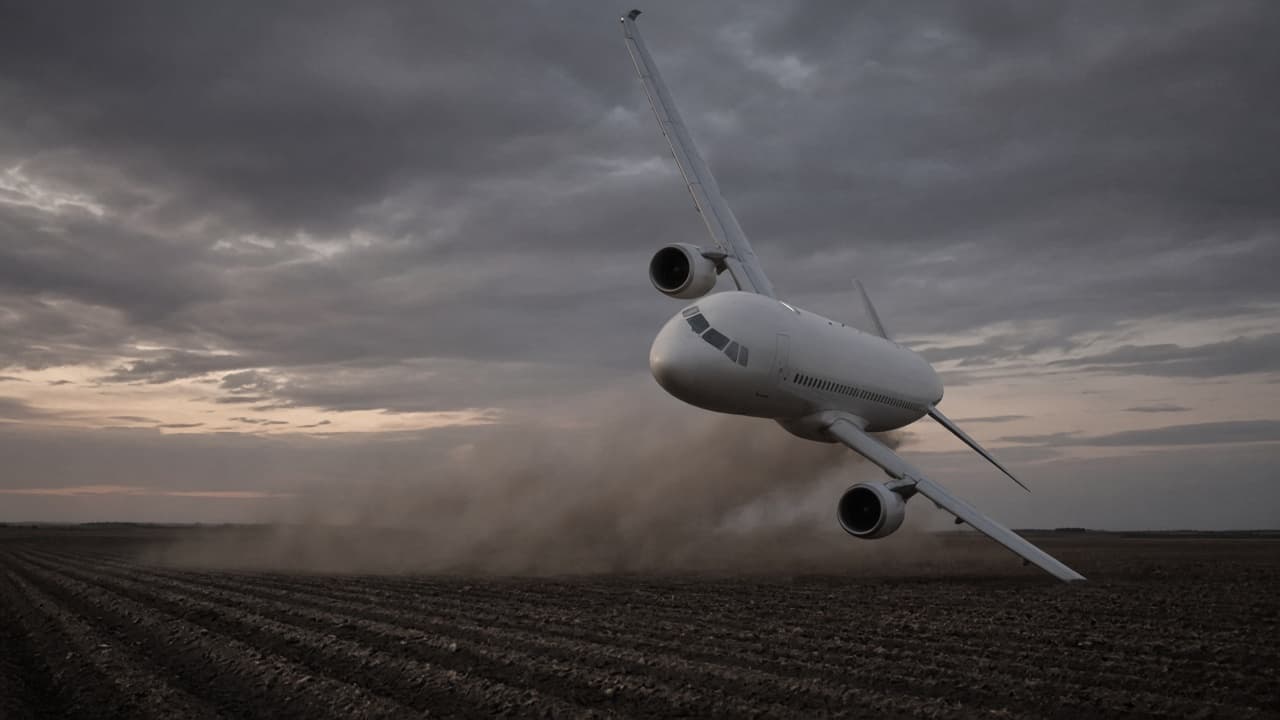
The cabin tilts. Screens, silence, or screaming; the long interval in which everyone understands. Dreamers remember the stomach-drop more than the impact, and many wake before the ground.
This version tracks a high-stakes process you are inside and cannot personally fly, a company restructure, a visa, a diagnosis pathway, a work project with too many dependencies. You have a seat. You do not have a yoke.
Where you were sitting can be oddly specific. A window seat and looking at the wing often means you can see the failure coming. A bathroom or galley at the moment of trouble more often means you were already slightly outside the official journey when it failed.
Watching a Crash From the Ground
You are on a field, a roof, a terminal window. The aircraft is someone else's. The feeling is still enormous.
Observer crashes map onto trajectories you are bonded to but do not control: a partner's career, a child's exam season, a parent's health, a public figure, a firm you work for but do not steer. Helplessness is the signature, similar in function to watching a storm or a tornado take a house you cannot enter in time.
If you felt guilty for watching, ask whether waking life has you in a bystander role you dislike, knowing, not being able to intervene, still looking.
Surviving the Crash
Impact, then quiet. You walk out. Others may or may not. The dream becomes about wreckage, smoke, a field, a road, the strange calm of still having a body.
Survival dreams often arrive after a real failure that did not, in fact, kill you: a redundancy, a breakup, a deal that collapsed, a public mistake. The psyche is catching up to the fact that the journey ended and the passenger did not. Shock and gratitude can sit together.
Who else survived is worth recovering. Walking out alone can mark an identity that was too fused with the project. Walking out with specific people often names who you actually trust once status is gone.
You Are the Pilot
Responsibility changes the entire meaning. The failure is now yours to hold, even if in the dream the instruments lied or the weather was impossible.
Pilot-crash dreams cluster around roles where other people are "on board": managing a team, parenting, being the financially stable one, leading a family through a move. The terror is of being the person who was supposed to keep altitude.
A co-pilot who would not listen, or passengers who stormed the cockpit, usually maps onto waking interference, a board, a family, a partner who grabs the controls. Engine failure with no human villain more often maps onto burnout: the machine you are was not given maintenance.
This is still not a verdict that you are crashing your life. It is a rehearsal of the fear of being the one who cannot be allowed to drop.
Have a Plane Crash dream of your own?
Write what you remember and get a clear reading.
Trying to Land, Jump, or Open a Door
Agency inside the disaster is its own family of scenes. You grab a parachute, wrestle a door, talk to air traffic control, aim for water.
Attempted-landing dreams often mean you still think skill can save the trajectory, and you may be right. Jumping, especially into sea, which then overlaps with drowning, more often means you are considering leaving the official vehicle: quitting, selling, withdrawing the application, getting off the career path that was supposed to be the rest of your life.
Doors that will not open are a bitter variant. They accompany systems with no emergency exit: visas, contracts, caretaking with no cover.
Wreckage Afterward, With No Memory of the Fall
Some dreams begin in the field. Luggage, seats, a wing, a quiet that feels wrong. You missed the crash and inherited the site.
Aftermath-only dreams tend to show up when the failure already happened in waking life and you are in the administrative part, insurance, explanations, "what we tell people", walking through a house that no longer matches the plan. The missing fall can mean dissociation: you know the result and have not felt the drop yet.
If you were searching the wreckage for a person or a document, name that object in daylight. It is usually the thing you fear the failure actually took.
A Crash That Is Strangely Calm or Unreal
Physics goes soft. The plane floats down. Nobody is hurt. You land on a street. Passengers keep talking.
Unreal crashes often mark anxiety that has not yet found a concrete object, or a defence against feeling the stakes. They can also appear when you know, intellectually, that a "crash" at work would be survivable and your body has not believed it yet.
If the calm felt eerie rather than comforting, you may be under-feeling a real risk. If it felt like a joke, you may be over-dramatising a change that is actually a landing.
Psychological Meaning
Allan Hobson's activation-synthesis work, and later the AIM model (Hobson, Pace-Schott and Stickgold, 2000), treats dreams as the narrative the mind builds around internally generated, often high-arousal brain states. A falling aeroplane is an almost perfect vehicle for that: vestibular drop, helplessness, a machine, a crowd, altitude. The sleeping brain has a lot of dramatic material and a weak grip on probability, so it writes catastrophe at scale.
That does not empty the image of personal meaning. It explains why the picture is so cinematic compared with, say, a car stalling. Planes are public, scheduled, and fatal in the imagination even when waking flying is statistically ordinary. If you are in a week of high-stakes dependence on systems, markets, hospitals, airlines, employers, the dream recruits the vehicle that matches the feeling of being a passenger at height.
Flight anxiety amplifies the loop. The dream is then both cause and effect. Handle the anxiety as anxiety; interpret the rest as a story about a journey you do not fully fly.
After the Night the Plane Would Not Stay Up
These dreams stop more often after a real decision about the journey than after rereading the crash. Choose: stay on, change destination, or get off. Even a small waking act, updating a CV, booking the medical, telling one person the project is in trouble, gives the psyche a different altitude to work with.
If plane-crash nightmares follow a real accident, near-miss, or news image you cannot stop seeing, that is closer to traumatic replay than to career symbolism. Imagery rehearsal and trauma-focused help are the right tools; a dictionary is not.