Quick Answer
Peacocks exist, evolutionarily speaking, to be looked at, so dreaming of one nearly always concerns visibility. Being admired, wanting to be admired, dreading being seen, or noticing someone else's performance and how it lands on you. The tail decides most of the reading. Fanned means display in progress; closed or dragging means the performance is over or has not started. After that, watch the sound and the setting, because a peacock's cry is harsh and unglamorous, and a bird in a formal garden means something different from one loose in a car park.
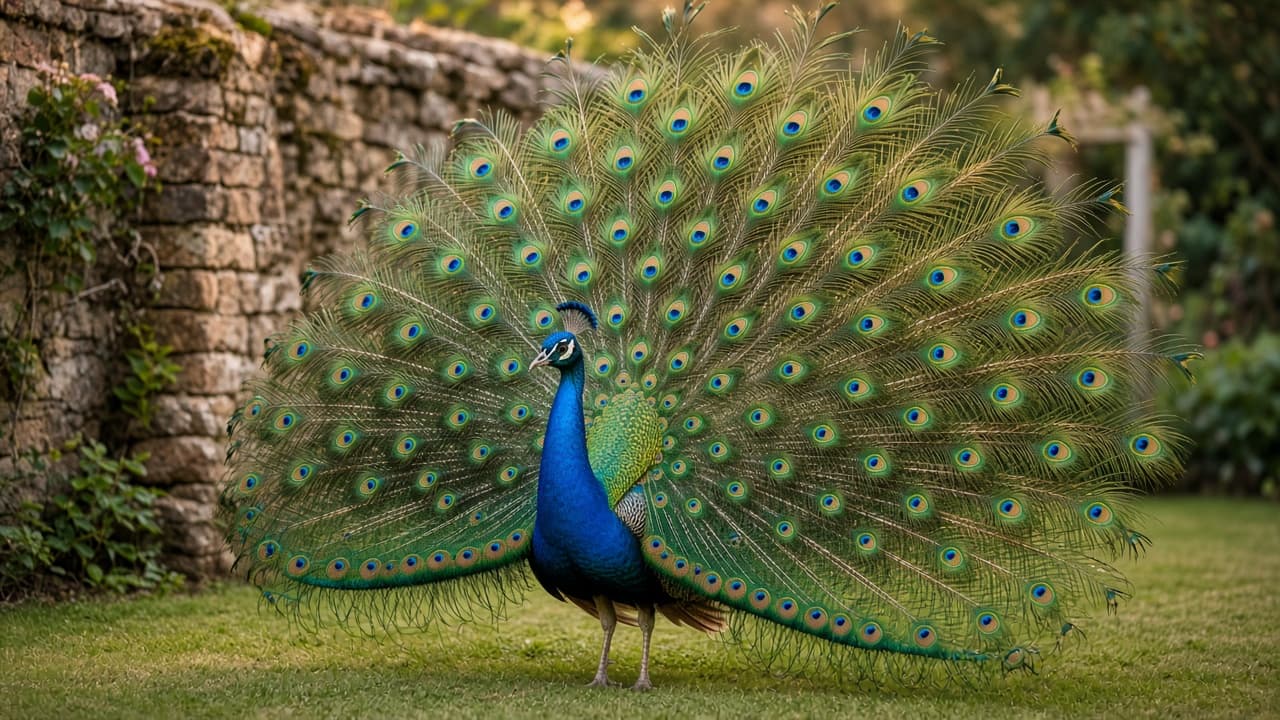
A Peacock Fanning Its Tail
The classic image, and the one most dreamers remember in detail: the fan opening, the eyespots, the slight shiver of the feathers.
Display dreams tend to arrive around moments of deliberate visibility, a presentation, an interview, a wedding speech, a launch, a first date, posting something you know people will see. Recover whether anyone was watching. An audience shifts the dream toward how the performance was received; an empty setting more often accompanies a capability you have that nobody has had cause to notice yet, which dreamers usually describe as a mixture of pride and frustration.
A Peacock With Its Tail Closed
The unglamorous version, and more common than people expect. The bird is present but ordinary: a long trailing tail, dust on its feet, none of the spectacle.
These scenes cluster around periods after visibility rather than before it, the week after the event, the month after the promotion, the stretch when you are simply doing the work without anyone applauding. Dreamers often report a flat, faintly disappointed tone. That is usually accurate about the waking situation, and worth reading as ordinary recovery rather than as decline.
A Peacock Screaming
Anyone who has lived near peacocks knows the cry: loud, harsh, almost human, entirely at odds with the plumage. Dreams that feature it tend to be built around that contradiction.
The mismatch is the meaning. These dreams frequently arrive when something beautiful in your life has an ugly noise attached to it, a glamorous job with a toxic manager, a relationship that photographs well and sounds terrible from the inside, a social circle whose charm collapses in private. If the cry woke you or dominated the dream, the reading is usually about what you can hear and other people apparently cannot.
Finding a Peacock Feather
Here the beauty has separated from the bird. A single feather on a path, in a book, on a windowsill.
Found feathers tend to accompany recognition that arrived without performance: an unexpected compliment, credit given when you were not in the room, a piece of your work resurfacing years later. Being handed one is subtly different, it usually involves a specific person's approval, and dreamers often remember who gave it more vividly than the feather itself. The superstition about feathers indoors, discussed below, sometimes leaks into the dream and turns a gift into unease.
A Peacock Attacking or Chasing You
People are often surprised that this version exists, but real peacocks are territorial and will go for a person, a car, or their own reflection.
Aggression dreams here tend to concern status conflict rather than danger. They arrive when someone showy has turned on you, a colleague who competes rather than collaborates, a friend who cannot tolerate your good news, a family member for whom every occasion must be theirs. Dreamers frequently report being embarrassed as much as frightened, which usually fits: the waking situation is humiliating rather than threatening.
A Caged or Clipped Peacock
Confinement puts the display in a frame. The bird is in an aviary, a small pen, or has had its tail cut short.
These dreams tend to arrive when self-presentation has become compulsory rather than chosen, a public-facing role you cannot step out of, an online presence you maintain out of obligation, a family reputation you are expected to uphold. Dreamers often report wanting to open the cage and not doing it. That hesitation usually corresponds to a real calculation about what would happen if they stopped performing.
Have a Peacock dream of your own?
Write what you remember and get a clear reading.
A Dead or Plucked Peacock
The most disquieting version, and the emotion is generally sadness rather than horror. A dead bird, scattered feathers, a tail pulled apart.
This one commonly follows public loss of face: a project that failed visibly, a demotion, a relationship that ended in front of everyone, a reputation damaged by something you cannot fully explain. Where dreamers report collecting the feathers afterwards, the dream is usually about salvage, what remains valuable after the display collapsed. That is a more hopeful reading than the image first suggests.
A Peacock in an Unlikely Place
Sometimes the setting supplies the whole meaning. A peacock in a supermarket, a bus station, a hospital corridor, your own kitchen.
Incongruity dreams tend to accompany situations where something ornamental has ended up somewhere practical: dressing up for an event that turned out to be casual, bringing ambition into a place that only wants competence, or a relationship where one person wants ceremony and the other wants function. Dreamers usually describe the bird as being fine and everyone else as awkward, which is often exactly the social dynamic being processed.
A Peahen Beside the Peacock
The comparison dream. The brown, unshowy peahen stands next to the male, and dreamers almost always notice her second.
Pairs like this tend to arrive during periods of unequal visibility, a partner who takes the attention, a sibling whose achievements dominate family gatherings, a colleague who presents work you both did. Which bird you identified with is the whole reading, and most dreamers know instantly. Identifying with the peahen often carries relief as well as resentment, since being unwatched has real advantages. Where the dream tips over into dread at being looked at, the exposure reading in naked dreams usually fits better than the display one.
Psychological Meaning
Display is a genuine psychological subject, not a moral failing, and peacock dreams are usually working on it.
G. William Domhoff's continuity hypothesis gives the most reliable frame: dream content follows waking preoccupation. If you are currently being appraised, promoted, photographed, interviewed or judged, an animal whose entire biology is about being looked at becomes an obvious image for your mind to reach for. The peacock arrives in the weeks when visibility is the live problem.
Michael Schredl's research on animal dreams offers a useful piece of context. Animals appear in dreams far more often in childhood than in adulthood, and adult animal dreams tend to carry symbolic weight rather than literal fear, which is why a peacock in an adult dream so rarely feels like a wildlife encounter and so often feels like a comment.
Carl Jung supplies the most distinctive reading, drawn from alchemy rather than from ornithology. In Mysterium Coniunctionis he discusses the cauda pavonis, the peacock's tail, as a stage in the alchemical process where a chaotic mixture suddenly displays all its colours at once, a sign of imminent integration rather than vanity. Where that fits, peacock dreams arrive at the point when a confusing period starts resolving into something recognisable. Treat it as a hypothesis to test against your own year, not a rule.
It is worth separating two feelings people bring to these dreams. Wanting to be seen is not the same as arrogance, and many dreamers arrive at a peacock page half-convinced the dream is an accusation. More often it is an accurate report of a real need for recognition that has not been met.
Spiritual and Cultural Meaning
Few birds carry as much religious and cultural freight, and it runs in genuinely different directions depending on where you look.
In Hindu tradition the peacock is deeply woven into iconography. It is the vahana, or mount, of Kartikeya, appears in imagery associated with Saraswati, and the peacock feather is a familiar element of Krishna's crown. The bird is also India's national bird, which layers civic pride onto the religious symbolism. Read from that tradition, a peacock dream leans toward protection, beauty as a divine quality, and the arrival of rain and renewal, peacocks are associated with the monsoon in a good deal of Indian poetry.
Greek myth gives the eyespots their most famous story. The many-eyed giant Argus was set to watch on Hera's behalf, and after his death his eyes were placed in the peacock's tail, which makes the fan an image of surveillance as well as splendour. If your dream involved feeling watched by the pattern itself, that is a strikingly old association.
Early Christian art treated the peacock as a symbol of resurrection and immortality, partly on the ancient belief that its flesh did not decay, a claim Augustine discusses in The City of God. That is why peacocks appear in catacomb and basilica mosaics rather than as emblems of pride.
In Yazidi tradition, Melek Taus, the Peacock Angel, is a central and revered figure, worth knowing because it is frequently and offensively misrepresented in Western occult writing. If you encountered the peacock as a sacred presence in your dream, that reverence has real precedent.
Finally, the superstition. In British and Irish folk custom, and especially in theatre, peacock feathers indoors are considered unlucky, the eyespot read as an evil eye. That belief is why a beautiful gift can land as dread in a dream. It is a cultural inheritance, not a warning about your week.
Biblical Meaning
Scripture mentions peacocks only in passing, and always as luxury imports. In 1 Kings 10:22 and 2 Chronicles 9:21, Solomon's fleet returns every three years carrying gold, silver, ivory, apes and peacocks, though some translations render the last word as baboons, since the Hebrew is uncertain.
What survives that ambiguity is the context: the peacock stands among the trappings of extraordinary wealth. Read through the wider biblical treatment of Solomon's splendour, the bird sits inside a story about glory that is real, admired, and ultimately unable to hold a life together.
For a dreamer reading through scripture, the question that follows is not whether display is sinful but whether the display has become the point. That is a gentler and more useful question than the vanity sermon these dreams usually invite.
When Peacock Dreams Keep Appearing
If the bird keeps returning, look at how much of your current life is spent being looked at, and whether you chose that.
Two moves tend to help. First, distinguish the audiences: there is usually one specific person whose regard the dream is organised around, and naming them clarifies the whole sequence. Second, notice which state the tail was in each time. A run of fanned-tail dreams during a visible period is straightforward rehearsal; a shift to closed tails or damaged feathers often marks the moment the performing started costing more than it returned.
These dreams are rarely frightening, so the practical advice is different from most animal entries. Rather than settling your nerves, they generally reward honesty about wanting recognition, and about how tiring it is to keep a display open when nobody is applauding. Similar questions come up across other animal dreams, particularly with birds.