Quick Answer
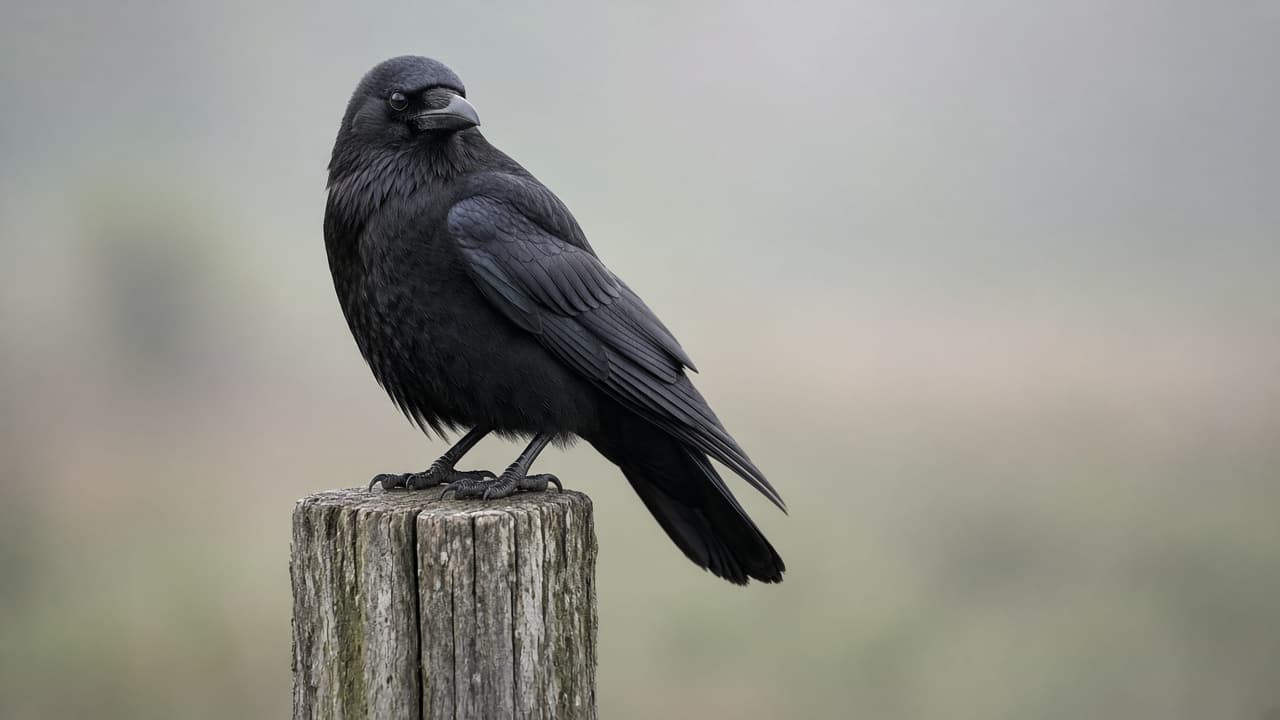
A crow in a dream is usually about being seen clearly. These are the birds that recognise faces, remember grudges, use tools and follow people, and dreams borrow that intelligence rather than the funeral folklore. Most crow dreams arrive during periods of scrutiny, or when a situation calls for wit instead of force. The scene sets the meaning: one bird watching leans toward personal attention, a flock toward collective judgement, a crow at the window toward something asking to be let in.
The Death Omen, Handled First
Almost everyone searching this symbol arrives with the same fear, so it is worth clearing before anything else. The belief that a crow means a death comes chiefly from European battlefield and gallows folklore, where crows and ravens gathered where bodies already were. That is the crucial detail: they arrived after. A bird that reliably follows death was never a bird that predicts it.
There is no evidence, historical, statistical, or clinical, that dreaming of a crow has any relationship to anybody dying. If you woke at 4am and searched this phrase because a relative is ill, the dream is far more likely to be processing your existing worry about them than announcing anything. Dreams reflect what you are already carrying; that is well documented, and it is much less frightening than the folklore.
You can put that down and read the rest of this page for what the dream is actually doing.
One Crow Watching You
The commonest version. A single bird on a post, a roof, a branch, or a wire, and it is already looking at you. It does not fly off when you notice. Sometimes it turns its head to keep you in view.
Being watched by something intelligent is the whole experience, and it maps onto waking situations where you are being assessed by someone who is paying more attention than they let on. New workplaces, probation periods, custody arrangements, a family member who notices everything. Dreamers often report that the bird did not feel hostile, just attentive, which is usually accurate about the real situation too.
How you responded is worth recovering. Staring back, talking to it, or moving on all describe different relationships with being observed.
A Crow at the Window
Tapping the glass, sitting on the sill, or looking in from the ledge while you stand inside.
Windows are threshold images, and a crow at one usually marks something outside your private life pressing to come in: news you are expecting, a person from your past, an official letter, a piece of information you half know is coming. See windows for the wider pattern of what glass does in dreams.
Whether you opened it is the reading. Dreamers who let the bird in tend to be readier for the news than they feel. Those who drew the curtains are usually managing something they are not prepared to hear yet, and there is no failure in that, only information.
A Flock of Crows
The collective noun is "a murder", which does a lot of unearned emotional work. What actually changes when the birds multiply is the shift from one observer to many.
Flock dreams cluster around collective judgement: office politics, a family verdict, a group chat, online exposure. Dreamers frequently describe the noise as the worst part, many voices, none of them individually threatening. That is often an exact description of what makes public opinion hard to answer.
Note the movement. Birds settling around you leans toward being surrounded by talk. Birds rising together at something you did not see leans toward a change you have sensed but not identified.
A Crow That Speaks
Corvids do mimic speech in real life, which may be why dreamers find this less absurd than a talking dog. A crow says your name, gives you an instruction, or delivers one clear sentence.
Keep the sentence if you can. Dream speech from an animal is generally a thought that would sound too blunt in your own voice, something you already know and have not been willing to state plainly. Dreamers often report the crow being right, and being annoyed about it.
A Dead Crow
Finding one on a path or a lawn is a distinct dream from being watched by a live one, and it inverts the symbolism entirely.
A dead crow tends to accompany the end of a period of scrutiny or cleverness: an inspection passed, a court case closed, a job left, a rivalry over. Some dreamers report grief that seems out of proportion, which often turns out to be about losing the sharpness that a difficult period demanded of them. Being watched keeps you alert; when it ends, the alertness has nowhere to go.
Have a Crow dream of your own?
Write what you remember and get a clear reading.
A Crow Attacking or Dive-Bombing You
Crows really do mob people near their nests, and the dream version keeps that specific quality: repeated passes, noise, no serious injury.
These dreams tend to accompany defensive aggression from someone who feels threatened rather than someone who wants to harm you, a colleague protecting their territory, a relative reacting to a boundary you set, a neighbour dispute. The mobbing feels personal and is usually not. Dreamers who realise mid-dream that they were near a nest often wake with the real answer already in hand.
A Crow Taking Something Shiny
Something small and valuable is lifted and carried off, keys, a ring, a coin, a phone.
Theft-by-crow dreams tend to be more irritating than frightening, and they usually track small losses to somebody else's cleverness: credit for an idea, a client, an advantage lost on a technicality. The object is worth identifying literally. Dreamers who report keys often turn out to be worried about access and control; those who report a ring, about a commitment.
Crows on a Roof or Over the House
Above the home rather than in it. Perched along a ridge, circling, or calling from a chimney.
This positioning usually points at something hanging over family or domestic life rather than over you personally, a parent's health, a house sale, a decision the household is waiting on. Dreamers frequently report going outside to look up, which is often what they are doing in waking life: monitoring a situation they cannot yet act on.
Psychological Meaning
Crow dreams make more sense once you know what crows actually are, because dreams are drawing on real reputation rather than superstition.
John Marzluff's research at the University of Washington, described with Tony Angell in In the Company of Crows and Ravens (2005) and in later face-recognition experiments, established that wild crows recognise individual human faces, remember people who have treated them badly, and pass that information to other crows. Corvids also cache food, use tools, and appear to plan. These are the animals in your local environment most likely to know who you are. A dream that uses a crow to represent being watched and remembered is using an accurate symbol, not a spooky one.
For why the dream arrived now, Domhoff's continuity hypothesis is the useful frame: dream content largely continues waking concerns. Periods of evaluation, surveillance, gossip and reputational risk produce watcher imagery, and a crow is the readiest watcher most people have.
Where the bird turns hostile, Antti Revonsuo's threat-simulation theory (2000) accounts for the mobbing dream, dreaming rehearses defensive responses to threats, and a repeated, noisy, non-lethal attacker is close to ideal practice material.
Grief deserves a separate note. Because of the folklore, crows genuinely do appear in the dreams of bereaved people, sometimes repeatedly. That is not an omen operating in reverse; it is your mind using the image your culture handed you for death, in a period when death is what you are processing. If crows are showing up while you grieve, read them alongside death rather than as a message about anyone still living.
Cultural and Spiritual Meaning
Crows carry some of the widest and least consistent symbolism of any bird, which is itself informative.
In Norse tradition, Odin's ravens Huginn and Muninn, thought and memory, fly out and return with news, making corvids figures of intelligence and information rather than doom. In Celtic material the Morrígan appears in crow form around battle, which is where much of the European death association originates. Across several Pacific Northwest Indigenous traditions, Raven is a creator and transformer whose stories turn on cleverness. In Hindu practice during Pitru Paksha, crows are fed as messengers who carry offerings to ancestors, a role of respect, not menace. In Japan, the three-legged Yatagarasu appears as a divine guide.
Notice how often the theme is messenger, memory, or trickster, and how rarely it is prediction. If your dream felt significant rather than frightening, those traditions offer better company than the omen lists.
Biblical Meaning
Scripture treats ravens and crows with striking generosity, which surprises most readers who expect the opposite.
Genesis 8:7 sends a raven out from the ark first, as a scout. In 1 Kings 17:6, ravens bring Elijah bread and meat in the wilderness, they are the means of his survival, not a threat to it. Luke 12:24 uses them as a lesson in provision: consider the ravens, they neither sow nor reap, and God feeds them. Job 38:41 asks who provides for the raven's young. Proverbs 30:17 is the harsh outlier, using ravens picking at the eyes of a scornful child as an image of consequence.
The weight of the tradition is toward provision, scouting and being noticed by God rather than toward death. If you read dreams through scripture, that is a considerably kinder starting point than folklore.
When the Same Crow Keeps Turning Up
Recurring crow dreams generally mean a period of being watched or judged that has not ended, or a problem that keeps requiring cleverness from you.
Try naming the watcher. Dreamers are often surprised to find it is not the person they assumed, sometimes it is their own monitoring of themselves, which is worth knowing before you go looking for an antagonist.
If the dreams began after a bereavement and are keeping you awake, be gentle with the interpretation and firm about the sleep. Grief disrupts sleep in well-documented ways, and support with rest usually does more for the dreams than any decoding of the bird.