Quick Answer
Owls see in the dark. That is the biological fact the dream uses. An owl usually marks a kind of knowing that does not belong to office hours, insight, suspicion, grief-watch, or the feeling of being observed when you had counted on privacy. Deflate the omen first. Owls collect death folklore in more than one culture, which is why people wake up frightened for relatives. The scene in front of you is almost always about watching versus being watched. Recover the bird’s posture, the time of day, and whether you could look back.
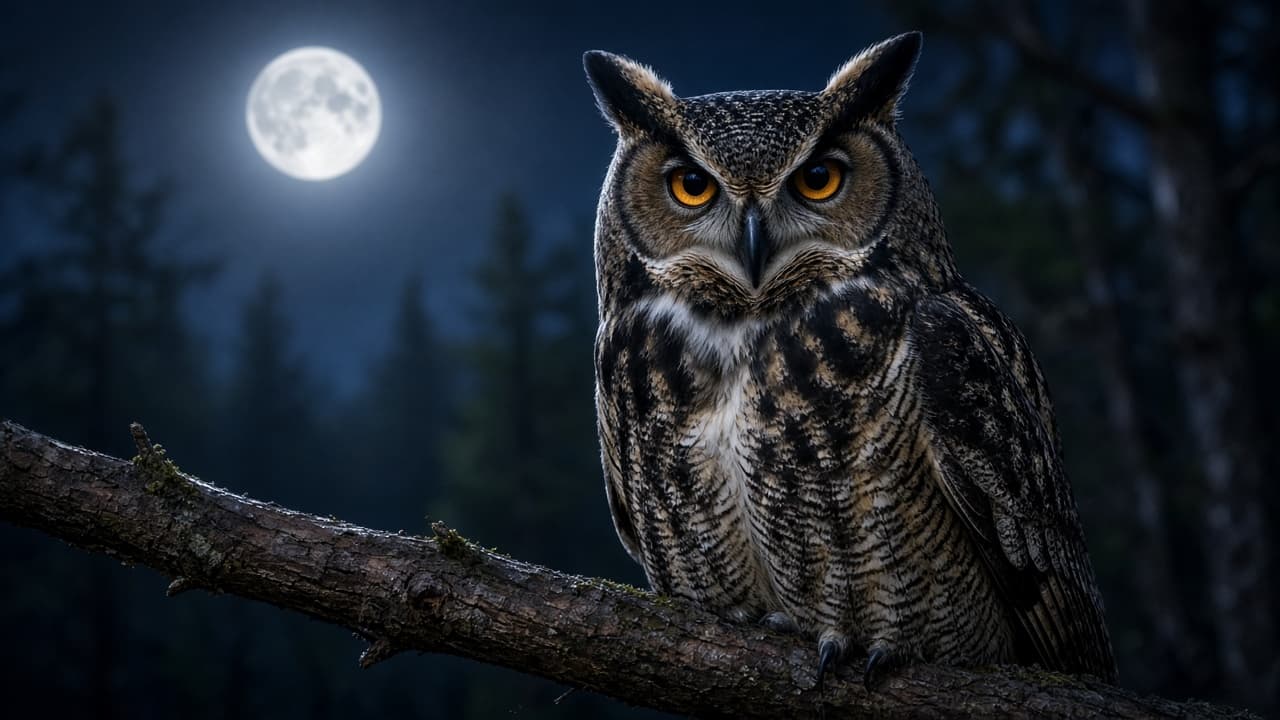
An Owl Watching You
The head turns. The eyes do not blink on your schedule. You are the thing being studied.
This is the core owl dream. It arrives during periods of quiet assessment: a hiring process with no feedback, a friend who has gone observant, a conscience that has started keeping records. Unlike a crow or a flock of birds, the owl is usually singular and still.
Meeting the gaze is a different dream from looking away. Dreamers who stare back often wake with a sense of having been caught, and of having caught something. Dreamers who hide are usually in a waking situation they do not want illuminated. Distance still counts: an owl in a far tree is background vigilance; an owl on the windowsill is inside the house boundary.
Hearing Hoots Without Seeing the Bird
Sound only. A question mark in the dark.
Unseen hoots track messages without owners. A mood in a family that nobody will name. A bodily signal you keep meaning to get checked. Industry gossip. The dream gives you the fact of a call and withholds the caller, which is often accurate.
If you went looking and never found the owl, the waking task is location: who or what is actually making that sound. If you stayed in bed and listened, you may be in a stretch of choosing not to investigate, which is a strategy with a shelf life.
An Owl in Flight
Silent wings, a body that should make noise and does not. Prey geometry.
Flight adds hunting. Someone, you, or a part of you, or a person you are afraid of, is moving on information other people do not have. These dreams cluster around negotiations, research, night-shift thinking, and the slightly predatory intelligence of "I saw that before they did."
Whether you were the owl, under the owl, or watching from a window splits the identification. Being the hunter is agency. Being the field mouse is exposure. Watching the hunt is often how you actually participate in a workplace or family: informed, not central.
An Owl in Broad Daylight
The night animal is out of its hours. Wrong medium, like a fish on a bank.
Daylight owls mark night-seeing forced into a day role, a private insight you now have to use in a meeting, grief that will not stay off-stage, a secret that has become operationally necessary in ordinary hours. The bird often looks stunned or too visible, which matches.
If people in the dream treated it as normal, you may already be in a culture where the unusual has been normalised (a workplace in crisis, a family in medical mode). If they pointed and stared, the insight is still socially expensive.
A White Owl Appearing
Snowy, barn-pale, a white face in dark trees.
Colour is tone, not a second symbol-system. White often feels clarifying, rare, or funerary depending on your culture. In some traditions a white owl is more omen-loaded than a brown one; that is folklore sitting on top of pigment. What the bird did still outranks the palette.
Dreamers report white owls after deaths, during snowbound winters, and in periods of unusual mental clarity. Continuity explains a lot of that. If the white owl attacked or fled, do not let "purity" overwrite the behaviour.
Have a Owls dream of your own?
Write what you remember and get a clear reading.
An Owl Attacking
Talons, face, a bird that should have stayed a watcher.
Attack converts observation into impact. Insight that hurts. A truth delivered without kindness. A person whose quiet attention turned out to have an agenda. Bats and raptors share some of this night-predator vocabulary; the owl specifically often feels like being struck by something that had been studying you.
Where you were hit matters. Head and eyes lean toward mind and how you are seen. Hands lean toward work. If you fought it off, you are already in conflict with the watching thing. If you froze, see also rabbits, freeze as strategy.
An Owl on a Shoulder, Desk, or Bookshelf
Contact, alliance, or a mascot that got too close.
A shoulder-landing is intimacy with the watching function, a familiar, a teacher, a part of you that has decided to be a companion rather than a judge. Dreamers with academic or "wise owl" associations often get this version; the culture primed the prop.
A desk or bookshelf owl is about knowledge as furniture. It can be benign (a craft, a study, a night of reading) or satirical (you have decorated your life with wisdom symbols and the bird is now staring at you). Baby owls learning to fly in the same dream usually mark an immature version of this night-skill, a new perceptiveness that is still clumsy.
Multiple Owls in Trees
More than one watcher. A parliament.
Plural owls are a social field of attention: a family that notices everything and says little, a professional community, neighbours, a group chat with eyes. The trees are structure, institutions, lineages, a street.
If they called together, the field has a shared message. If they ignored each other, you may be dealing with several independent observers rather than a conspiracy. Conspiracy is the story the omen-mind wants. Distributed attention is commoner.
Psychological Meaning
Deirdre Barrett’s work on dreams as an overnight thinking space is a good fit for owls. The bird is almost too on-the-nose as an image of "I am trying to see in conditions that are not well lit." Problem-solving dreams often recruit a watcher when the day-self has been performing rather than looking.
G. William Domhoff’s continuity hypothesis (2018) predicts that people who are actually being evaluated, people who work nights, people who birdwatch, and people in grief-watches dream owls more. The moon in the same sky is extra night-context, not a separate oracle.
Jung treated birds as images of thought and spirit; the owl specifically collects the shadow-side of wisdom, knowledge that is not social, not sunny, not necessarily kind. That lens helps when the dream feels like conscience. It does not license a death forecast.
Revonsuo’s 2000 threat-simulation theory applies mainly to attacking owls and to the prey-feeling of being watched from above. Silent flight is a predator technology. The dream can rehearse detection. Tore Nielsen’s typical-dream surveys remind us that animal encounters are common; the species is personalised by culture and media.
Watching Versus Being Watched
Finish the owl by assigning the roles. Were you the seer, the seen, or the person standing under a tree full of other people’s eyes? Folklore will try to make the bird a messenger from the grave. Your week will usually supply a quieter job: a truth that only shows up after hours, a gaze you cannot return, a skill of noticing you have not decided whether to use.
If the same owl returns, it is probably still on duty. Change what you are willing to look at in the day, or whose watching you will no longer treat as weather, and the night bird often relocates, or simply blinks and looks elsewhere.