Quick Answer
A roof is the part of a building whose only job is to keep the weather out, so dreaming of one leaking usually points at protection that has started to fail. Savings that no longer cover the month, a health issue you have been monitoring, a relationship whose boundaries have worn thin, a plan with a hole in it that you have known about for some time. Two details matter most: how fast the water came, and what it was damaging underneath. A slow drip into a bucket describes something entirely different from a ceiling giving way, and water ruining paperwork means something different from water falling on a bed.
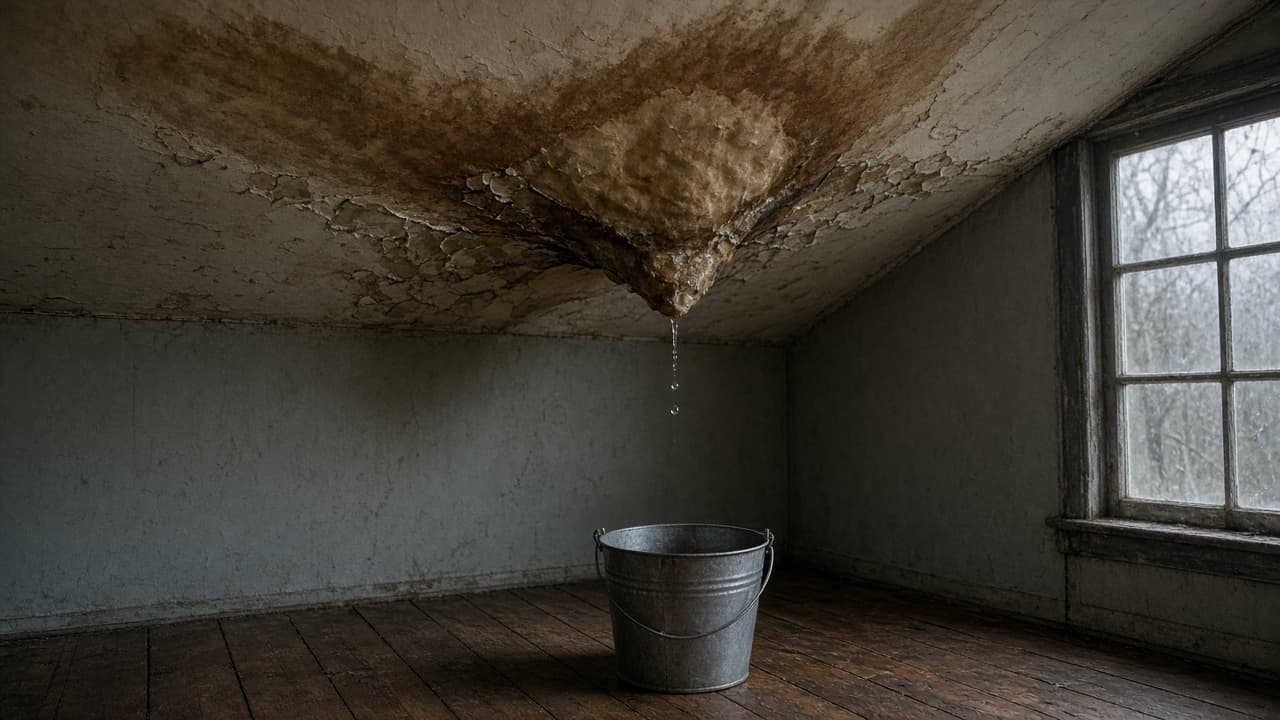
A Slow Drip From the Ceiling
The commonest version, and the most quietly stressful. One drop, then another, with a rhythm you find yourself counting.
Slow leaks tend to represent problems that are not urgent enough to force action but persistent enough to occupy you: a subscription-heavy budget bleeding money, a low-level pain you have not booked an appointment for, a friendship losing warmth by small increments. Dreamers frequently report listening to the drip rather than doing anything about it, and that inaction is generally the honest part of the dream.
Water Pouring Through and the Ceiling Giving Way
At the other extreme, the roof fails. Plaster bulges, sags, and comes down in wet sheets.
Collapse versions usually arrive after something has already broken through in waking life rather than before. A landlord's notice, a diagnosis, a redundancy, a confrontation that could no longer be postponed. Dreamers often describe standing still and watching, which is common in the aftermath of a real event, the dream is registering the scale rather than warning you.
Buckets, Towels and Endless Management
Here the dream is entirely about containment. You are positioning pans, wringing towels, emptying a bucket that fills again, moving furniture out of the drip line.
Management dreams describe coping rather than fixing, and dreamers usually recognise the pattern instantly. They cluster around situations being absorbed indefinitely: covering a shortfall every month, holding a team together without more staff, buffering a family member's moods so nobody else has to. The exhaustion in these dreams is rarely dramatic. It is the specific tiredness of maintenance without end.
A Leak Nobody Can Find
A frustrating and very common variant. Water is definitely coming in and no one can locate the source. It might be a pipe, might be a tile, might be somewhere behind the wall.
Untraceable leaks tend to accompany problems whose cause is genuinely unclear: money disappearing without an obvious culprit, a relationship deteriorating with no identifiable argument, symptoms without a diagnosis, a project slipping with no single failure. Dreamers often report going up into a loft to look. That search usually corresponds to real investigative effort, reading statements, retracing conversations, waiting on tests.
A Spreading Stain on the Ceiling
Sometimes there is no water at all, only the mark: a brown ring, a bloom of damp, paint lifting at the edge.
Stains are evidence of damage that has already occurred somewhere out of view, which gives these dreams their particular flavour. They arrive when the only visible part of a problem is its trace, a comment that revealed something about how a colleague sees you, an old resentment surfacing in a partner's tone, a symptom that persisted after an illness. Dreamers often report checking whether the stain has grown since last time, which is usually exactly what they are doing in waking life.
Rain Coming Into the Bedroom
Location changes the stakes. A leak in a hallway or a spare room is an inconvenience; a leak over the bed is personal.
Bedroom leaks tend to appear when the failing protection has reached rest and intimacy, money worries that keep you awake, a housing situation that no longer feels secure, a relationship problem that has moved into the last private space. Dreamers frequently describe trying to move the bed and finding nowhere dry to put it, which is a fairly exact rendering of having no untouched part of life left. Rain covers weather that stays outside, which is a noticeably gentler dream.
Have a Leaking Roof dream of your own?
Write what you remember and get a clear reading.
Being on the Roof Trying to Fix It
Some dreams put you above the problem, usually in bad conditions: wind, rain, loose tiles, a ladder that does not feel safe.
Repair dreams shift the subject from damage to responsibility. They arrive when you are the person expected to solve something structural, the one managing a parent's care, keeping a business solvent, holding a household together. The risk in these dreams is worth reading: dreamers often report the roof itself being unsafe to stand on, which tends to describe fixes that require you to put yourself in a precarious position.
A Leak Somebody Else Refuses to Fix
Here the dream introduces an antagonist. A landlord who does not answer, a contractor who never arrives, a housemate who claims not to have noticed.
These versions are about responsibility rather than water. They cluster around situations where you are absorbing the consequences of someone else's inaction: a partner who will not deal with their share of the admin, an employer who ignores a known problem, a sibling leaving the caring to you. Dreamers often report arguing in the dream and being unheard, which usually mirrors a conversation that has already happened several times.
A Leak in a House From Your Past
Setting shifts the timeframe. The leaking roof belongs to a childhood home, a former flat, a house you have not lived in for years.
Past-house leaks tend to concern inherited or long-standing problems rather than current ones: a family pattern with money, an old insecurity about stability, something that was never repaired when you were young. If the house was one where you actually experienced housing insecurity, the dream may be closer to memory than metaphor. Houses explains why buildings in dreams so reliably stand in for the self.
Psychological Meaning
Buildings are the most-used metaphor system in dream life, and the roof has a specific job within it.
Calvin Hall's 1953 cognitive theory of dreams argued that dreams express a person's conceptions, of themselves, of others, of problems, in concrete imagery rather than in abstract terms. A house makes an ideal vehicle for conceptions of the self, and a roof, whose entire function is exclusion of harm, becomes the natural image for whatever you rely on to keep difficulty out. When that reliance weakens, the roof leaks.
The timing is where G. William Domhoff's continuity hypothesis earns its place. These dreams cluster in months of insecurity, money, health, housing, employment, and their frequency generally tracks how uncertain the protection actually is. That is why they are so common among renters, the self-employed, and people supporting others financially.
There is also a straightforward sensory route worth knowing. William Dement and Edward Wolpert's 1958 experiments sprayed water on sleeping participants and found the stimulus incorporated into dream reports, and the same principle applies to sound. Real rain on a window, a dripping tap, a full bladder, or a genuine leak in your actual home can all be recruited into the imagery. If your leaking-roof dreams coincide with storms, check the mundane explanation before the symbolic one.
The emotional signature of this category is distinctive: not terror but attrition. Dreamers rarely report panic. They report the flat, tired vigilance of watching a problem that is not yet a crisis, which is usually a very accurate description of what they are living through.
Biblical and Proverbial Meaning
The leaking roof has an unusually direct scriptural presence, and it is used almost exactly as the dreams use it.
Ecclesiastes 10:18 puts it plainly: through idleness the rafters sag and through slack hands the house leaks. That is neglect producing structural failure, the same logic as a slow drip nobody has dealt with. Proverbs 27:15 compares constant quarrelling to a continual dripping on a rainy day, and Proverbs 19:13 makes a similar comparison. Both use the drip specifically because of its wearing, repetitive quality rather than its danger.
That is a useful frame for the interpretive question. Scripture's leaking roof is not an omen; it is a consequence, and one that follows from small maintenance left undone. Read that way, the dream asks what you have been postponing while it slowly gets worse, which is close to what the psychological reading suggests anyway.
Where a spiritual practice reads shelter as provision, a leaking roof can also raise a harder question about trust: whether you believe you will be looked after if the structure fails. That is worth sitting with honestly rather than resolving quickly.
When Leaking Roof Dreams Keep Returning
Repeated leak dreams usually mark a protection you know is inadequate and have not yet been able to strengthen. The most productive question after waking is not what the water symbolises but what it was falling on.
A few things help. Deal with the smallest real version if one exists, the actual damp patch, the actual insurance policy, the boiler service, because these dreams respond well to genuine maintenance, even partial. Then name the protection that has thinned: an emergency fund, a tenancy, a body you used to be able to rely on, a person who used to absorb the difficult conversations. And notice whether your dream self was repairing or containing, because containment dreams almost always signal that something needs to change structurally rather than be managed more efficiently.
If the dreams are frequent and arriving alongside real housing or money insecurity, the dreams are the symptom and the situation is the problem, practical advice, a benefits or debt adviser, or a conversation with a landlord will do more than interpretation. If they wake you repeatedly and leave you dreading sleep, that is worth raising with a GP. Other object dreams often work the same way: the thing that is failing tells you what you have been relying on.