Quick Answer
A hotel in a dream is not a [house](/dreams/houses). You did not furnish it, you cannot stay, and someone else has a master key. That combination, shelter without belonging, is the core meaning. Hotel dreams cluster around temporary arrangements: new cities, new jobs, affairs, hospital-adjacent lives, and any period when you are living in a version of your days that has not yet been claimed as yours. Corridors, room numbers, and [keys](/dreams/keys) do most of the interpretive work. The lobby is a public face. The room is whatever privacy you still have.
The Wrong Room
You open the door you were given and the interior is occupied, or decorated for a stranger, or from a different decade. Sometimes the number is right and the life inside is wrong.
This is a fit dream. A role, a flat, a relationship, a job title: you were issued the correct-looking access and the contents do not belong to you. Dreamers describe other people's clothes in the wardrobe, a child who is not theirs, a view onto a city they have never visited. The psyche is reporting a mismatch between the booking and the stay.
If you apologised and backed out, you are probably still treating the mismatch as your mistake. If you stayed anyway, unpacking over someone else's things, that is a different honesty, you know it is not yours and you are using it because you need a bed.
A Key That Will Not Open the Door
The card does not light up. The metal key turns without catching. You are standing in a corridor with authorised-looking permission that the lock does not recognise.
Hotel keys are more provisional than house keys. They expire. They can be recoded at the desk. Dreams of failed keys often accompany visas, contracts, memberships, and relationships whose access is real until it is not. You thought you were in. The door is conducting a second check.
Compare ordinary keys dreams: losing the key to your own house is about home and identity. Losing a hotel key is about a stay you do not fully own. The shame of going back to reception to ask again is often the most accurate emotional report in the whole dream.
Endless Corridors
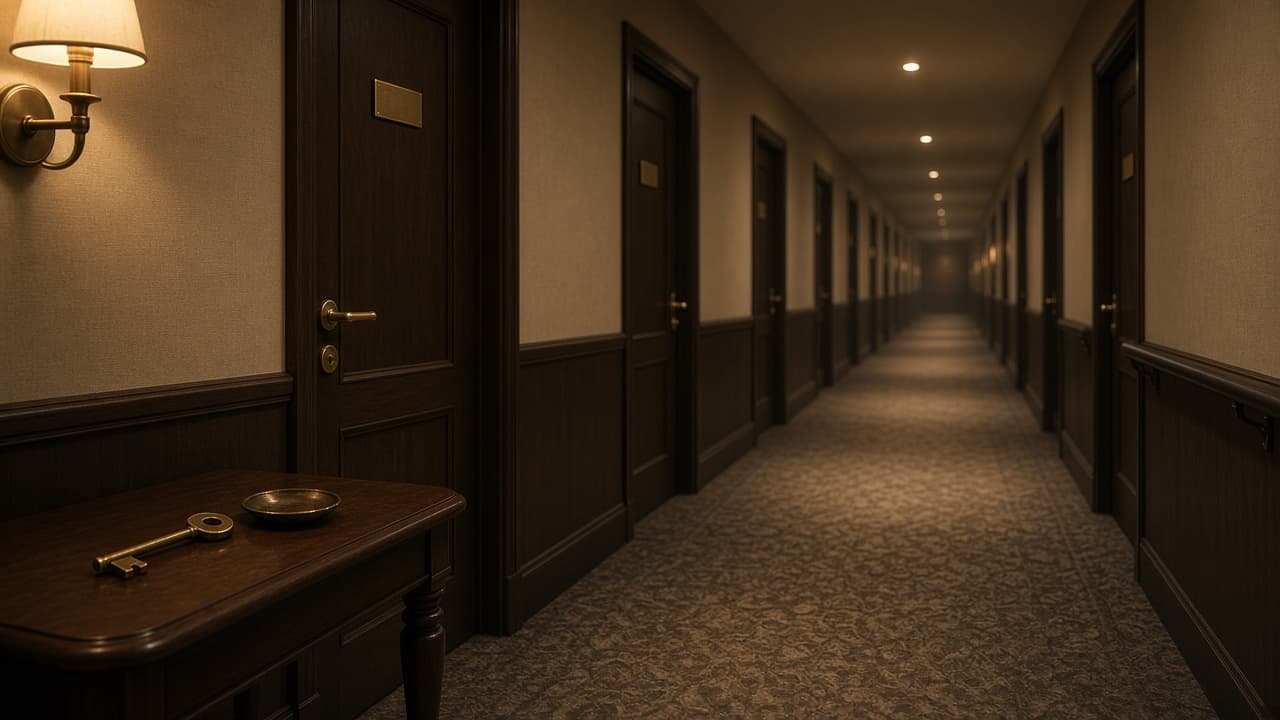
Identical doors, bad signage, a lift that skips your floor, a fire door that opens onto another fire door. You know there is a room. You cannot assemble the path.
This is one of the classic anxiety architectures, and hotels specialise in it because they are designed as repeating units. The dream uses that design to talk about anonymity and about systems. Hospitals, airports, large offices, and university campuses produce the same geometry.
It shows up during onboarding, travel, bureaucracy, and any week when you are a number in a building that does not care who you are as long as the booking is valid. If other guests were friendly, the system is impersonal but not hostile. If the corridor was empty at 3 a.m., you are more likely dealing with isolation inside a crowd.
Checking In and Checking Out
The desk is the ritual of being received. Dreamers remember the receptionist, the passport, the unexpected charge, the room upgrade, the room that is not ready.
Checking in tends to mark a threshold you are actually crossing, the first night in a new arrangement. Whether the staff were welcoming is a quick read of how received you feel. Checking out, especially if you could not find your bags or had not packed, tracks endings you have not completed. You are trying to leave a stay while still scattered through the drawers.
A stay that will not end, you check out and find yourself in another corridor of the same hotel, is one of the clearer pictures of a temporary life that has become the life. Short-term work. A relationship that was supposed to be a phase. Living out of a suitcase in a city you keep calling temporary.
Have a Hotel dream of your own?
Write what you remember and get a clear reading.
A Hotel That Is Also Home
The room has your photographs. Your childhood bed is in a suite. You know the breakfast staff. The category has collapsed: this is a house wearing a hotel's rules, or a hotel that has quietly become where you live.
People who grew up in institutions, boarding schools, military housing, or frequent relocation get this hybrid often. So do people currently living in extended-stay places, caring for someone in a hospital-adjacent hotel, or splitting weeks between cities. The dream is less a symbol than a documentary with dream physics.
If the hybrid felt comforting, part of you has made a nest in transience and does not want to be rushed into a more permanent story. If it felt wrong, you wanted a front door that was only yours, the dream is naming a hunger for a house that is not issued by a desk.
Other Guests, Parties, and Thin Walls
Hotels are full of strangers performing privacy next to yours. A party on the same floor, sex through the wall, a wedding downstairs, someone crying in the next room: the dream is about adjacency without intimacy.
This clusters around shared housing, open-plan work, family visits, and any living situation where you can hear other people's lives and they can hear yours. Thin walls are a boundary image. You are not as separate as the room number promised.
If you joined the other guests, you wanted in on a social world that is happening beside your official stay. If you called the desk to complain, you wanted the institution to enforce a quiet it does not actually provide.
The Room Has Changed Overnight
You go out and come back to a different interior. The view has moved. Your things have been packed, or replaced, or laid out as if by a stranger who almost understands you.
Hotels legally can enter your room. That fact is the metaphor. Something has access to your private space without living there, a parent with a spare key, an employer with monitoring, a partner who rearranges, an illness that reorders the day while you are out trying to be a person. The maid in the dream is not always a maid.
Whether you were angry or merely tired when you saw the change is worth recovering. Anger means the boundary still matters to you. Tiredness often means you have been living with uninvited access long enough to treat it as weather.
Psychological Meaning
Michael Schredl's 2008 and later work on the continuity between waking life and dream content is the most straightforward tool for hotel dreams. Schredl has shown, repeatedly, that current concerns, daily activities, and living situations reappear in sleep with high fidelity. If you are actually in hotels, travelling, or between homes, start with that before you reach for a symbol. The dreaming brain is a good journalist of where you put your head down.
When the hotel is not literal, Ernest Hartmann's idea of contextualizing, dreams weaving a present feeling into a broader picture, still helps. Temporary shelter is an excellent picture for identities and arrangements that work and are not yet claimed. A corridor of identical doors is an excellent picture for being interchangeable.
Jung wrote about the house as a map of the psyche; a hotel is what you get when that map is rented. You can inhabit a floor without owning the building. You can lose the key to a self you were only issued for the week.
Read the dream as a report on belonging versus function. A good night's sleep in a plain room can be a healthier image than a suite you could not leave.
When You Keep Sleeping in the Same Hotel
Recurring hotel dreams usually mean the temporary arrangement is still the arrangement. Either you have not moved yet, or you have moved and your sense of home has not caught up.
One useful question: in daylight, where would you unpack a box and not feel you had to keep the lid handy? If you cannot name that place, the dream is not being mysterious. It is describing the suitcase.
If the hotel is a nightmare, you cannot get out, staff will not see you, the building has no exterior, treat it as an anxiety architecture closer to prisons than to travel. Ask what institution currently issues your days, and whether the stay still has a checkout date you believe in.