Quick Answer
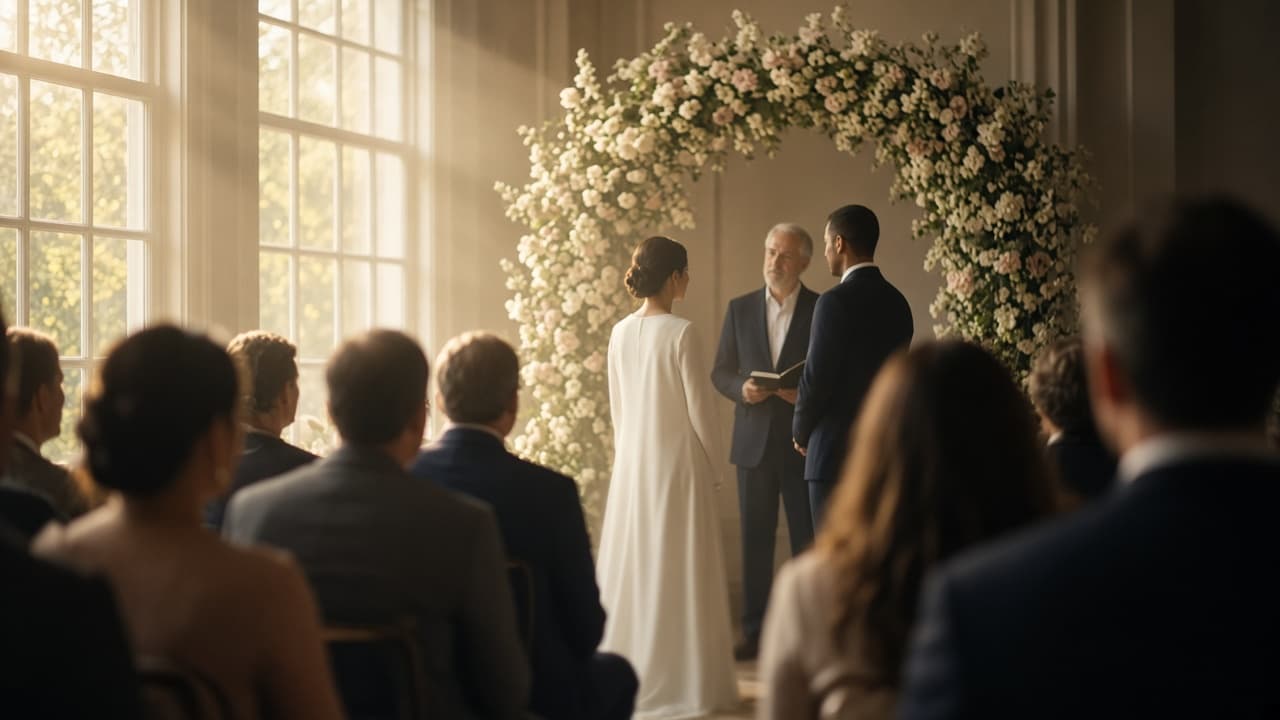
To dream of getting married is usually to dream about a binding choice, not a romance. The ceremony supplies what your mind needs to stage the feeling: a public yes, witnesses, paperwork, and a version of you that exists on the other side of it. That is why these dreams arrive during house purchases, immigration decisions, new jobs, and pregnancies as readily as during engagements. The detail that decides the reading is your own position in the scene, whether you chose the person, recognised them, or simply found yourself walking down an aisle already in motion.
Marrying Someone You Have Never Met
An unknown partner is one of the most reported versions, and dreamers often cannot describe the face afterwards at all.
That blankness is doing the work. A faceless spouse tends to represent an outcome you have already agreed to without being able to picture it, a relocation to a city you have not visited, a role whose day-to-day nobody explained, a treatment plan you consented to on trust. The dream is not asking who the person is. It is asking how you feel about saying yes to something unseen.
Your emotional temperature at the altar is the signal. Calm curiosity generally accompanies a decision you are at peace with. A creeping sense of wrongness more often turns up when you have agreed to something on someone else's timetable.
Marrying the Partner You Already Have
Dreaming of marrying your current partner when you are already together, or already married to them, sounds redundant and is not.
These dreams tend to cluster around a change of stage rather than a proposal: moving in, merging finances, meeting the parents properly, deciding about children, or coming through a bad stretch and quietly re-choosing each other. Long-married dreamers often report the second-wedding dream after a period of repair.
Look at who attended. Partners marrying with nobody present frequently maps onto a commitment you have deepened privately and not announced. A crowded ceremony leans toward pressure from family or a social expectation that has become part of the decision.
Marrying an Ex
This one alarms people disproportionately, particularly dreamers who are happily settled with someone else.
It is very rarely a wish. Marrying a former partner more often revives the self you were in that relationship, younger, more anxious, more deferential, more free, depending on the history. When your present situation rhymes emotionally with that period, the old partner is the nearest available image for the feeling. Dreams of this shape also show up when you are being asked to commit again and the only template you have is the previous attempt.
If the ex in the dream behaved as they actually did, the dream is probably processing unfinished business; our page on ex-boyfriend dreams deals with that pattern in more depth. If they behaved nothing like themselves, they are standing in for someone or something else entirely.
Marrying a Friend or Someone You Are Not Attracted To
Dreamers find this version embarrassing and usually worry it reveals a secret desire. Attraction is often entirely absent from the dream, which is the clue.
Marrying a friend in a dream tends to be about the quality that friend represents, reliability, bluntness, ambition, ease, becoming something you are binding yourself to. A dreamer who marries their most organised colleague after taking on a chaotic project is generally not having a romantic dream.
The same reading applies when the partner is someone you actively dislike. That variant frequently accompanies a commitment you have made to a situation you did not want, where the thing being joined to you is a constraint rather than a person.
Waking Up Already Married
Some marriage dreams skip the ceremony. You are simply married, mid-life, with a ring and a shared house and no memory of choosing any of it.
These dreams tend to arrive when a commitment has become a fact before you registered consenting to it, a career that hardened into an identity, a caring role you absorbed year by year, a city you meant to leave in 2019. There is usually no dread in the scene, just disorientation, which is an accurate report of how drift feels.
Have a Getting Married dream of your own?
Write what you remember and get a clear reading.
The Vows You Could Not Get Out
A distinct and telling variant: everything proceeds normally until you are asked to speak, and the words will not come, or come out as the wrong sentence.
Speech failure at the altar concentrates the dream on the declaration itself. It shows up when you are willing to do the thing but not to say it publicly, a relationship you have not told your family about, a decision you are enacting while still officially undecided, a belief you hold and would not defend in a meeting. Recovering what you did manage to say, if anything, is often the most useful part of the dream.
Getting Married in the Wrong Clothes or the Wrong Place
Wardrobe and venue failures put the emphasis on fitness for the role rather than on the commitment.
Dreamers describe arriving in work clothes, in something borrowed, in something dirty, or finding the ceremony in a supermarket, a school hall, a stranger's garden. The common waking match is a real commitment being made in circumstances that feel unequal to it: getting engaged during a financial crisis, starting a serious job while ill, having a baby in a flat that is too small. The vow is fine. The frame around it is not.
Wanting to Run Before the Ceremony
Dreams that end with you outside a side door, in a car park, or halfway down a road in formal clothes are worth taking seriously, but not literally about the person waiting inside.
Flight dreams of this kind attach to irreversibility. Dreamers often report that the reason for running was unclear even inside the dream, which fits: what they were escaping was the cost of not being able to change their mind. If you are engaged and this dream is frightening you, the honest reading is that you have noticed the stakes, not that you have discovered a secret objection.
Where the dream repeats and the dread is specific, a particular person, a particular condition of the arrangement, that is worth a waking conversation rather than a symbol lookup.
Psychological Meaning
Marriage is unusually well suited to dreaming because it compresses several things your mind tracks anyway: social evaluation, identity change, a decision with a witness, and a future you cannot preview.
G. William Domhoff's continuity hypothesis is the frame that fits most of these dreams. Dream content largely carries on with waking concerns, using whatever imagery is most available, and a wedding is one of the most vivid scripts almost everyone has watched repeatedly. Hall and Van de Castle's 1966 content-analysis system made a related point structurally: dream scenes reuse familiar social settings and a small cast of roles, which is why the same altar appears in dreams about jobs, houses and health.
Erik Erikson's account of intimacy and isolation in early adulthood remains useful for the specific fear these dreams carry, whether you can bind yourself to someone without losing the parts of you that were only yours. That fear does not resolve at a particular age, and it reactivates at each new merger.
Practically: name the decision in your waking life that currently has no clean exit. Then check whether your dream self was choosing, consenting, or being carried along, because those are three different relationships to the same commitment.
Cultural and Family Meaning
Marriage dreams are strongly shaped by what marriage means where you grew up, which is why generic readings so often miss.
In traditions where marriage joins families rather than individuals, much of South Asia, parts of the Middle East, many diaspora communities, dream ceremonies frequently foreground relatives, negotiations, and approval, and the anxiety attaches to obligation rather than to the partner. Dreamers from those backgrounds often describe a wedding they are attending as the main character rather than hosting.
There are also older folk readings that deserve a calm correction. Several European and Chinese traditions treat dreaming of your own wedding as an inversion omen tied to funerals or illness. Nothing supports it. The association survives because both events gather everyone you know into one room in formal clothes, and dreams borrow the staging freely. Rituals of union also carry genuine spiritual weight in many traditions, the seven steps of the Hindu saptapadi, the covenant language of Christian vows, and if the dream felt sacred rather than stressful, that weight is likely part of why.
If You Keep Dreaming About Your Own Wedding
Repeated marriage dreams usually mean a commitment is still open rather than going wrong. They tend to cluster in the months around a decision and thin out once the thing is either done or abandoned, and the dreams often stop before you consciously feel resolved.
Track one thing across repeats: whether you get further into the ceremony each time. Dreamers who move from arriving late, to reaching the aisle, to actually speaking are generally describing progress they have not credited themselves with. Dreamers whose wedding gets interrupted at the same point every time usually know exactly which conversation they have been avoiding, and it is almost never with the person they were marrying in the dream. For how these scenes look from the guest's seat, see someone getting married.