Quick Answer
Fire in dreams is a converter. It turns fuel into heat, structure into ash, a night into a gathering. The meaning lives in the difference between a hearth and a house going up, between what you meant to burn and what you still needed intact. Ask what was fuel, what was home, whether you lit it, and whether it would go out. Those four answers usually locate the waking process: anger, desire, a project with real heat, or a life arrangement that cannot survive the temperature it is already at.
A Cozy Hearth or Campfire
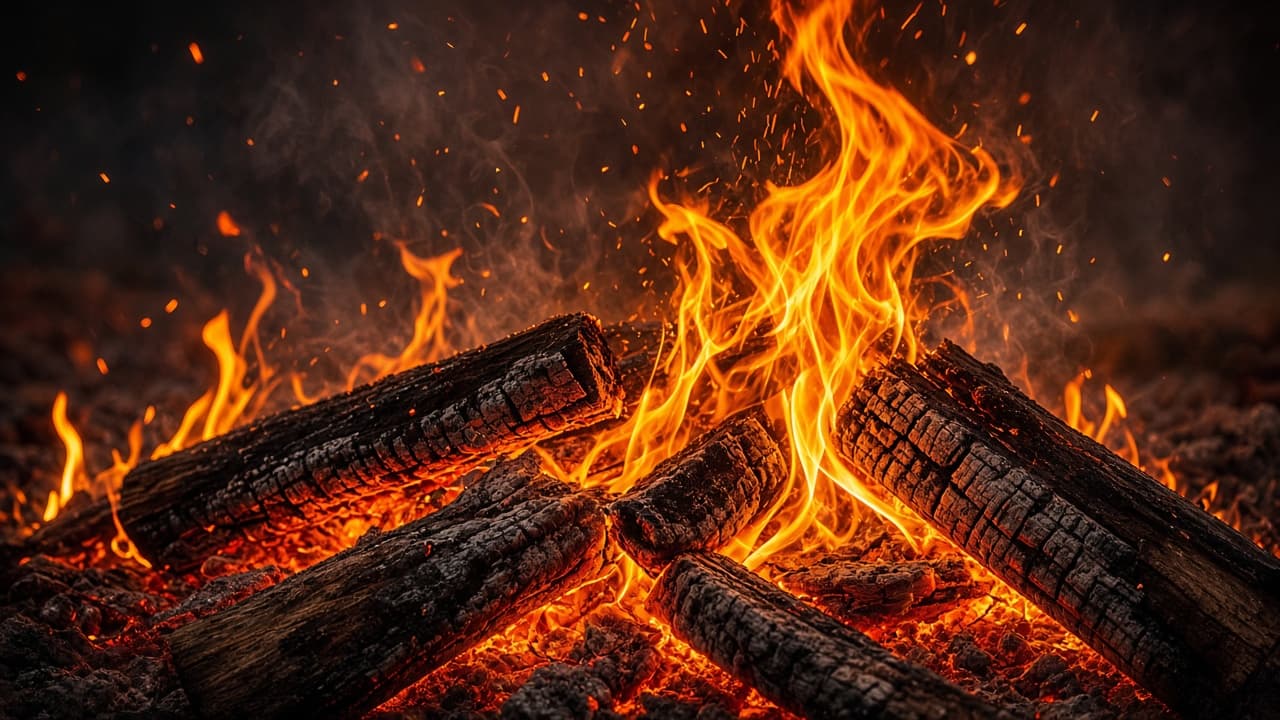
Contained, useful, social. Faces in the glow. Wood you can still add or let burn down.
Hearth dreams often track warmth you actually have, a friendship that is working, a team, a wintering that is chosen rather than imposed. Campfires add the temporary: a gathering that will not last forever and does not need to. Dreamers describe talking, feeding the fire, watching sparks, and waking with less loneliness than they went to bed with.
If nobody else was there, the fire is more about your own focus, a craft, a grief you are sitting with, a night of thinking that had a centre. Smoke in the eyes is worth noting; even a good fire can sting if you sit too close.
Starting a Fire Deliberately
Matches, a lighter, kindling arranged on purpose. You are the cause.
This scene accompanies initiating heat: a resignation, a confrontation, a creative risk, a sexual or political move you have stopped postponing. The dream is often less guilty than the waking mind expects. Dreamers report a grim practicality, this needed to happen.
Control afterwards is the fork. A fire that stays in the ring maps onto a change with a container. A fire that jumps to the grass maps onto a move whose consequences you cannot yet bound. Neither is a moral verdict. Both are planning information.
A House or Building on Fire
The dwelling is the fuel. That is a different dream from a campfire, even if the element is the same.
Houses in dreams tend to be the life-structure, family, the self as lived in rooms. Fire there usually means the private world is under a conversion it did not schedule. Marital crisis, a parent’s decline that rearranges every room, a job that has colonised the home, an argument that will not stay in one evening.
Which floor and whether you got living beings out are the details. Kitchen fires lean toward the domestic economy (food, money, daily care). Bedroom fires lean toward intimacy and rest. Saving a person or an animal is often the dream’s report of what you are actually protecting. Watching from the street is a different posture: the conversion is happening and you are already outside.
Wildfire Spreading Rapidly
No single building. Landscape going. Wind as an accomplice.
Wildfire is scale and contagion. It shows up when a mood or a conflict has left the original plot, a rumour, a market, a family faction, a political climate, burnout that jumped from one project to the rest of the week. You cannot point at one log.
Direction of the wind relative to you matters. Fire coming toward a place you live is threat to the base. Fire you are driving away from is evacuation as strategy. Fire on a ridge you are watching can be a problem that is still geographically someone else’s, for now. Storms and wind in the same dream usually mark conditions you do not control.
Trying to Extinguish Flames
The plot is the effort. Buckets, extinguishers, dirt on a campfire, a hose that will not reach.
These dreams itemise a waking strategy for reducing heat: peacemaking, overwork to "get ahead of it," substances, silence, humour. Whether the fire responded is the reading. Flames that die under ordinary effort often mean the situation is still within your current tools. Flames that ignore water usually mean the tool is wrong, you are applying the soothing strategy to a structural fire.
If other people stood and watched while you fought it, recover who they are. That distribution of labour is frequently the most accurate part of the dream.
Have a Fire dream of your own?
Write what you remember and get a clear reading.
Walking Through Fire Unharmed
Heat without injury. A corridor of flame, a burning room you cross, clothes that should ignite and do not.
This is a competence-in-crisis image, and it can be true or inflated. Dreamers report it after a week they survived that should have undoing them, a medical wait, a public failure, a family explosion. The body in the dream is reporting a fact: you went through it.
The unharmed part is the part to test in daylight. Some people walk through fire at work and then cannot sleep. If you were unharmed in the dream and wrecked on waking, the dream may be the persona, not the cost. If you were unharmed and felt clean, you may actually have a method that works in heat.
Fire That Will Not Go Out
You have already done the reasonable things. It is still burning.
Inextinguishable fire tracks processes that are not finished because they are not finishable by the current means: an appetite, a grudge, a creative obsession, an inflammatory health situation, a political anger. Ernest Hartmann would call this a contextualising image for "this will not cool."
What you tried is worth listing. Water, smothering, walking away, calling help. Each maps onto a waking tactic. The dream is often asking you to stop repeating the failed tactic, not to become a better firefighter of the same fire.
Candles, Ritual Flames, Fire in Someone's Eyes
Small fire, used as sign. Birthday, altar, a gaze.
Candles often mark attention with a wick, grief, hope, a person you are keeping a light for. Ritual flame leans toward meaning-making: you are trying to make a transition visible. Fire in someone’s eyes is about intensity directed at you or from you, desire, fury, charisma you do not trust.
These scenes are easy to over-spiritualise. They are still about heat in a relationship or a practice. If the candle would not stay lit, the practice or the attention is currently under-resourced. If the eyes were the only fire in the room, the heat is interpersonal, not environmental.
Psychological Meaning
Jung treated fire as a classic transformer, the alchemical heat that changes a substance rather than merely destroying it. That is the right instinct when something in the dream is being converted: a job into a former job, a marriage into a negotiation, a forest into a field. It is the wrong instinct when the dream is simply "I left the stove on," which is continuity with a household worry.
G. William Domhoff’s continuity hypothesis (2018) keeps fire dreams attached to waking heat sources: conflict, sexual intensity, creative deadline, actual news of wildfires if you live with that threat. People in arguments dream of kitchens going up more often than people in quiet weeks.
Antti Revonsuo’s 2000 threat-simulation theory is at home with house fires and wildfires. These are costly ancestral and modern dangers; the dreaming brain rehearses evacuation, protection of dependents, and the failure of containers. Michael Schredl’s work on nightmare frequency then explains why they cluster in stressful months rather than arriving as fate.
Hobson’s activation-synthesis reminder: REM is a hot, activated brain. Fire is an available story for arousal. That does not make the house meaningless. It explains why this element, rather than paperwork, gets the part.
Fuel Versus Home
The question that finishes most fire dreams is simple and not mystical: what in your life is currently serving as fuel, and what is currently serving as a dwelling? Sometimes they are the same object, which is why the dream is frightening.
If the fire was a hearth, protect the conditions that keep it useful, people, time, a craft. If it was a structure you still live in, the work is not "interpret fire." The work is to name which room cannot stay at this temperature, and whether you are the one holding the match.