Quick Answer
Dogs attacking you is dogs in their threat mode with numbers. A pack, a pet turned, more than one animal, more than one angle. It is not the same as a single dog bite, which is close-range injury from one mouth. Here the horror is social: loyalty that hunts in a group, or a neighbourhood of mouths. Scene decides whether the pack is strangers, colleagues-as-dogs, or the animal that sleeps on your bed.
Not a forecast of a mauling. A map of a group that was supposed to be safe.
A Pack on a Street
Several dogs, mixed breeds, a road that should be ordinary. They share a direction. You are the direction.
Pack-as-street is public belonging gone hostile. A workplace cohort, a friend group, a comment section with teeth. No one animal has to be a villain. The count does the violence. If they herded you rather than biting in the story, the waking analogue is often social pressure: you are being moved. If they blocked a door you needed, the group controls access to shelter.
Neighbours watching from windows and doing nothing is a specific extra: the wider world treats the pack as weather. You are on your own with the mouths.
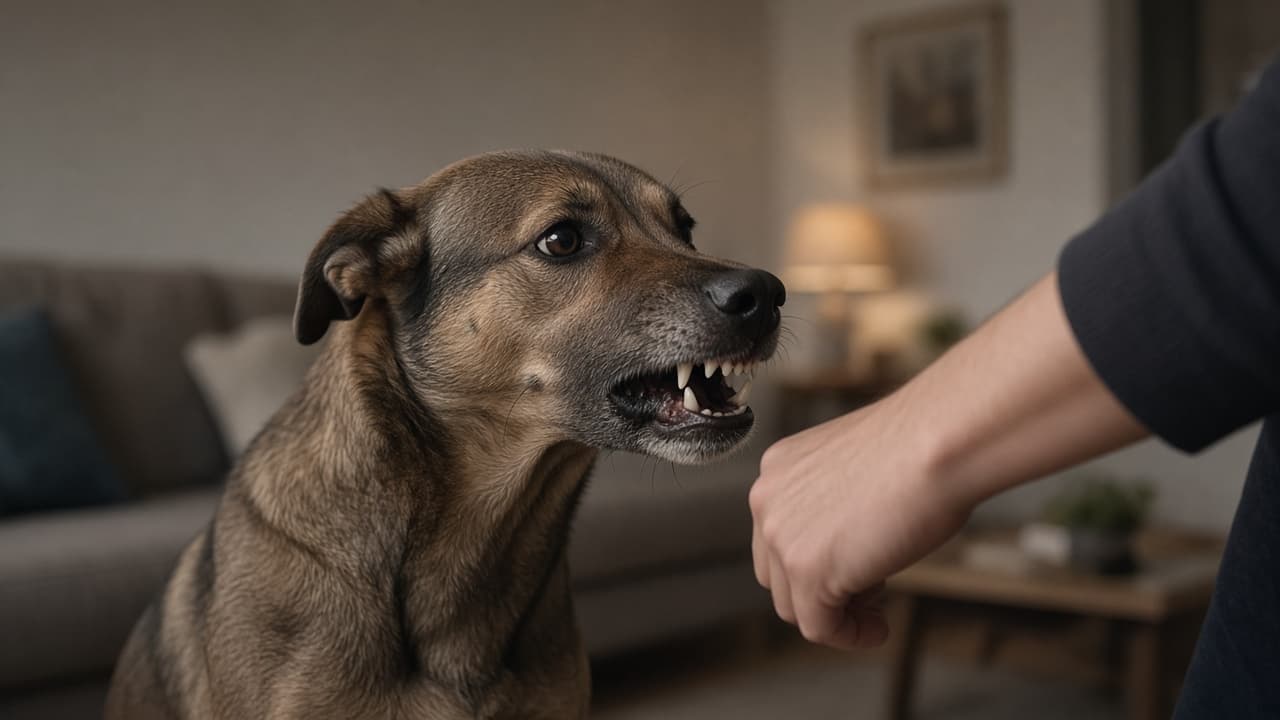
Your Pet Turned
The dog with a name. The lead. The bowl in the kitchen. Then the change.
This is the domestic contract tearing. A person who was supposed to be safe. A part of you that was supposed to be loyal (the pleaser, the guardian, the family dog) turning on the rest of you. Keep the violence non-spectacular. The shock is recognition, not cinema.
If other dogs joined your pet, your private bond has been recruited by a group, a partner taking the family's side, a child taking a peer group's side, you taking a team's side against yourself. If you still tried to use the old command ("sit," a name), you are using a language the contract no longer speaks.
Multiple Directions
Front and behind. An alley. You cannot face them all. This is not a duel.
Surrounded is the meaning. Threats that are individually manageable and collectively not: tasks, relatives, symptoms, messages. Being chased by one pursuer still has a vector. This does not. Spinning is a reasonable dream behaviour and a miserable waking one.
If one dog was the leader, the group still has a face you could name. If they were equal, you are dealing with a culture. Cultures do not sit when called.
Dogs You Know From the Neighbourhood
Specific animals: the German shepherd two doors down, the little one that already scares you on walks.
Continuity first. If those dogs exist, you may be dreaming last week's pavement. After you subtract that, known neighbourhood dogs are a map of known local threats, people whose moods you already track, whose yards you already avoid. Attack from them is those moods losing the leash they usually have.
A friendly known dog in the attacking group is a betrayal with a postcode. You thought that one was yours.
Have a Dogs Attacking You dream of your own?
Write what you remember and get a clear reading.
Cannot Get Inside
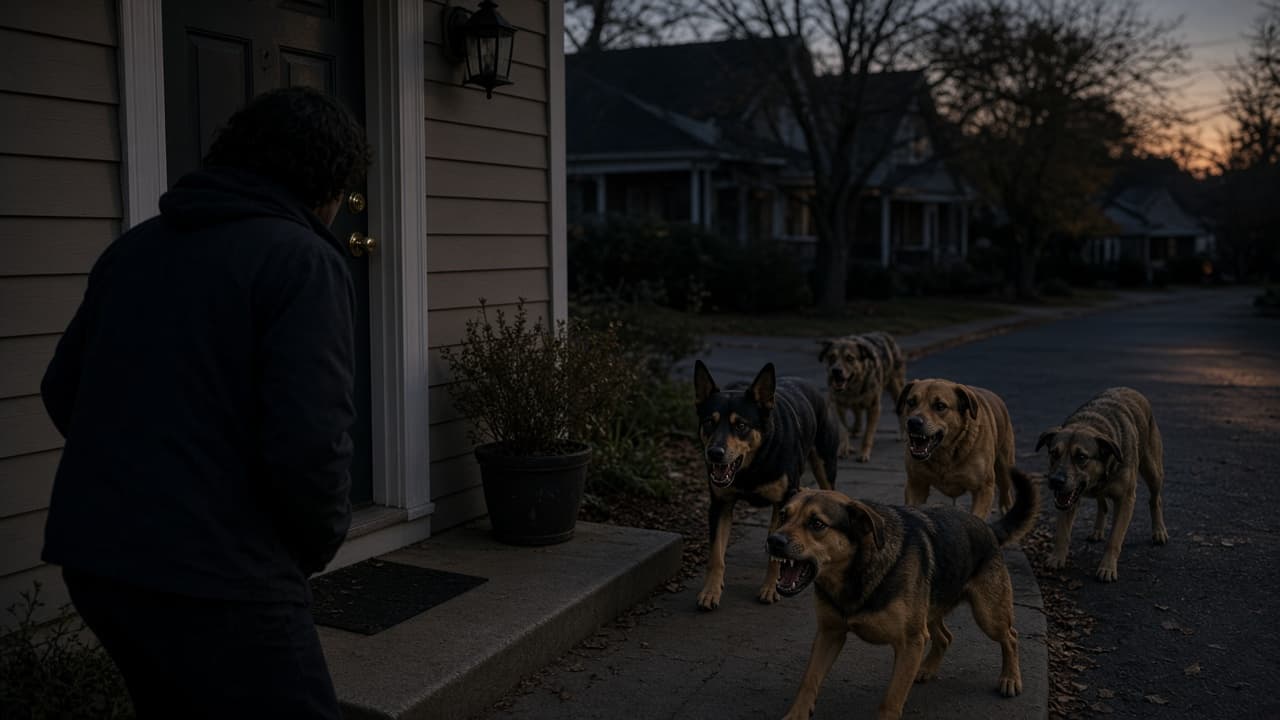
A porch, a key, a door that will not open while the pack closes. Shelter exists and will not admit you.
Access is the subject. Home, a job, a friend who "is always there", the inside is not currently for you. If someone inside would not open the door, a person is choosing the pack over you, or choosing their own fear. If the door is merely jammed, the failure is mechanical: a system that should work (HR, a lock, a parent) is failing without a villain.
Getting in and hearing dogs still at the glass is aftermath: you have shelter and the social threat has not left the property.
Fighting Them Off, a Stick, a Voice That Works
You find a tool. A shout lands. A gap opens.
Agency in a pack dream is rehearsal of a boundary that needs volume. Dogs (unlike bears) are supposed to be influenceable by human social signals. When a shout works, you still believe the group can hear a no. When it does not, the group has left the domestic deal and you are in wolf territory wearing collars.
Protecting another person while you fight is care. Leaving someone to the pack is a guilt the dream is willing to stage. If that guilt matches a waking calculation, do not decorate it. Change the calculation if you can.
After the Attack: Running On, Waking, the Dogs Still Circling
The bite-story ends (keep it non-graphic) and the pack remains in the street. Or you wake and the feeling of being surrounded stays.
Aftermath is about whether the group threat has a next scene. Circling is unfinished social business. Silence after is a nervous system dumping adrenaline. Seeking a vet or a police officer in the dream assigns the problem to official handlers, sometimes a wish for HR, a mediator, a friend with authority.
If you then comforted a dog that had been attacking, you are already back in the old contract. That turn is important. Some of us would rather soothe the pack than admit the deal broke.
Psychological Meaning
Antonio Zadra and Don Donderi's 2000 paper on nightmares and bad dreams distinguished distressing dreams that wake you from those that do not, and linked frequency to waking distress. Pack-attack dreams are high-distress social imagery. If they wake you often, the daytime group situation is probably not subtle.
Hall and Van de Castle's aggression coding already noted that animals carry social themes in adult dreams. Dogs are the animal we invented for loyalty. An attacking pack is that invention inverted. People with dog fear, bite history, or reactive pets need the continuity filter first. Everyone else can read teams, families, and neighbourhoods.
Cats almost never hunt you as a pack in dreams. When dogs do, the species is doing its historical job: group hunter that was supposed to hunt for you.
When the Pack Will Not Stop
A repeating dog-attack usually means a group bind is still live. Name the pack in daylight: the team, the siblings, the street, the group chat. Then pick one mouth to deal with, one conversation, one mute, one walk that takes a different road, rather than facing every angle at once.
If a real dog is unsafe, that is behaviour and fencing, not a dictionary. If the dogs are people, you still do not have to win a street fight in the night. You have to stop treating loyalty as a promise the group cannot break. They can. The dream is already telling you they did, or that you fear they will, which is close enough to use.