Quick Answer
Cake is celebration in edible form: more ritual than nutrition, timed to a person or an event, sweet on purpose. In a dream it usually tracks acknowledgement, reward, excess, and the moment of cutting, when the interior has to match the icing. A [birthday](/dreams/parties) cake, a [wedding](/dreams/weddings) cake, a cake nobody will eat, and a cake that is wrong inside are four different social facts. Start with whose name was on it.
Birthday, Candles, the Official Self
Your age in icing, a room full of faces, the small public duty of making a wish. Birthday-cake dreams are about being counted as a person in time.
If the cake was for you and the room was kind, you may be hungry for acknowledgement that waking life has been thin on. If the cake was for you and you wanted to hide, visibility is the problem, not sugar. A wrong age, child again, decades skipped, candles that will not tell the truth, often marks a life stage you have not inhabited, or one you are being forced to inhabit on someone else's calendar.
Blowing the candles out is a brief authority: you get to end a small fire in public. Failure to blow them out is a comic humiliation that maps onto not being able to complete a simple ritual of self.
Too Much Sweetness
Icing that will not end, slice after slice, a mouth that is already tired and still eating. Excess of the good thing.
This can be permission after a long diet of being good, work, virtue, a body project. It can be a binge image, and if you have a real eating struggle, continuity and kindness first; the dream is not a moral. It can be a picture of a life that is all occasion and no ordinary meal: praise, treats, peaks, no protein.
Nausea in the dream is a useful vote. The psyche can love sweetness and still know when it has become the only flavour. See also eating dreams where the table never becomes dinner.
The Cake That Is Wrong Inside
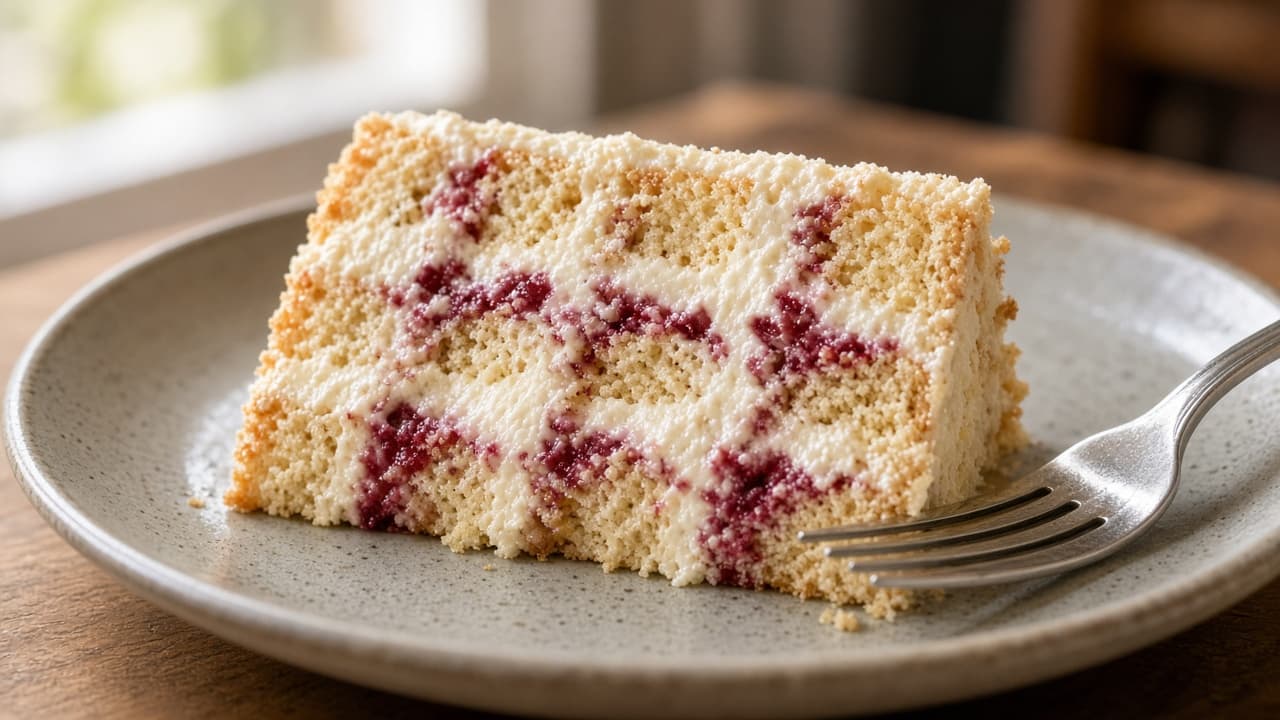
Perfect frosting, and then mould, raw batter, a hollow, a object that does not belong, raw meat, sand. The cut is the reveal.
This is one of the cleaner pictures of a celebration that cannot survive inspection. A relationship that photographs well. A family party with a private weather. A job whose culture is cake and whose insides are something else. You were invited to taste. You received information.
If other people kept eating and only you could see the interior, you are the designated knower, which is a tiring role. If everyone saw and laughed, the wrongness may be a shared joke, a ritual that everyone knows is hollow and performs anyway.
Baking for Someone Else
Mixing, waiting, a collapse in the oven, a delivery, a cake as gift. Labour toward another person's occasion.
Love is the generous reading and it is sometimes correct. So is unpaid event-production: you are the one who makes birthdays exist in a family that would not otherwise have them. If they ate with pleasure, the labour landed. If they did not look, you are producing peaks for people who do not have a mouth for them.
A cake that collapsed can be a fear of not being enough for someone's milestone. It can also be an honest report that the occasion cannot be held up by sugar and your effort alone.
Have a Cake dream of your own?
Write what you remember and get a clear reading.
Not Being Offered a Slice
There is cake. There is a knife. There is no plate for you. Exclusion at the moment of serving is a sharp little social wound.
It maps onto being adjacent to other people's milestones, weddings you attend as furniture, promotions that happen to the next desk, family events in which you are useful and not feted. You can smell the sweetness. You are not in the count.
Taking a slice without asking is a different dream: hunger that has stopped waiting for permission. Guilt afterwards tells you about the household rules you still carry. Lack of guilt tells you those rules have already been rewritten.
Wedding Cake and Shared Cutting
Two hands on a knife, a public first bite, icing on a face that may or may not be a joke. Partnership as spectacle and as food.
These dreams appear around actual weddings, around the question of marrying, and around any merger that will be photographed, businesses, blended families, a public coupling. If the cutting was kind, you may be ready to be seen as a we. If the knife slipped, or one person ate and the other watched, the merger has an appetite problem.
A wedding cake you were expected to pay for, carry, or repair is labour again: you are holding up an occasion that is supposed to be joy.
Leftovers, Stale Cake, Cake in the Bin
The occasion is over and the sugar remains. Fridge shelves, a dry slice at 11 p.m., throwing it away, feeding it to birds.
Aftermath of celebration is an underused image. Peaks produce leftovers that are not as good as the moment and still demand a decision. Keep the sweetness going (and get sick of it). Throw it away (and feel wasteful). Freeze it (postpone the ending).
Finding ancient cake in a house you thought you had cleared is a leftover occasion in the psyche, a birthday that was never had, a congratulations that arrived late, a sweetness you did not get to eat when it was fresh.
Psychological Meaning
Calvin S. Hall's 1953 The Meaning of Dreams, and the later Hall and Van de Castle 1966 coding, treated food and social occasions as straightforward continuity plus wish. Cake is a high-social, high-reward food. People dream it around parties, and around the wish to be celebrated. That boring reading is often the right one.
Deirdre Barrett's 2001 The Committee of Sleep would add that dreaming can problem-solve in pictures. "Is this celebration real?" is a problem. Cutting the cake and finding the interior is a method. "Am I allowed sweetness?" is a problem. Eating past fullness, or being refused a slice, is a method.
Freud's 1905 Three Essays on the Theory of Sexuality is easy to drag in whenever mouths and pleasure appear; use a light touch. Appetite for sweetness can be appetite for sweetness. It can also be a stand-in for other hungers if the rest of the dream is erotic, infantile, or shame-soaked. Let the scene vote rather than the theory.
Read the dream as a report on occasion and substance. Who was celebrated, whether the interior matched, and what you did with leftover sugar.
When Cake Keeps Being Served
Recurring cake dreams often mean the question of acknowledgement is still open, you are not being celebrated, you are over-celebrating to avoid a plainer meal, or you keep cutting into events that look right and feel wrong.
If you are actually in a season of birthdays and weddings, let continuity have the first week. If you are not, ask who in your life is hungry for a ritual, including you. One real, small, well-timed acknowledgement in daylight (a note, a slice, a name said in a room) changes these dreams more than a larger performance does.
If cake dreams sit inside a painful eating pattern, skip the symbol and use the support you would use by day. A dream cannot be your dietitian, and it should not be your accuser.