Quick Answer
Dreaming of taking a shower is rarely about hygiene. It is a dream about wanting something off you: guilt, someone's touch, an association with a place or a job, the residue of a period you would rather rinse away entirely. Three details do most of the work. Whether the water ran clean, whether you had privacy, and whether you actually felt clean at the end. A satisfying shower and a shower that leaves you still dirty are almost opposite dreams, even though the scene looks the same.
A Shower That Feels Clean and Good
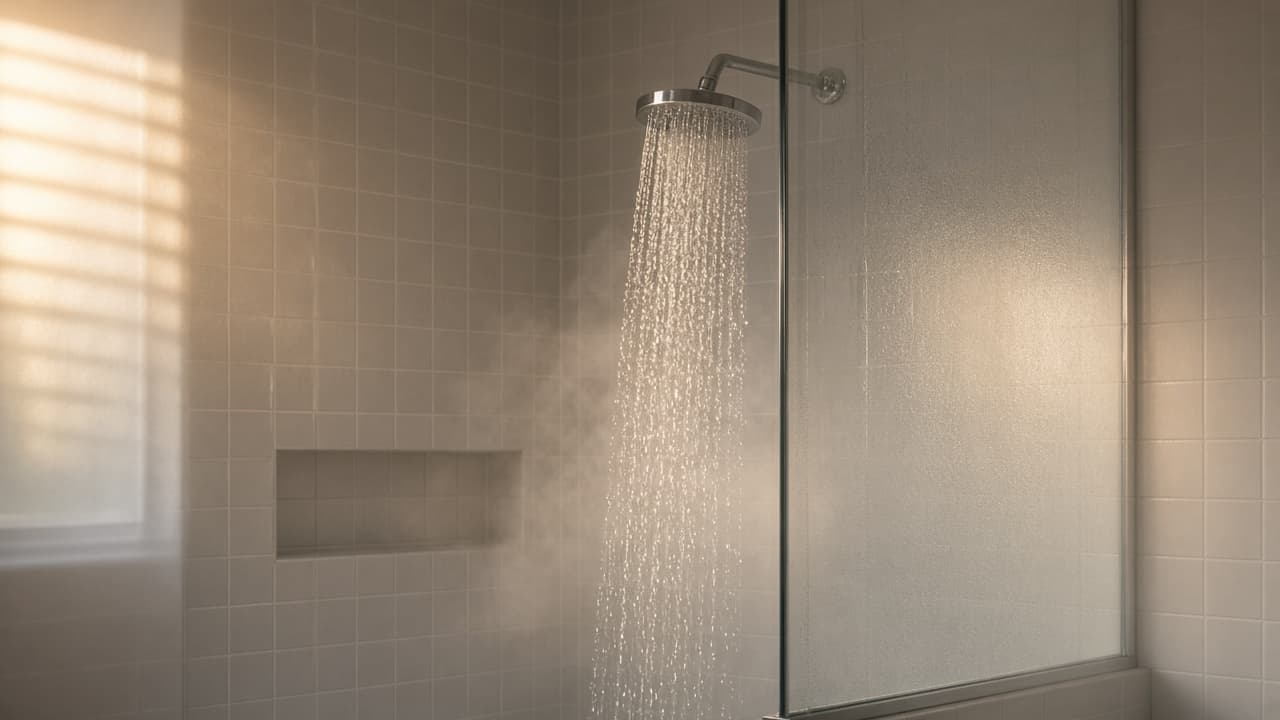
The pleasant version, and worth taking seriously rather than skipping past. Warm water, steam, no interruption, and a distinct sense of relief.
These dreams tend to arrive at the end of things: after an exam period, after a court case, after a course of treatment, after leaving a job that was making you ill. Dreamers frequently describe the feeling as being able to stop holding something. Where the dream is genuinely restorative, it usually marks completion rather than desire, your mind acknowledging that a difficult stretch is actually over.
No Water, or Water That Stops
A frustrating variant with a consistent meaning. You are in the shower, ready, and the water is a trickle, or dries up, or never arrives.
Dry showers tend to track relief that is unavailable. The holiday you cannot take, the apology you will never receive, the conversation the other person refuses to have, the closure that a death or an estrangement has made impossible. Dreamers often report standing there waiting, which is usually the accurate description: not despair, just an unresolved wait.
Showering in Public With No Privacy
Here the walls, door or curtain are missing. A shower in a corridor, a changing room with no cubicles, a bathroom whose door will not stay shut while people come and go.
Exposure replaces cleansing as the subject. These arrive during periods of visibility, a new workplace, a formal review, a breakup that everyone has an opinion about, a health matter that colleagues now know about. Recover how the other people behaved. Bystanders who barely notice generally point at a fear of judgement that outstrips the real audience, and dreamers usually find that reassuring once they see it. Being naked covers pure exposure dreams without the washing element.
Dirty, Brown or Foul Water
One of the more disturbing versions: the water itself is contaminated. It runs brown, smells, comes out thick, or carries something in it.
The reversal is the point, the thing meant to clean you is making you dirtier. It clusters around remedies that made a situation worse: a conversation intended to clear the air that started a bigger fight, advice you followed and now regret, a job you took to escape a worse one, a substance used to cope that became its own problem. Dreamers frequently report noticing partway through and being unable to stop, which usually matches the real sequence.
Washing and Still Not Feeling Clean
Distinct from dirty water, and arguably harder. The water is fine. You wash thoroughly. Nothing changes.
Failed cleansing tends to accompany guilt that has survived action. You apologised and the shame stayed. You repaid the money, ended the affair, told the truth, and the feeling did not lift. What the dream reports is the persistence of the emotion rather than the seriousness of the original act, which matters, because dreamers usually assume the dream is passing judgement on them. It is more often describing a stuck feeling that needs a different remedy than further scrubbing.
Cold or Scalding Water
Temperature gives the dream its emotional register. Freezing water tends to arrive with shock and a sense of punishment; scalding water with urgency and a kind of desperate thoroughness.
Cold-shower dreams often accompany situations where relief came with a sting, the honest feedback that helped, the breakup that was right and hurt, the ending you needed. Very hot water more frequently appears alongside disgust that has become self-directed, where dreamers describe wanting to burn something off rather than rinse it. If you noticed yourself turning the temperature up in the dream, that detail is worth sitting with.
Have a Taking A Shower dream of your own?
Write what you remember and get a clear reading.
Showering Fully Clothed
An oddly common variant. You are under the water in your clothes, sometimes without noticing until partway through.
Clothes in a shower prevent the water reaching you, which makes this a dream about incomplete surrender. It shows up when someone is attempting to deal with something while staying defended, going to therapy but staying general, having the conversation but withholding the actual grievance, resting without ever putting the phone down. Dreamers rarely report distress here, more often a mild absurdity, which fits a strategy that is not working and is not exactly failing either.
A Filthy or Unfamiliar Bathroom
Sometimes the shower is fine and the room around it is the problem: mould, broken tiles, a stranger's bathroom, a public facility you would not normally use.
Setting-driven versions point at circumstances rather than actions. They arrive when the means of taking care of yourself have themselves become degraded, trying to recover in a chaotic household, resting in a home that stresses you, using help you do not trust. The dream is not commenting on your cleanliness but on the conditions available for looking after yourself.
Being Interrupted or Watched
Someone walks in. Someone talks to you through the door. Someone is simply there, and the dream produces no explanation for it.
Interruption dreams tend to concern the impossibility of private repair. They are common among parents of young children, carers, and anyone whose recovery time is constantly claimed by other people. If the watcher was specific and unwelcome, the reading narrows considerably and is usually about that relationship rather than about privacy in general.
Psychological Meaning
The link between physical washing and moral feeling is one of the better-evidenced findings in social psychology, which makes these dreams unusually well grounded.
Chen-Bo Zhong and Katie Liljenquist's 2006 study in Science, often called the Macbeth effect, found that recalling an unethical act increased people's desire for cleansing products and their willingness to take an antiseptic wipe, and that physically cleaning afterwards reduced the moral discomfort. The mind treats guilt as something like contamination. Shower dreams draw on precisely that overlap, which is why a dream about water can carry such specific ethical weight.
G. William Domhoff's continuity hypothesis explains when they arrive. These dreams cluster after events people describe with the vocabulary of dirt: a betrayal, an association with someone who behaved badly, a compromise at work, unwanted contact, a period of illness. The image is not decorative; it is the closest available representation of how the situation feels.
There are two practical checks worth making before interpreting anything. A full bladder reliably produces water imagery in dreams, so a shower dream that ends in urgent waking may be plumbing rather than psychology. Real sounds, rain, a running tap, a partner in the shower, also get absorbed into dream content readily. And if you are physically unwell, sweating at night, or recovering from something that left you feeling unclean, the dream may simply be reporting the body.
Where the dream involves a specific person's touch that you want removed, treat it with more care than a symbol dictionary can offer. Repetitive washing dreams after unwanted sexual contact are common, are not a judgement on you, and respond to trauma-focused therapy rather than to interpretation.
Spiritual and Ritual Meaning
Almost every major religious tradition has a washing rite, which is why shower dreams so often feel more ceremonial than the setting warrants.
Islam has wudu before prayer and ghusl for full purification; Judaism has immersion in a mikveh; Hindu practice includes ritual bathing in sacred rivers, particularly the Ganges; Shinto has misogi, purification under cold water and waterfalls; and Christianity has baptism as its entry rite. The consistency across otherwise unrelated traditions says something about the strength of the underlying intuition: water changes status, not just surface.
Read from that angle, the question these dreams raise is what you are preparing for or being released from. Spiritually inclined readers usually focus on whether the water ran clean, since clear water tends to be read as genuine renewal and foul water as an incomplete or false one.
There is a caution worth keeping. The desire to be spiritually cleansed can become a way of avoiding practical repair, praying about a wrong instead of addressing it with the person affected. Most traditions actually insist on both, and dreams of washing that never work sometimes point exactly at that gap.
Biblical Meaning
Scripture uses washing constantly, and in more than one direction.
Psalm 51 gives the most direct language: a plea to be washed thoroughly and made clean, written as a response to real wrongdoing rather than to ritual dust. In 2 Kings 5, Naaman is told to wash seven times in the Jordan and is initially offended by how ordinary the instruction is, a detail that speaks to anyone whose dream involved refusing a simple remedy. Baptism runs through the Gospels as a washing that marks a change of life, not merely a cleaning.
The counter-example is just as useful. In Matthew 27:24 Pilate washes his hands in front of the crowd, which is the clearest scriptural example of cleansing used as evasion. If your dream involved washing conspicuously, or washing in front of other people, that is the passage worth holding next to it.
Together these give the biblical reading its shape: water can genuinely restore, and it can also be a performance. The dream usually knows which one you were doing.
When Shower Dreams Keep Coming Back
Recurring shower dreams generally mean something has not come off yet. The useful question is not what the water represents but what you have been trying to remove, and whether the method you are using can actually reach it.
Three things tend to move these dreams along. Name the specific thing, most dreamers can, once they stop looking for a general meaning. Notice whether the dream lets you finish, since dreams that keep interrupting the shower usually point at circumstances rather than guilt. And check whether you are attempting to rinse away something that actually requires a conversation, a repayment, or an apology, because these dreams are remarkably persistent when the real repair is being avoided.
If the washing dreams are frequent and you also find yourself washing compulsively while awake, or feeling contaminated in a way that will not respond to reasoning, that combination deserves a clinician rather than a dictionary entry. It is a recognised and very treatable pattern. Other action dreams tend to work the same way, what you are doing in the dream matters less than whether the dream lets you complete it.