Quick Answer
Stars are lights used for orientation, wonder, and, in modern life, celebrity metaphor. A dream of the night sky usually asks whether you have a heading, whether the scale of things has made you small, or whether something brief and bright is falling. They sit with the [moon](/dreams/moon) and the [sun](/dreams/sun) as sky-objects, but they behave differently: many, distant, used for navigation, easy to wish on, easy to confuse with fame. Recover whether you were reading the sky or merely lying under it.
A Clear Night Sky Full of Stars
Cold air, depth, more lights than you can count. You look up and the ground becomes secondary.
A full sky is a scale dream. It can be consolation: your problem is not the whole universe. It can be erasure: you do not matter enough to show. Which one it was is in the feeling, not in an encyclopedia.
If you were naming constellations, you currently have a cultural or personal map for the large things. If the stars were beautiful and you could not stop looking, wonder is doing work, possibly spiritual, possibly aesthetic, possibly a break from a cramped week. A sky over a desert or an ocean adds exposure: nothing between you and the reference points. A sky over a city with only a few stars is the light-pollution variant below.
Using Stars to Navigate
A heading. A bright one you chose as north. A journey that depends on not losing the pattern.
Navigation dreams are the most practical star scenes. You are trying to cross a stretch without a road, a career with no obvious next step, a grief with no protocol, a crossing that official maps do not cover. Stars here are reference points you chose, not ones an institution provided.
If the constellation held, you trust your own orientation system. If the stars moved or rearranged, the references are unstable: mentors changing advice, values in flux, a political or family north that will not stay put. Losing the North Star specifically is a loss-of-principle dream. Finding it again is a recovery of heading, even if the destination is still far.
Birds flying against the sky in the same dream can double the navigation theme: other creatures already know the route.
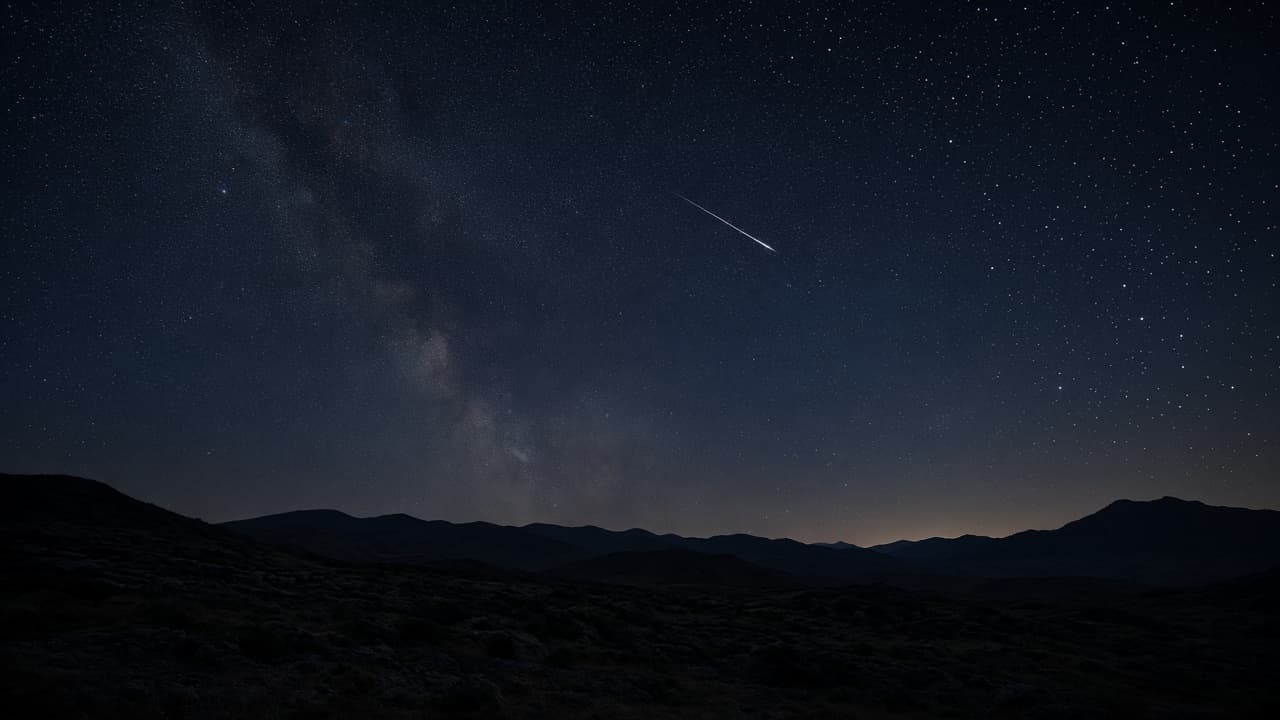
A Falling Star
A streak. A wish you did or did not make in time. Sometimes it hits the ground. Sometimes it is only a line.
Falling stars are brief high events. A hope, a person who flared, a project that had a moment, a life that ended in a way that looked like light. Folk luck is loud here; the dream is quieter. What you did as it fell is the reading.
Wishing is desire attached to a short window. Watching without wishing can be awe or dissociation. Trying to catch it is a wish to make the brief thing stay, which is usually impossible and still informative. A star that falls and starts a fire is intensity with consequences on the ground. A shower of them is abundance of brief things, a season of news, of deaths, of chances, rather than one omen.
Do not treat a falling star as a scheduled death. If death was in the dream too, read both scenes; do not collapse them into a prediction.
Stars You Cannot See
Overcast. Fog. City glare. You know the sky should have them and it does not. You feel cheated or lost.
Missing stars are missing reference points. Clouds as cover. Light pollution as competing glare, notifications, opinions, a workplace so bright with metrics that you cannot see a longer heading. A moonless, starless black can be more frightening than weather; it is orientation with the lights off.
If you were waiting for the sky to clear, you believe the references will return. If you tried to paint stars on or invent them, you are trying to manufacture a heading, which can be creative or denial depending on whether you admitted the invention. Asking someone else where the stars went is a social version: you want a person to be your sky.
Have a Stars dream of your own?
Write what you remember and get a clear reading.
Being a Star, or Chasing Stardom
A stage name, paparazzi, your face in lights that are also the night sky. Or a desperate wish to be one.
Fame-adjacent sparkle is a modern overlay on an ancient object. Being "a star" in a dream is about visibility at scale, being looked at by more people than you can know. It shows up around actual public work, around sibling comparison, around the quieter wish to be chosen.
If stardom felt like a costume, you may already be visible in a way that does not match your private self. If you wanted it and could not get near the lights, the goal is currently placed at celestial distance: unattainable by walking. Meeting a celebrity who was also a literal star in the sky is the mind mixing metaphors; recover which half felt more real.
This is not a prediction of fame. It is a report on hunger for, or fear of, being seen from far away.
Stars Falling Out of Place, or the Sky Wrong
Constellations scrambled. The Plough in the south. Stars so close you could touch them. A sky that is indoors.
A wrong sky is disorientation of the large map, not only of your heading. Political, religious, or scientific frames that used to organise the world have slipped. Dreamers report this after losing a faith, after a public narrative collapses, after moving across hemispheres, sometimes literally, the sky is different.
Stars close enough to touch can be wonder or a category error: the distant has become intimate, which is beautiful until it is too hot. An indoor sky, stars on a ceiling, is a managed, fake cosmos: a planetarium, a child's room, a relationship that provides a sky that is not the real one. Ask whether you currently live under a ceiling someone painted for you.
A Single Bright Star
The rest of the sky dim or empty. One light you keep looking at. A person, a goal, a grief.
A single star is focused orientation. All heading runs through one object. That can be love, a vocation, a child, a dead person you still steer by. The risk in the image is the same as in the life: if that light goes, there is no backup constellation.
If the star led you somewhere good, the focus is currently working. If you stared until you could not see the ground, you may be navigating so hard by one light that you are tripping. A star that dimmed while you watched is a fear about that person's or project's durability. Again: a feeling, not a schedule.
Psychological Meaning
Stars are a long-range visual system. Antti Revonsuo's threat-simulation theory (2000) is not the first frame people reach for with a pretty sky, and that is useful. His argument was that dreaming preferentially rehearses threat. A calm starfield may therefore be what the system looks like when it is not running a chase: orientation without pursuit, scale without a predator. When the stars fall, hide, or scramble, threat returns in a cosmic register, loss of map rather than loss of limb.
You can hold that alongside ordinary continuity. If you have been camping, watching astronomy videos, or using "star" as a metaphor for a person, the night will reuse the material. Navigation dreams in particular are often weekday problem-solving in a nicer climate: you need a heading, and the sleeping mind gives you the oldest human heading-tool.
Stars do not assign fate. They report whether you currently have reference points, and what happens in you when the sky is too large, too empty, or briefly on fire.
When Star Dreams Keep Returning
A repeating clear sky may be the mind offering scale as medicine; let it. A repeating starless night usually means orientation is still missing, name three actual reference points in daylight, even small ones. A repeating falling star usually means a brief high thing has not been grieved or integrated.
If the dreams feel spiritual, you do not have to strip that away. You do have to keep the scene. Awe plus a heading is different from awe plus helplessness. And if you wake from star dreams calm, that calm is part of the result, not a failure to find a darker meaning.


