Quick Answer
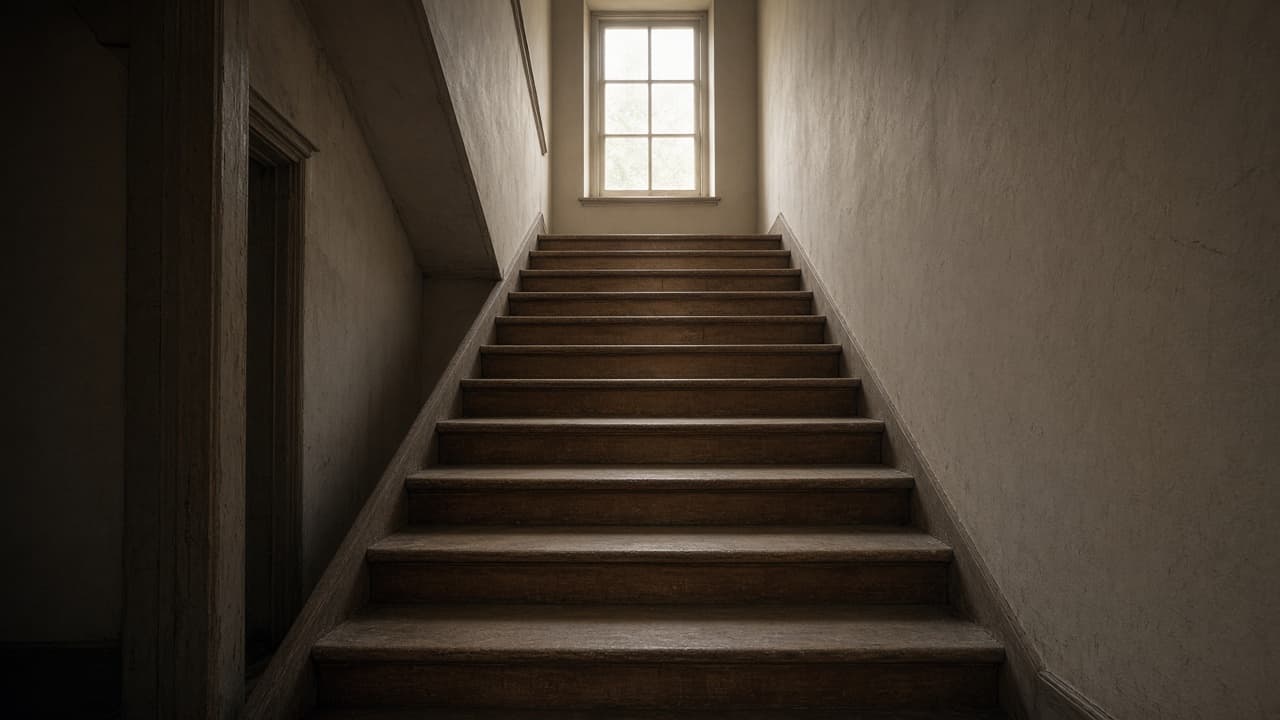
Stairs live inside a building. That is the first distinction from [ladders](/dreams/ladders), which you can move, and from [mountains](/dreams/mountains), which are landscape. A staircase is a designed, repeated, indoor change of level, careers, family [houses](/dreams/houses), institutions. Dreaming of stairs usually tracks effortful movement between those levels: up toward a more public or more responsible floor, down toward storage and privacy, sideways on a landing that will not decide, or on a flight that has no end. The condition of the treads matters as much as the direction.
Climbing Stairs
A flight, then another. Breath. A landing. A door at the top you may or may not reach.
Ascent on stairs is structured ambition or structured effort. Someone built these steps; you are using an existing route, not pioneering a cliff. That often maps onto institutions: grades, job bands, floors of a hospital, the attic of a family home where the old things live.
If the climb was easy, you currently trust the route. If it was exhausting in a short flight, the grade is steeper than the building admits, a "small" promotion that costs a huge amount of breath. Counting steps and losing count is a dream about not knowing how much more the process requires.
Arriving to a party or a light room is a different ending from arriving to more stairs. The first is arrival. The second is the endless variant beginning.
Descending Stairs
A basement, a cellar, a lower hall, a night version of the house. You may be relieved to go down. You may be dreading it.
Descent is not a moral downgrade unless the dream's feeling says so. Basements hold boilers, archives, childhood boxes, things that keep the house running out of sight. Going down can be rest after a public floor, or an investigation into material you stored.
If the stairs were pleasant and the lower room was safe, you may need less altitude in waking life, fewer performances, more private floor. If the basement was threatening, the stored material is the point, not the direction. A descent that becomes a tunnel has left domestic architecture for a more bodily, underworld image; treat that as a change of metaphor mid-dream.
Running downstairs out of fear is escape from an upper floor, a family scene, a job level you cannot stand. Walking down slowly is more often chosen.
An Endless Staircase
Escher, spiral, a flight that renews. Landings that are not landings. You wake tired.
Endless stairs are effort without a storey change you can keep. Bureaucracies, PhDs, care work, "one more level" games, companies with infinite intermediate titles. You are not lost in a forest; you are in a structure that was supposed to have floors and refuses.
If other people passed you going up, comparison is in the dream: someone else's climb has visible storeys. If you were alone, the process may be private and therefore harder to audit. Sitting down on the endless stairs is a legitimate scene, a refusal to keep performing progress. Dreamers who report that they kept climbing out of habit are often describing a waking week.
Missing Steps or a Broken Staircase
A gap you have to stretch over. Rotten wood. A tread that gives. The rest of the flight looks fine.
Missing steps are discontinuities in an otherwise official path. The career ladder (here, staircase) has a missing year of training. The family house has a missing conversation between two floors of the story. You can see the next level and cannot get there by ordinary walking.
Jumping the gap successfully is improvisation that worked. Refusing to jump is often wisdom: the structure should be repaired, not heroically leapt. A step that breaks under you is a trust-in-the-institution problem, a promotion, a floor, a promise that would not bear weight. Unlike falling off a cliff, the drop is usually one flight, which still hurts and is not the abyss. That scale is useful: this is a contained failure-mode.
Have a Stairs dream of your own?
Write what you remember and get a clear reading.
Falling Down the Stairs
A slip, a tumble, the particular violence of edges. You may stop on a landing. You may hit the bottom.
Stair-falls are loss of control during a level change. They are extremely common and they are not omens of injury, though a recent real fall will colonise the image. Psychologically they track humiliating loss of rank or composure while moving between roles, tripping in front of the people on the next floor.
If someone pushed you, name them. If you tripped on something you were carrying, the load is part of the accident: you were changing level with too much in your hands. Waking before impact is the mind's mercy; hitting the bottom and being intact is a survival report. Pain in the dream that lingers after waking is worth checking as a body note, jaw, back, an actual bruise, before it is only a symbol.
A Grand Staircase or a Hidden Back Stair
Marble, a sweep, being seen. Or a narrow staff flight behind a door, smelly, efficient.
The type of staircase is social geography. Grand stairs are public ascent: ceremonies, houses designed to display, institutions that want you to feel the climb. Back stairs are the unofficial route, service, secrets, how the building actually works. Dreamers who take the back stairs to avoid someone on the main flight are managing visibility.
If you were not allowed on the grand staircase, rank is explicit. If you were lost between the two systems, you may be operating in an organisation whose org chart and whose real paths do not match. A spiral stair adds disorientation: you cannot see who is coming the other way.
Standing on a Landing, Unable to Choose
Not up, not down. A window. Two flights. Time passing.
Landings are decision architecture. You have already climbed or descended some way; you have not committed to the next storey. Career pause, a relationship on a pause floor, a house move half-done. The landing can be a rest or a stall.
Looking out of a landing window is often a wish for information from outside the building. Other people using the stairs while you stand still is comparison again. If the landing was beautiful and you wanted to live there, you may be trying to make a transitional state into a home, sometimes possible, often expensive.
Psychological Meaning
Stairs are a favourite of dream-theorists because they are such a clean spatial metaphor for hierarchy and effort. J. Allan Hobson, in The Dreaming Brain (1988), argued that dream bizarreness, including impossible architecture, endless flights, steps that will not stay still, arises from the sleeping brain's distinctive neurochemistry, not from a disguised wish-code. The staircase that will not end is, on this view, what a level-seeking thought looks like when the brain cannot stabilise a consistent space.
You can use Hobson without throwing out meaning. The feeling still belongs to you: effort, rank, a house with floors. The weird geometry is how REM builds environments, not a second secret message. That combination is practical. Ask what level-change in waking life is currently effortful. Then allow the endlessness or the missing tread to be a picture of that effort under a brain state that cannot keep the floors still.
Stairs are not destiny and they are not always sex, despite older overlay. They are buildings asking your legs to agree to a new floor.
When Stair Dreams Keep Returning
Repeating endless flights usually mean a process still has no landing you believe in. Repeating missing steps mean a gap in a path has not been repaired or admitted. Repeating falls mean control during a level change is still the fear.
If the stairs are in a childhood house, include family rank in the reading. If they are in a workplace, include actual org charts. One useful experiment: in imagery, put a landing where the dream refuses to put one, and stand there for a minute while awake. You are allowed to rest between storeys. The dreaming brain sometimes needs that permission modelled in daylight.