Quick Answer
Dreaming of losing hair, as a process, not only as a dramatic handful, usually means something is thinning: status, youth cues, energy, a professional look, a family's resemblance. Slow loss and clump loss are different clocks. Ageing and illness-anxiety borrow this image constantly; neither clock is a diagnosis. Read this beside [hair](/dreams/hair) more generally. If the dream was all shock and handfuls in a sink, the sudden-shed page will fit tighter. This page stays with duration.
Slow Thinning Over Time
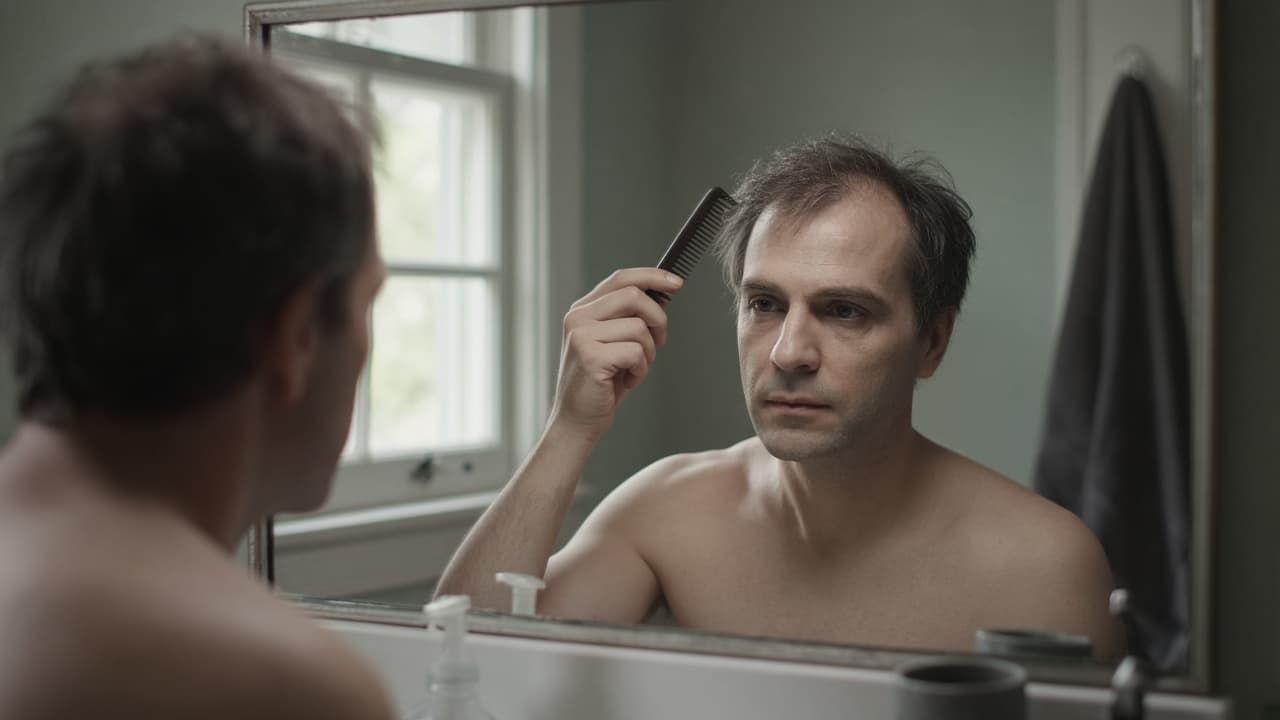
You notice a wider part, a receding edge, a comb that comes away with more than yesterday, but there is no single rip.
Process dreams match process lives: a long work grind, a slow cooling of a marriage, a decade of being the reliable one. Nothing happened "to" your hair. Time happened.
Comparing yourself to an old photograph in the dream is a common device. The photograph is the previous self. Disgust at the new hairline is often disgust at a bargain you have been making, trading vitality for duty, not at follicles.
Hair Coming Out in Clumps
A different clock: event. A shower that becomes a pile. A brush full at once.
Clumps belong to weeks you can date, a betrayal, a public failure, a grief spike, a medical scare (again: scare, not proof). They overlap with sudden-falling-out dreams. Keep them here when the emotion was "I am losing this" as an ongoing identity, not only "it came away in my hand as evidence."
If you tried to weigh the clumps, you are trying to quantify a loss that is actually qualitative. How much hair is the wrong question. Which self is leaving is the right one.
Ageing in the Mirror
Grey arriving with the loss, or a face that is suddenly a parent's face, or a future you.
Ageing dreams use hair because hair is licensed to show time. They gather around birthdays, reunions, becoming the oldest in a room, watching family change. They are not death omens. They are time becoming visible.
If the aged face was still yours and you felt curious, you may be making room for a later chapter. If you felt erased, the fear is that there is no valued role after the current look expires. That is a cultural problem as much as a personal one.
Illness-Anxiety Without a Diagnosis
You "know" in the dream that the hair means something is wrong. You search symptoms. You hide your head. You wait for a verdict that does not come.
This plot is fear of the body as a traitor. It is extremely common and should be handled with care: do not let me, or anyone, turn it into a diagnosis. The dream is showing the search, the waiting, the Googling stance. If you need a medical check, book one because of waking symptoms or because uncertainty is costing you sleep, not because a dream presented a bald patch.
Crying in this version is often about helplessness in the face of information you cannot get. That feeling deserves company in daylight, from people who can sit with uncertainty.
Have a Losing Hair dream of your own?
Write what you remember and get a clear reading.
Someone Commenting on Your Hair Loss
A colleague, a relative, a stranger on a bus. They name it. You had been hoping it was still private.
Comment dreams are exposure plus thinning. The loss is no longer only yours to manage. They cluster around workplaces with harsh appearance norms and families that narrate each other's bodies.
If you had a comeback, you are rehearsing dignity. If you had none, the dream may be asking for a sentence you can actually use. Write one when you are awake. Typical-dream logic still applies: being seen badly is a standard human rehearsal, whether the organ is teeth or hair.
Treatments That Fail
Oils, pills, hats, a clinic, a promise. Nothing holds. The loss continues.
Failed-treatment dreams are about hope with a receipt. They map onto any fix you have already paid for that is not returning the old self: a course, a product, a relationship strategy, a professional rebrand. Hair is the costume of the fix.
A hat that keeps blowing off is a cousin image: the cover will not stay. Ask what cover you are currently buying.
Losing Hair That Is Not on Your Head
Brows, lashes, a beard, body hair. The "wrong" field.
Displacement of the field often means the identity mark you actually worry about is not the one you discuss. A beard dream can be about masculinity cues. Lashes can be about looking "awake" or feminine-coded polish. Treat the field as a pointer to which social signal you think you are failing, not as a dermatology chart.
Psychological Meaning
Robert Stickgold's research on sleep and memory (including work around 2001 on how sleep consolidates emotional and procedural material) helps explain why a slow daytime worry becomes a vivid nightly body story. Sleep is not a courtroom. It is a workshop that restages incomplete concerns in sensory form. Hair is available, visible, and culturally loaded; the workshop uses it.
Illness-anxiety dreams then make sense as unfinished threat files: the mind keeps opening the folder because daylight never closed it with a clean result. Stickgold's broader point is that sleep processes what you were in the middle of. If you were in the middle of comparing yourself with a parent, scrolling health forums, or noticing a comb, the dream continues that.
Freud's 1900 interest in hair as a public sexual sign still lurks in culture. You can notice that without accepting a one-to-one decoding. The educational move is: name the clock (slow vs clump), name the audience, refuse diagnosis from the image.
Living With a Repeating Hair-Loss Dream
If thinning is the repeating plot, look at the long bargain: what have you been trading away by the month. If clumps repeat, look at the last shock.
Practical care of actual hair and sleep will not offend the metaphor. Eating, resting, and stepping away from symptom searches at midnight often lower the volume. If a clinician is needed for mood or for the body, that is ordinary adult maintenance. The dream can wait until you are less tired; tired brains love baldness as a symbol because it is simple and cruel.


