Quick Answer
Dreaming of a hummingbird usually means you are looking at something small that requires enormous energy: a joy that will not keep, a task that only works at hover-speed, a person or a mood that cannot perch. Brief sweetness and metabolic cost share the bird. The scene decides the balance. At a feeder, the exchange is visible. In the house, intensity is trapped in furniture. Injured, the engine is failing. Many at once, the sweetness has become weather. If hummingbirds live in your actual garden, allow for residue. Then check whether the dream bird was doing a job your garden birds do not.
Hovering at a Flower or Feeder
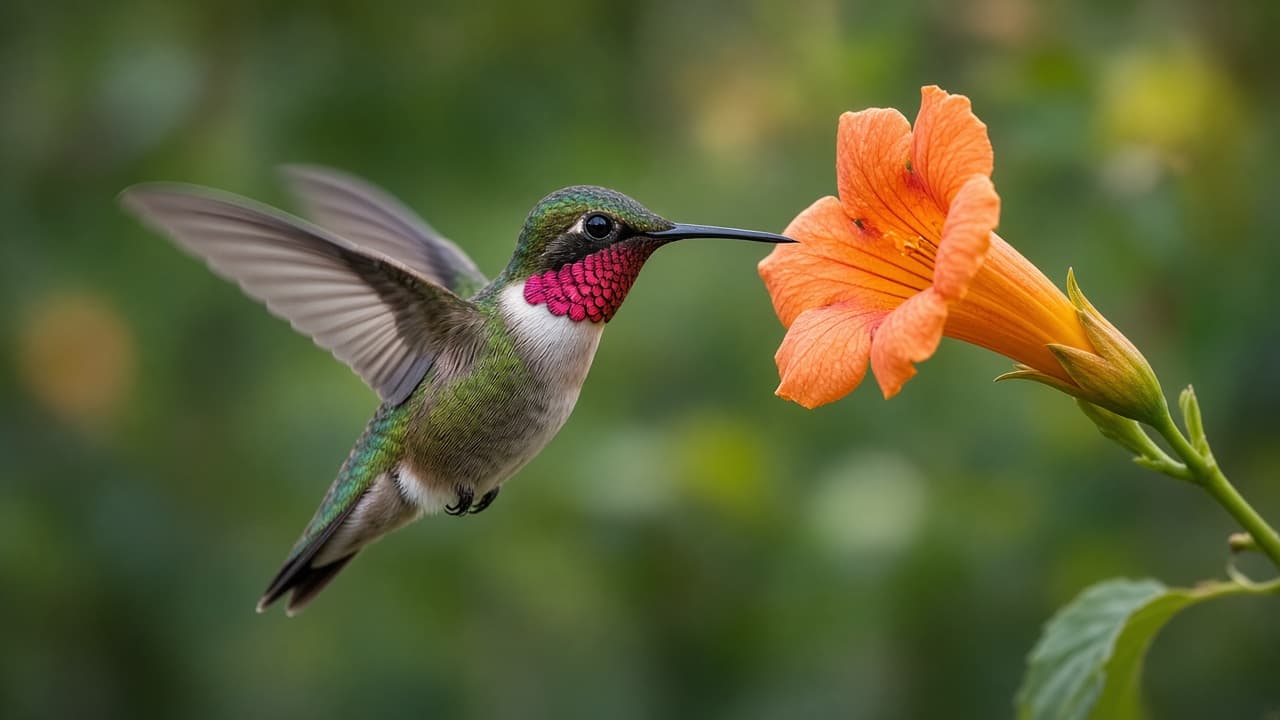
The signature posture. Motion that looks like stillness. A tongue, a sugar, a leave.
Hover-and-feed dreams are about exchange under effort. You get the nectar. You pay in wingbeats. Waking matches include work you love that still exhausts you, care that is sweet and unsustainable, a spiritual or creative practice that only works when you show up at a ridiculous frequency. Related bees share the labour-and-flower field; the hummingbird is less colony and more solo engine.
If the feeder was empty, the night may be talking about a source that used to pay and currently does not. If you were the one filling it, you are in a provider role for a high-needs joy.
A Hummingbird Entering the House
Glass, panic, a living jewel against a pane. Everyone too big. The bird too fast.
Indoor hummingbirds mark an intensity that does not know the architecture of domestic life: a crush, a grief that arrived during dinner, a child’s delight in a sombre house, a talent that wrecks the furniture of a job. Helping it out is a test of patience. Panic makes it worse. An open window and less chasing is often the wiser method in both worlds.
If it found nectar in a vase and calmed, you may already have a corner of a house that can host wild sweetness. If it died at the glass, a joy may be spending itself on the wrong barrier.
Too Fast to Catch, Too Brief to Hold
Hands, a camera, a child laughing, a moment that will not pose.
Uncatchability is the point. Some goods in a life are not for possession: a mood, a visit, a season of health, a look on someone’s face. The dream is kind when it lets you watch. It is cruel when your whole plot is capture.
If you put the camera down in the dream, you may be learning a better stance than collection. If you wrecked the garden trying to hold it, you already know that strategy’s bill.
An Injured or Exhausted Hummingbird
A bird that should be a blur, on a step. The horror of a stopped engine.
High-metabolism failure maps onto burnout in compact lives: the gifted child, the always-on helper, the artist who only works in sprints, a relationship that has no rest gear. You want to cup it. You are afraid your warmth is wrong.
Feeding it sugar water in the dream is a picture of emergency fuel, sometimes correct, sometimes a way of refusing the need for actual rest. A box and darkness can be wisdom or a prison. The dream’s outcome usually tells you which you fear more.
Many Hummingbirds
A tree loud with them. A feeder fight. Beauty as a crowd problem.
Plural hummingbirds are abundance with competition: a party of small intense people, a week of treats that still add up to jitter, siblings or colleagues around a limited nectar. Sun and garden in that scene often feel like a blessing until you notice you cannot hear yourself.
If they ignored you, you may be visiting a joy-system that does not need a protagonist. If they all came to your hand, a provider high may be running; check whether you have fuel.
Have a Hummingbird dream of your own?
Write what you remember and get a clear reading.
Feeding a Hummingbird From Your Hand
Trust, stillness, a tickle, pride. The wild engine choosing you for a second.
Hand-feeding dreams mark a rare alignment of your nervous system with something that usually will not stay. Parenting a sensitive child. A shy friend. A creative state. A moment of being trusted by a skittish part of yourself. Stillness is the skill, not charm.
If you twitched and it left, you already know the cost of extra motion in that relationship. If it stayed past comfort, the sweetness may be becoming a job.
A Dead Hummingbird
The engine, ended. Grief that feels too large for the size of the body, which is information.
Death of a hummingbird can mark the end of a brief era: a crush, a holiday self, a child’s phase, a project that only lived at sprint. It can also be grief for a person whose presence felt like that kind of visit, intense, sweet, not built to stay in your kitchen.
If you buried it under a tree, you are already in ritual. If you could not stop looking at the stillness, the night may be teaching you a pace you have been refusing: zero.
Rain, Cold, or a Hummingbird Out of Season
Wrong weather for a body that runs on immediate sugar. Rain, a window-ledge at dusk, a place that does not have these birds.
Out-of-range hummingbirds picture a sweetness or a talent in an unfit climate: you in a job that has no nectar, a relationship in a culture that punishes delight, a body in a season of illness trying to still be a blur. Compassion is the first reading. “Try harder” is usually the wrong one.
If you brought it inside, you are improvising habitat. That can save a night. It cannot be a forever climate policy unless you change the weather of a life.
Psychological Meaning
Deirdre Barrett’s work on dreams as metaphorical and sometimes problem-solving thought (The Committee of Sleep, 2001, and her 1993 incubation research) fits a bird that is already a living metaphor. Hovering is a picture of staying with a demanding moment without the rest of landing. Brief nectar is a picture of joys that will not store. When dreamers incubate a question about burnout, pace, or a fleeting relationship, the sleeping mind can hire a hummingbird because the physics are honest: this engine cannot do long still.
Robert Stickgold’s research on sleep and emotional memory offers a second, less poetic frame. Highly salient, positively toned, fast events, a look, a garden moment, a child’s laugh, a sugar crash after a good day, are exactly the sort of material REM reprocesses. The bird is a binder for that material, not a telegram from another world.
G. William Domhoff’s continuity hypothesis remains the floor. If you garden, if you live where hummingbirds are ordinary miracles, if you have been living at hover-speed, the image is ready. Continuity does not insult the beauty. It locates it in a week.
Practically: ask whether the dream was about sweetness, effort, or the inability to perch. Those three are three different waking adjustments.
When the Hovering Will Not Become a Landing
Hummingbird dreams process intensity and pace. They are not a guarantee of joy, a visit from the dead unless that frame genuinely consoles you, or a command to become more delightful.
If the same bird returns to the same empty feeder, put nectar in a waking place: rest, food, a pleasure that is not a performance, a pause in a care role that has been all wingbeat. Recurrence loves an engine you keep sending out with no sugar.
If you wake still buzzing, treat the body as part of the data. Slow the first hour. The bird was never asking you to be smaller. It was showing you what high-frequency living costs, and you are allowed to perch.


