Quick Answer
Dreaming of a house fire usually means a home-sized structure, family, self, the rooms of a life, is under a heat that will not stay in one pot. Fire is fast, consuming, and oddly clarifying: you find out what you try to carry. The scene decides the rest. Starting in the kitchen is a domestic source. Smoke without flame is a warning without a visible cause. Watching from the pavement is occupancy already lost. Check real alarms if you are genuinely worried. Then ask what you saved.
Fire Starting in the Kitchen
A pan, a cloth, a toaster, a row that becomes a room. The heart of household labour going first.
Kitchen origins map onto domestic fuel: money fights, unpaid work, hunger, the person who cooks and therefore carries the heat of the house. A family argument that began as logistics. A habit left on the hob, resentment, alcohol, a secret, while everyone was in another room.
If you put it out with something absurd (a coat, a thesis, a child), recover that. Improvised extinguishers are often a list of waking coping tools.
Trying to Save People or Animals
Lists of names. A hallway. A count. The physics of smoke versus love.
Rescue-in-the-house is a values inventory under time pressure. Who you looked for first is information you may not like and should still keep. Who you could not find is the guilt the dream came to hold for a night. This is not a prediction of dying. It is a picture of attachment when the structure fails.
If nobody else would wake, you may be the only one treating the household’s heat as an emergency. If they would not leave without objects, you already know that family’s religion of things.
Watching From Outside
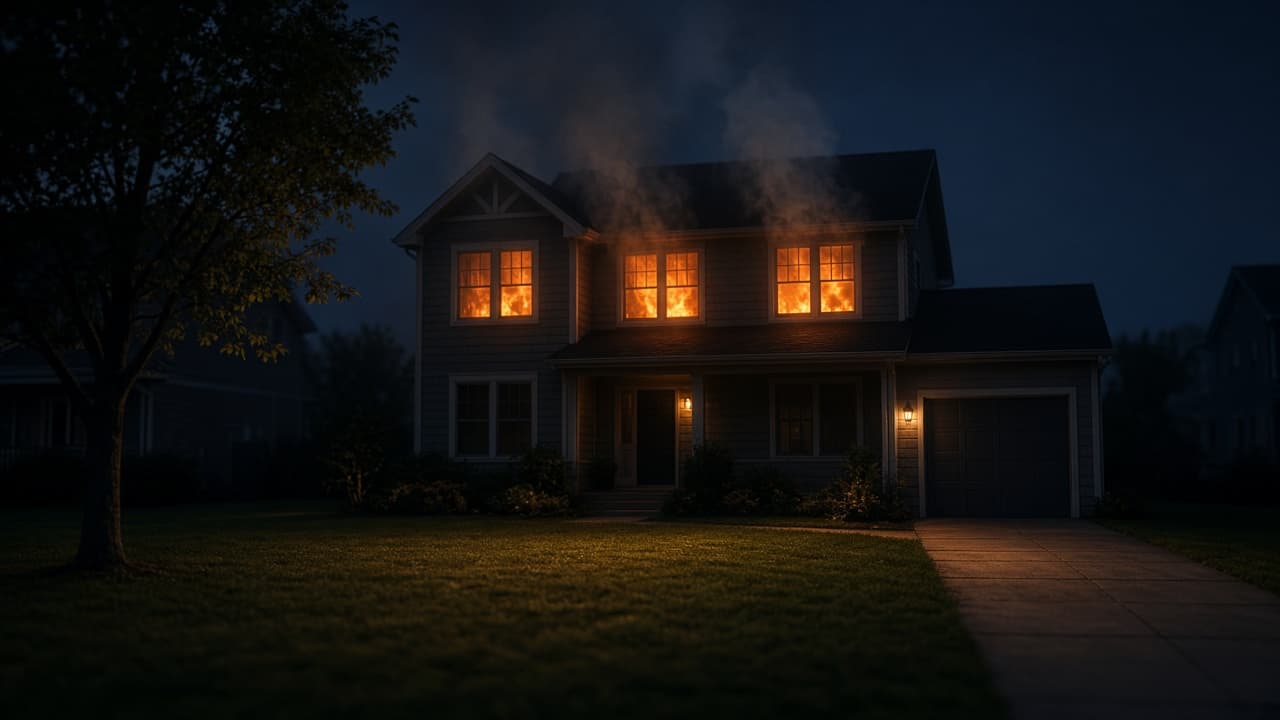
Pavement, a lawn, a phone camera, neighbours in coats. The windows as a film. Heat on your face. You are not in the rooms.
Witness dreams mark lost occupancy. A childhood home you cannot go back into. A marriage you have already, in some inner sense, left. A self you can only observe in crisis. The social layer, who came, who filmed, who brought a dish, is the community’s relationship to your private collapse.
If you felt relief, some houses were prisons of a kind. If you felt nothing, dissociation may be the current insulation. If you wanted to go back in, a loyalty is still inside.
Smoke, No Clear Flame, Cannot Find the Door
Blindness plus time. Crawling. A door that should be there. Air that is not air.
Smoke dreams are about danger you cannot locate as a single object. A household mood. A slow medical or financial crisis. A workplace that is toxic without a villain. You know you should leave and you cannot see the exit architecture.
If a window finally gave you air, lateral exits may be the real strategy, not the front door everyone is arguing about. If you woke still coughing, the body is participating; take a minute before you interpret.
After the Fire: Ruins, Ash, What Remains
Daylight in the dream, or a second night. A chimney. A photo that survived. Insurance as a character. A street that looks the same.
Aftermath is identity after a home-sized ending. Who are you without that kitchen. What still stands. Dreamers report unexpected peace in the empty lot, which is allowed. They also report a compulsion to sift ash for a thing that was never going to survive, which is also allowed.
If you started rebuilding immediately, you may skip grief as a lifestyle. If you sat, you may need the sitting.
Have a House Fire dream of your own?
Write what you remember and get a clear reading.
You Set It, Accidentally or Not
A cigarette, a candle, a wish, a match you lit because the house would not change any other way.
Agency in the burning is a hard image and a common one. People who need to leave a family system, a church, a version of themselves, sometimes dream arson because daylight language still says “I’m not that kind of person.” Accidental cause maps onto neglect: a thing that needed tending. Intentional cause maps onto a decision with smoke attached.
Compassion beats a verdict. Ask what could not continue. Then ask whether waking life has a less total method, or whether the totality is the honesty.
A Neighbour’s House, a Childhood House, a House You Do Not Own
Not your name on the deed. Still your night.
Other people’s fires are empathy, memory, and sometimes relief that the heat is next door. A childhood home burning often processes a family of origin you cannot renovate. A neighbour’s house can be a community’s crisis, or a displaced picture of your own that you are not ready to locate.
If you helped, you are in a helper role you probably also occupy by day. If you watched and were glad it was not yours, believe the gladness without becoming cruel; survival has moods.
Recurring Fire in the Same Room
The bedroom again. The attic again. The office you made in the spare room.
A repeating room names a repeating fuel. Bedrooms lean toward intimacy and rest. Attics toward stored family material. Home offices toward work that has colonised the house. Putting the same room out every night and finding it lit again means the waking source is still on.
Change the room in daylight if you can: a conversation, a device that leaves, a lock, a therapist, a night away. The dream is a stubborn smoke alarm.
Psychological Meaning
Ernest Hartmann’s theory of the contextualising image is almost too apt here (Dreams and Nightmares, 1998). Fire in a house is heat, light, destruction, and purification in one picture, scaled to the place the dreamer lives. When the emotion of a week is “this whole arrangement is going up,” the night does not always invent a distant volcano. It invents the kitchen. Intensity of flame and closeness of smoke track intensity of feeling, not a building-inspection report.
G. William Domhoff’s continuity hypothesis then specifies whose house. People in divorces, people caring for a parent whose house is no longer safe, people whose identity was a family role, people who have survived real fires, they will dream combustion when those concerns are live. Real fire history should be treated as possible replay, not as a cute symbol.
Antti Revonsuo’s threat-simulation account explains the running, the crawling, the door that will not open: ancestral and modern survival drills. They do not schedule a blaze. They run the feeling of a shelter failing.
Practically: list what you tried to save. That list is usually more accurate than any essay about “transformation.”
When the House Keeps Burning After You Wake
House-fire dreams process home-sized heat. They are not a prophecy of arson or wiring failure, and they are not a moral grade on whether you saved the right object.
If the same kitchen lights again, name the fuel in a boring sentence, the fight, the habit, the secret, the job in the spare room, and change one piece of it before the next night shift. Recurrence loves an unmoved hob.
If you wake smelling smoke that is not there, let the nervous system come down: water, a window, a check of the actual alarm if that helps you rest. Then put the omen down. What remains is a practical question of occupancy: which rooms of a life are still habitable, and which ones you are only standing on the lawn of, watching.