Quick Answer
A hospital is a building designed to help, organised in a way that can strip agency. Dreams set there usually turn on that tension: you need care, you wait, your body becomes a system other people read, [family](/dreams/family) hover, a corridor never ends. They cluster around real medical seasons and around metaphorical ones, burnout, a relationship that needs intervention, a life that has been medicalised by anxiety. The dream is not a diagnosis. If you have symptoms, use a clinician. If you do not, read the institution and the role you occupied.
Being a Patient
A gown, a bed that is not yours, a wristband, someone taking blood. You may know what is wrong or you may be waiting to be told.
Patient dreams are about handing your body, or your problem, to a system. That can be a relief: at last someone competent is in charge. It can be a horror: you are now a case. Many dreamers feel both in the same scene, which is often accurate to waking hospital experience and to any situation in which you have become a file.
If you could not get staff to listen, the dream is about being unread, symptoms dismissed, a concern waved away, a metaphorical pain nobody will treat as real. If staff were kind and you still wanted to leave, you may be fighting the patient role itself: you do not want to be the one who needs.
A dream of not being able to breathe in a hospital bed should be checked against sleep and anxiety physiology as well as against symbol. Panic and REM atonia both produce that plot.
The Waiting Room That Will Not Call You
Plastic chairs, a board of names, a clock, other people's names going up. Yours does not. You cannot leave because you might miss the call.
Waiting-room dreams are about delayed care and opaque ranking. They map onto actual NHS or insurance queues, and onto any life in which help is theoretically available and practically not yet yours, a specialist referral, a visa medical, a therapist's list, a partner who will "talk properly" later.
Who else was waiting matters. Empty rooms can feel like exile: even the sick community has not included you. Crowded rooms add comparison and contagion of worry. If you waited for a relative rather than for yourself, you are in the family-advocate role, which has its own exhaustion.
Leaving the waiting room and then panicking that you missed your turn is a common twist: you cannot both rest and remain eligible.
Trying to Get Help and Being Lost in Corridors
Wings, lifts, signs that contradict, a nurse who points the wrong way. The help exists in the building. You cannot locate it.
This is a navigation-of-care dream. Modern hospitals are literally hard to wayfind; the dream uses that fact to picture any system of help that is real and unusable, benefits, HR, a cancer pathway, a university disability service. You are not refusing help. You are failing to reach the counter.
If the building kept changing, the waking analogue is often a process that reorganises while you are in it. If you found the department and it was closed, the help has hours you do not live inside. A house that turns into a hospital mid-dream usually means private life has been colonised by medical or care logic.
Visiting Someone Else
A relative in the bed. Flowers. You are the one who can leave at the end of hours. Sometimes the patient is well; sometimes you cannot tell.
Visitor dreams process the helper's side of illness: love, guilt about leaving, the strangeness of seeing a powerful parent made horizontal. They are common when a family member is actually in hospital, and they continue afterwards as the mind files the image.
If you could not find the right ward, you may not know how to locate the person in their new role as patient. If the person in the bed was someone who is healthy in waking life, the dream is often about a vulnerability you have noticed and not discussed, or about your own fear of needing them to need you. Do not treat a healthy relative in a dream bed as a prediction. Treat it as a feeling about their fragility or yours.
Have a Hospitals dream of your own?
Write what you remember and get a clear reading.
Working in the Hospital
You are the nurse, the doctor, the cleaner, the person wheeling the trolley. Other people's bodies are your shift. You cannot sit down.
Staff dreams flip the helplessness. Now you are the system. They show up for actual clinicians and for unofficial carers, the sibling who manages the appointments, the colleague who became the team's emotional first-aider. Exhaustion is usually the point.
If you did not know how to do the job, you have been put in charge of a crisis without training. If you knew and still could not keep up, the load is the meaning. Making a mistake that harms a patient is a responsibility nightmare, not a forecast of malpractice; it is especially common in people who hold real duty of care.
Wanting to take off the uniform and being unable to is a boundary dream: the helper role has no off shift.
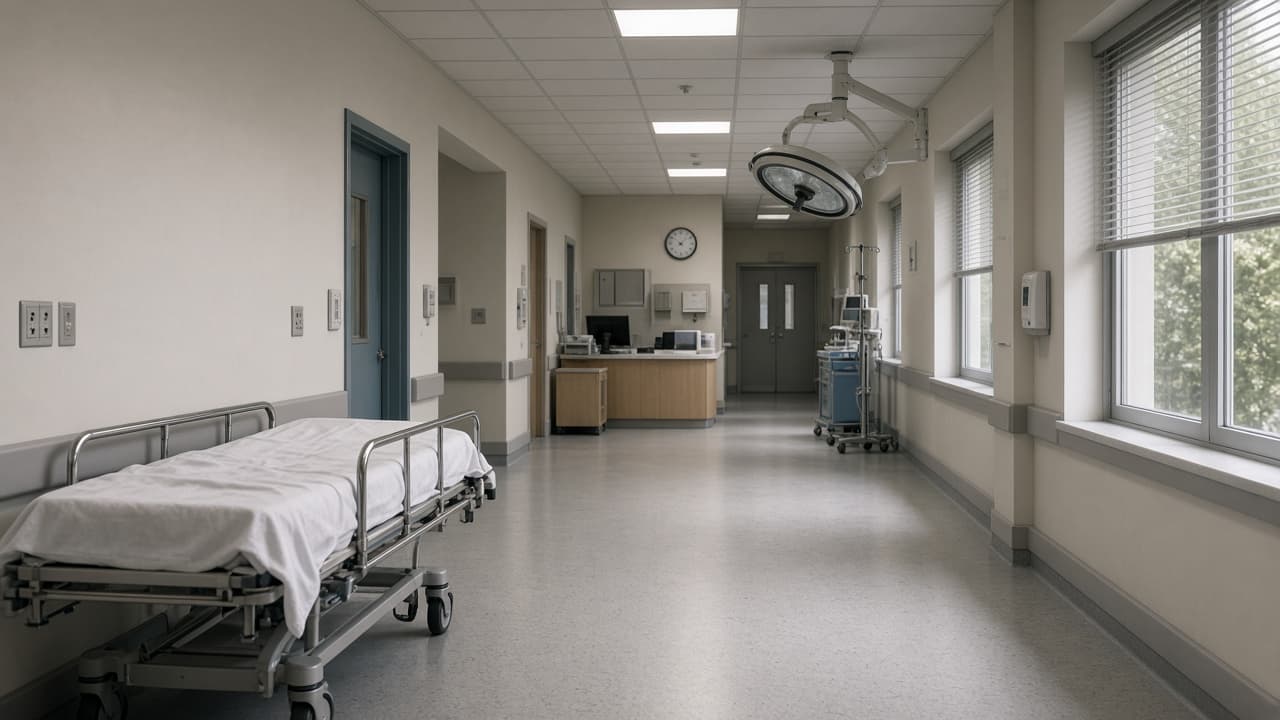
A Hospital That Is Empty, Abandoned, or Wrong
Wards without staff. Equipment covered. A building that looks like a hospital and will not function as one. Sometimes horror-film lighting; sometimes just dust.
Non-functioning hospitals picture help that should exist and does not. Defunded services, a family that used to be able to cope, a body you used to trust, a spiritual or medical authority that has gone vacant. The architecture of care remains; the care does not.
If you were searching the empty building for someone, you still believe a helper might be in a back room. If you were hiding in it, you may be using the idea of "being unwell" as shelter, a role that explains why you cannot currently perform. That is a psychological observation, not an accusation.
Operations, Scans, and the Body as a System
Theatres, scanners, a surgeon talking over you, images of your insides on a screen. You are present and also an object.
These scenes medicalise the self. Something about you is being inspected, opened, or repaired. Around real procedures they are rehearsal. Around no procedures they often track a desire to have an inner problem made visible and fixable, "please find it on a scan", or a fear of being reduced to parts.
Consent is the split. An operation you agreed to is a cooperation-with-repair dream. One you did not agree to is a violation-of-agency dream, and should be read with care if you have medical trauma. Waking up mid-procedure is a classic anxiety image of being aware during a process you cannot stop. Again: not a prediction. A picture of consciousness without control.
Psychological Meaning
Hospital dreams sit at the intersection of body, institution, and help. David Foulkes, in Dreaming: A Cognitive-Psychological Analysis (1985), argued that dreams are organised by the same cognitive systems that organise waking thought, using the knowledge and concerns the dreamer actually has. A hospital is a dense packet of such knowledge: illness scripts, waiting, expertise, gowns, corridors, the hope of repair. You do not need a hidden code. If your week is full of medical appointments, care logistics, or the metaphor of "something in me needs treatment," the dreaming cognition will assemble a hospital because that is the building those thoughts already live in.
Foulkes's view is a useful counter to omen-reading. The dream is not a telegram from the future about dying or cancer. It is a thought in pictures, using an institution you know. That still leaves room for the pictures to matter. A waiting room that never calls you is a precise thought about delayed care. A staff dream is a precise thought about being the care.
If the dream follows a real admission, treat it as processing, possibly trauma processing. If it does not, ask what in your life currently has the structure of a hospital: help that is real, ranked, slow, and capable of making you a case.
When Hospital Dreams Keep Returning
Repeating waiting rooms usually mean a queue, medical or metaphorical, is still the organising fact of your weeks. Repeating patient dreams during actual illness are often just the mind filing the ward. Repeating staff dreams in people who are not clinicians deserve a look at unpaid care.
Do not let the dream diagnose you. Do let it prompt a practical question: is there a real appointment you have been postponing, a relative you need to visit, or a load of care you need to set down? If hospital nightmares follow a traumatic admission and wreck sleep, that is a clinical problem with good treatments, not a riddle you are failing to solve.