Quick Answer
Dreaming of going to jail usually means your life has been pictured as consequence plus confinement: judged, narrowed, timed by someone else’s clock. Arrest is the moment of becoming a case. A cell is the daily physics of not leaving. Wrongful imprisonment is a story that does not match your own. Visiting is love across a barrier. If you have real legal exposure, deal with that as itself. For most dreamers the [prison](/dreams/prisons) is a job, a family, a secret, or a harsh inner court.
Being Arrested
Public becoming official. Hands, a kerb, a kitchen, a workplace, witnesses. The conversion of a person into a process.
Arrest dreams cluster around the moment a private problem becomes a record: HR, a family intervention, a diagnosis conversation that felt like charging, a moral inventory that finally had a scene. Shame in front of neighbours is often the loudest part, louder than the cell that follows.
Whether you went quietly or fought splits compliance from protest. Both can be accurate to a waking style. If you kept asking what you had done and nobody would specify, the charge may be a climate rather than a deed.
Inside the Cell
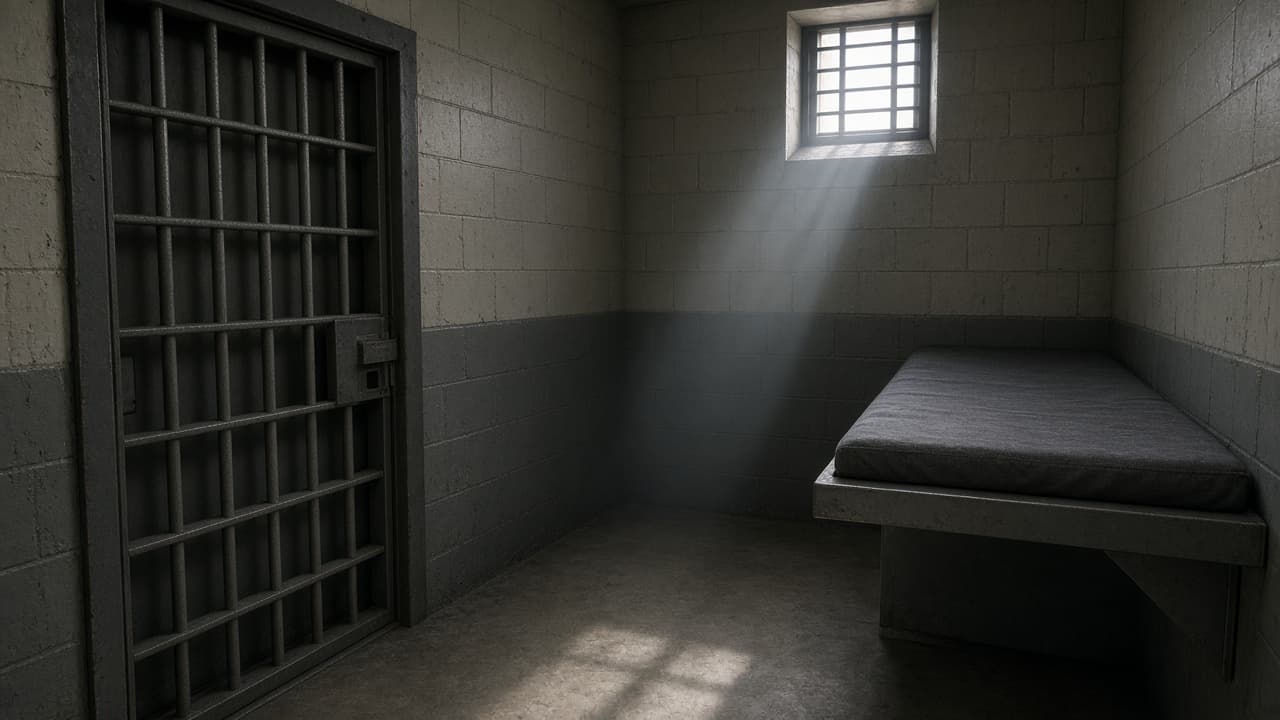
Time, a door, a slot, a roommate, a toilet, the knowledge of hours. This is the confinement dream in its pure form.
Cells map onto lives with no exit in the diary: caregiving with no cover, a contract, a town, a body, a reputation you cannot leave overnight. Related door imagery, locked, watched, opening the wrong way, usually confirms whether the night thinks a hinge still exists.
If the cell was oddly restful, some punishments are also relief from a more chaotic outside. If it was crowded, the confinement may be social rather than solitary: a family system, a dorm, a team.
Wrongfully Imprisoned
You know you did not do it. The system is uninterested in that knowledge. Appeals go nowhere. A lawyer who will not listen.
Mismatch-of-story dreams attach to reputations, family myths (“you were always the difficult one”), workplace narratives, and any process in which your testimony is structurally weak. The cruelty is epistemic as well as spatial. You cannot even serve an honest sentence.
If a piece of evidence existed and you could not show it, recover what it was. Dream-objects in the pocket at that moment are often the waking fact you have not yet used.
A Trial, a Judge, a Sentence
Before the cell, the theatre of judgement. A bench, a parent as judge, a boss, a faceless panel, a crowd.
Judgement dreams are about whose court you live in. Some people carry a portable tribunal and dream it as architecture. Some are actually being evaluated: visa, exam, medical board, family court, a church. The sentence, time, a fine, a look, is the night’s estimate of what the court wants from you.
If you sentenced yourself, the inner court may be harsher than any outer one. If you could not speak, speech is the missing defence in daylight too.
Visiting Someone
Glass, a phone, a time limit, a child on your side of the room. You will leave. They will not, today.
Visiting dreams mark attachment across a barrier that is not only metal: addiction, shame, illness, a partner’s depression, a parent in a facility, a friend in a life you cannot share without becoming a resident. Love is present. Agency is split.
If you did not want to leave, you may be more identified with the confined one than your day-self admits. If you could not wait to get to the car, the visits in waking life may be costing more than you have said.
Have a Going To Jail dream of your own?
Write what you remember and get a clear reading.
Waiting for Release, Counting Days
Calendars, rumours of a date, a door that opens for others, not you. Hope as a management problem.
Anticipation-of-exit dreams attach to end dates: a contract, a treatment, a child’s school year, a secret with an expiry, a visa. They also attach to hoped-for dates that nobody has actually given you. The torture is temporal.
If the date kept moving, you already know that institution. If you were afraid of the door opening, the cell may have become an identity, and freedom is its own threat.
Escape
A window, a laundry cart, a guard who looks away, a tunnel that is also a mouth. Unofficial exit.
Escape is the psyche refusing the sentence. It can be healthy, leaving the job, the marriage-as-punishment, the town. It can be a wish that skips the legal and relational work of leaving well. Guilt on the outside is a useful tell: part of you still believes the court.
Who helped is often a map of unused allies. Who you left behind is a map of loyalties that still bind.
Family Seeing You There
The audience that hurts. A parent’s face, a child’s, a partner in the gallery or at the glass.
Shame-in-front-of-loved-ones is often the engine of arrest dreams even when the plot is about work. You can survive a cell in the abstract. You cannot as easily survive being rewritten in the eyes of people whose story of you mattered.
If they were kind, you may have more mercy available than your inner judge uses. If they turned away, that turning may be a memory, a fear, or a rehearsal of a conversation you still have not had.
Psychological Meaning
Freud treated punishment dreams and moral anxiety as the psyche staging a court (see the discussions of guilt, the superego, and “examination dreams” adjacent to punishment in The Interpretation of Dreams and later papers). You can take that without taking his whole machinery. A jail is a vivid court-plus-sentence. People with harsh inner judges dream cells the way people with harsh workplaces dream cells. The bars are a picture of restricted agency under observation.
G. William Domhoff’s continuity hypothesis then fills the charge sheet from life. If you are under actual investigation, under a parent’s roof at thirty-five, under a job’s surveillance, under a secret, the dreaming mind will not always invent a dragon. It will invent a facility.
Michael Schredl’s work on stress and negatively toned dreams explains the clustering around evaluation seasons, exams, lawsuits, performance reviews, family crises. Confinement imagery rises when waking options fall.
Practically: write the charge the dream named, even if it was absurd. Then write the charge your daylight life is actually serving. The overlap is the interpretation. The non-overlap is often the inner court adding extra years.
When the Cell Reappears on Ordinary Nights
Jail dreams process judgement and restricted motion. They are not a prediction of arrest, and they are not proof that you are a bad person who got away with something.
If the same bunk returns, ask which waking room has no hinge, a job, a family role, a secret, and whether one legal, relational, or calendar step exists that the night is tired of waiting for. Recurrence loves unstarted appeals.
If you wake still guilty without a crime, treat the inner court as the thing to reform, not the dream as a confession. A clinician can help when shame is the jailer. You do not have to decode your way out of a room that a harsher part of you keeps locking from the inside.