Quick Answer
Getting a tattoo is a decision that stays on the body. In a dream that usually means identity, affiliation, love, or error is being treated as permanent, sometimes by you, sometimes by a [needle](/dreams/needles) you did not book. Pain, placement, and who holds the design are the useful details. This is not a command to get inked, or a warning not to. It is a report on marks that do not wash off in the morning of a life.
Chosen Identity
You picked the image. You booked the artist. You are in the chair on purpose. Agency is the headline.
Chosen-mark dreams accompany periods of self-definition that you want to make undeniable: a name, a value, a grief, a sexuality, a joke you are willing to wear. Compare writing on skin; here the writing is meant to outlast the mood.
If you felt proud in the chair, you are probably ready to be recognisable as this. If you felt solemn, the mark may be closer to a vow. If you felt nothing, you may be performing an identity for a room rather than for a self.
Placement still talks. Hands and neck are public. Ribs and hip are for whoever is allowed close. A face tattoo in a dream is a high-stakes visibility most people do not actually want; as an image it means you will not be able to pass as unmarked.
Regret Mid-Ink
The needle is moving and you already know. Stopping is complicated. The artist cannot unmake the line that exists. This is one of the more precise commitment dreams available.
It maps onto marriages, contracts, public identities, tattoos you are actually getting, and any process that is easier to enter than to exit. You have enough information now. You do not have a clean undo.
Dreamers describe bargaining, "make it smaller," "change the word," "just finish so it looks intended." That bargaining is often the waking strategy: doubling down so the mistake looks like a choice. Sometimes it is wisdom (complete the story). Sometimes it is how people stay in chairs they should leave.
Someone Else's Design
A partner's name you did not pick, a parent's handwriting, a logo, a trend, a face you do not love. The body is becoming a surface for another author's image.
Family scripts love this metaphor. So do scenes and jobs that come with a look. If you consented in the dream, you may be in a season of borrowed aesthetic, trying on a life. If you did not, the mark is closer to a brand. Consent after the fact (learning to like the design) is a real human skill and a real human trap.
Covering someone else's tattoo, in the dream, is revision of inherited identity. Painful, possible, not total: the old line is often still there under the new one. That is an honest picture of how change actually looks on a life.
The Image Will Not Stay Still
A word that changes, a portrait that ages, ink that runs, a symbol that becomes something else by morning. Permanence fails.
This can be a fear that your statement will not mean in five years what it means tonight, fair, if you are young or in flux. It can be a hope: you do not actually have to be this forever. It can be a comment on identity in a culture of temporary everything, where even "permanent" marks are expected to be content.
If the running ink looked like blood, the statement is costing more body than you budgeted. If it looked like art, the instability may be creative rather than tragic.
Have a Getting A Tattoo dream of your own?
Write what you remember and get a clear reading.
Pain, Blood, and the Artist
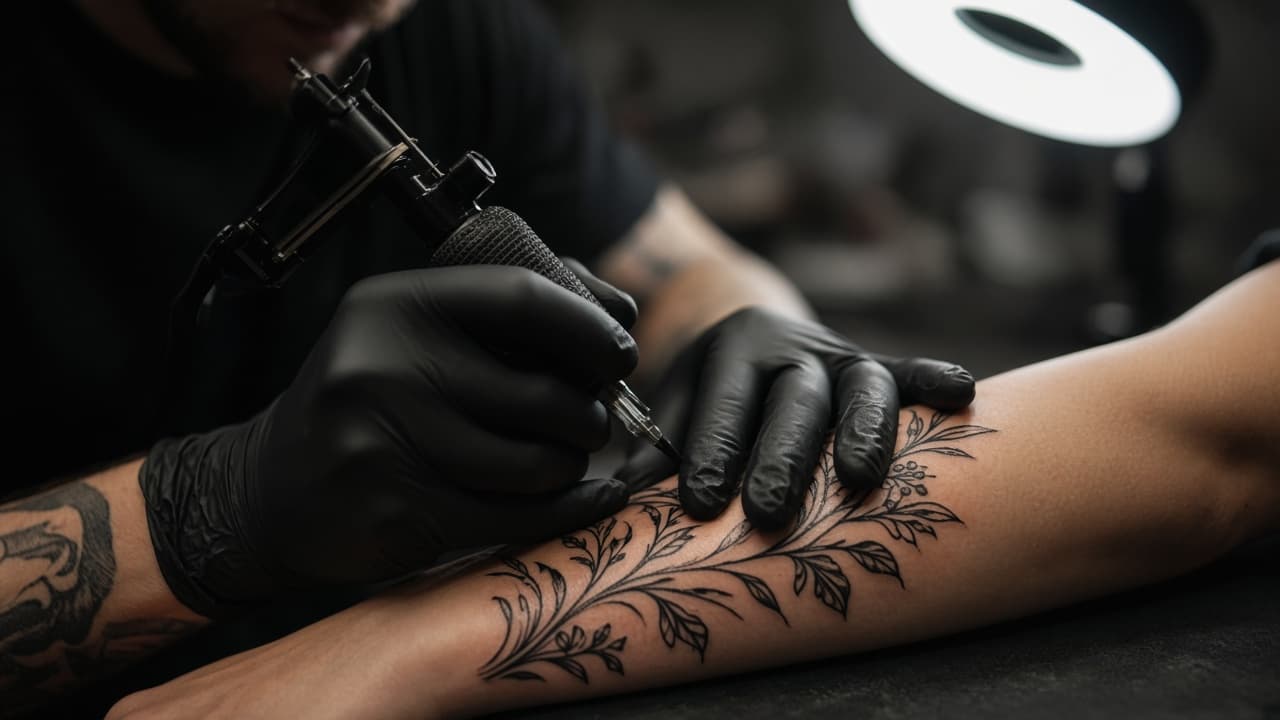
The scene emphasises the needle, the wipe, the hands of the other person, your own endurance. Process, not product.
Pain in tattoo dreams is often the cost of becoming visible as this. You want the mark. You are less sure about the hour it takes. People who hate medical needles and still sit for ink in a dream are drawing a line between puncture as treatment and puncture as chosen meaning.
The artist's manner is a relationship image: a careful craftsperson, a chatterer, a sadist, a friend. Who you let write on you, and how they treat your flinch, is worth taking to daylight. Some of us keep choosing artists who do not look up.
An Unsought Mark
You wake in the dream and it is already there. No chair, no consent, a label you did not shop for. Closer to scar than to tattoo.
Unsought marks track events that name you: a rumour, a diagnosis, a divorce, a viral moment, a role ("the difficult one," "the survivor"). The psyche uses ink because ink is how culture talks about permanence. You can still argue with the picture. You may need a cover, a context, or a very long time.
If other people admired the unsought tattoo and you did not, you are being celebrated for a story you did not want as your face. That is a known cruelty. The dream is not inventing it.
Removing, Covering, Showing, Hiding
Laser, a sleeve, a plaster, a high collar, a moment of rolling up a sleeve in a room. Aftercare of identity.
Wanting it gone is a wish for a previous unmarked self, or for a mistake to become rumour rather than evidence. Showing it on purpose is a test of a room. Hiding a tattoo you chose is a split: the identity is real and not yet speakable in this company, family, work, a country.
Hair growing over a tattoo, or clothes that will not cover it, are pictures of time and of failed camouflage. The mark is winning. That can be relief.
Psychological Meaning
Tore Nielsen's 1993 work on the incorporation of bodily stimuli into dreams is a fair first citation for a page about skin. Pressure, pain, and attention to a body site get into sleep. If you have been thinking about a tattoo, touching a tattoo, or sitting near the idea of permanence on skin, expect the chair.
G. William Domhoff's continuity hypothesis then carries the identity half. People in the middle of visible self-definition, gender, subculture, grief jewellery, a public job, dream of marks. The tattoo is a compact picture of "this will still be true tomorrow."
Jung treated the body as a place where psyche writes. A tattoo dream is almost too on-the-nose for him, which is useful: sometimes the unconscious is not being subtle. It is discussing a mark.
Hobson would remind you that REM likes visually intense, sticky images. Ink on skin is sticky. Not every skull or swallow needs a Victorian dictionary. Look at consent, placement, and regret first.
Read the dream as a report on a permanent statement. Who authored it, whether you could stop, and whether you will show it in the rooms you actually enter.
When You Keep Sitting in the Chair
Recurring tattoo dreams usually mean the identity statement is still wet. You have not finished choosing, or you have chosen and not yet lived in the mark, or you are being written on and have not said so.
If you have a real appointment, pack the practical questions (design, artist, aftercare) into the day so the night does not have to be your only studio. If you do not, ask what you are currently inking: a post, a job title, a couple name, a silence. Mid-ink regret in a dream is a gift if you use it before the line is a life.
If the unsought mark is a nightmare and tracks real branding, abuse, a medical event, a public shaming, skip the style advice. That is trauma on the skin of the psyche. It responds to care, not to a better design.