Quick Answer
Fireworks are a crowd technology: they make a private sky into a shared event for a few minutes, and then they are smoke. In dreams they usually mark climax, celebration, national or family mood, and the odd fact that beauty here is a controlled explosion. You look up together, or you fail to. Distance is everything. A display on the horizon is not a shell landing in the garden. One is spectacle. The other is [storm](/dreams/storms) and [gun](/dreams/gun) territory wearing festive colours.
Looking Up With a Crowd
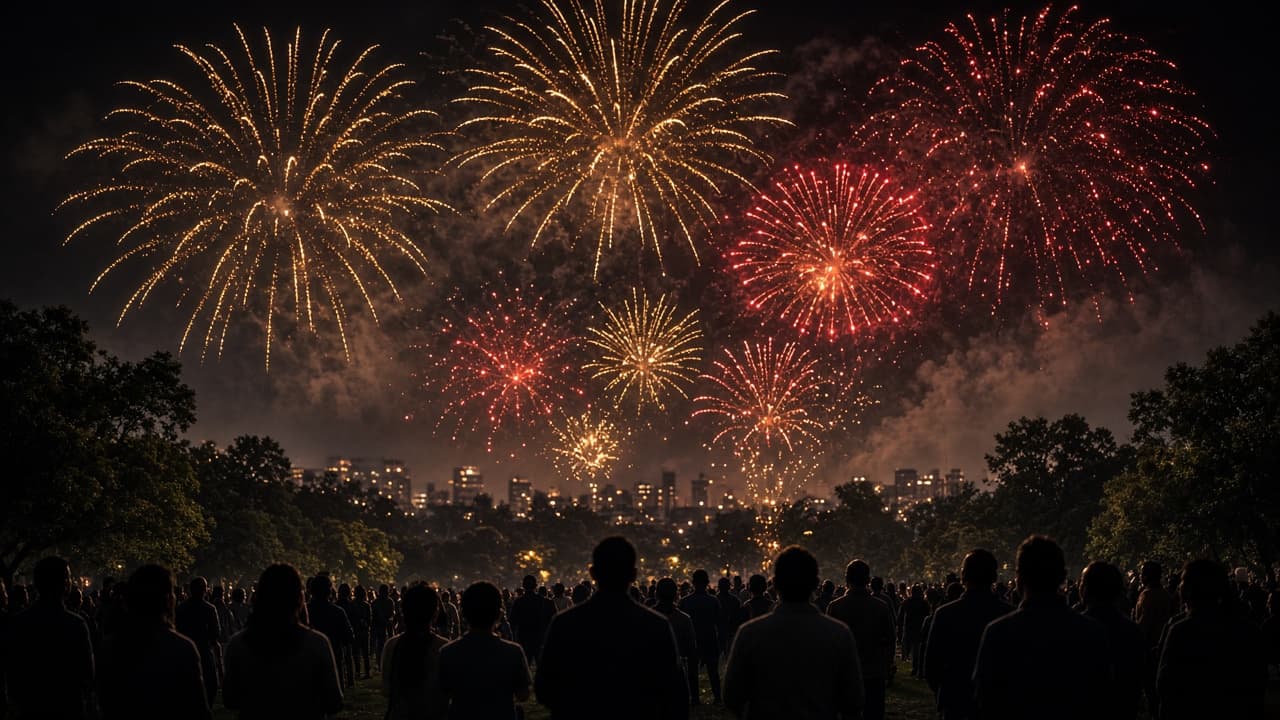
Blankets, a hillside, a party on a roof, strangers whose faces keep turning the same way. Shared attention is the plot.
If the looking felt easy, you are in a picture of belonging at a peak, a wedding, a city holiday, a team win, a moment when your private mood and the public mood agreed. That agreement is rarer than people admit, which is why the dream bothers to stage it.
If you were in the crowd and could not feel it, or you were looking at the faces instead of the sky, you are adjacent to a celebration that is not yours. Holidays after a loss do this. So do workplaces that insist on morale.
Too Close, Too Loud, Falling Into the Garden
The display has no respectful distance. Sparks on skin, a smell of powder, windows rattling, a child crying. Spectacle has crossed into threat.
This is common in people who find public climax overstimulating, and in people with real startle, veterans, anyone who has lived near fireworks bans that failed, anyone whose body does not believe "it's festive." The dream is not being poetic. It is reporting that the explosion and the party are the same event in your nervous system.
If you tried to get people indoors and they would not come, you are the lookout in a culture of looking up. That is a lonely job.
Lighting Them Yourself
A fuse, a box of shells, a backyard, a professional rig. You are the cause of the sky.
Putting on a show can be love: you want other people to have a peak. It can be control: the feeling will not count unless it is undeniable and timed. It can be risk, if you did not know what you were doing. Amateur fireworks in dreams often accompany attempts to manufacture a moment, a proposal, a launch, a family Christmas that will finally work.
Whether anyone watched is the bruise. Unwatched fireworks are effort without a crowd, which is a particular kind of sadness for people who cope by producing peaks.
Celebration That Will Not Start, or Will Not End
You wait. The countdown repeats. The first shell is a dud. Or the display goes on until the sky is a headache and nobody is allowed to go home. Failed or endless climax.
The dud is a picture of a hoped-for peak that did not arrive, a birthday, a reunion, a night that was supposed to change the temperature of a relationship. Endless fireworks are the opposite disorder: a life of peaks with no ordinary dark, a culture of announcement, a nervous system that cannot come down. Smoke without a gap is not joy. It is air quality.
Wanting the dark back is a healthy wish in the second version. Do not let anyone tell you that makes you ungrateful.
Have a Fireworks dream of your own?
Write what you remember and get a clear reading.
Colours, Shapes, and a Message in the Sky
Hearts, names, flags, a sentence written in sparks. The display is trying to mean something in language.
This is public communication at its most expensive and least durable. It maps onto declarations, love, patriotism, branding, an apology so big it becomes theatre. If you could read the words, they are probably words you are waiting for or words you are afraid will be said about you.
If the message was for someone else and you only happened to see it, you are in the position of the neighbour at a proposal. Intimacy as spectacle, with witnesses who did not ask to be witnesses.
Silent Fireworks, Distant Fireworks, Remembered Fireworks
No sound, or a display so far away it is only colour on cloud, or a childhood night you are walking back into. Distance and memory strip the event down to image.
Silent fireworks often accompany dissociation at a public event, or grief on a date that is supposed to be loud. You have the picture of joy without the sensory agreement. Distant fireworks can be other people's climax, a city being happy a few postcodes over, a family celebration you were not invited to, a life peak happening in a peer group.
Childhood displays are continuity plus feeling. If the remembered night was safe, you may be hunting a kind of communal awe that adult life has not replaced. If it was not safe, the festive sky is a cover over an old startle.
Afterward: Smoke, Litter, Ears Ringing
The show is over and the park is a mess. This is the honest last act of fireworks, and dreams that linger here are interested in aftermath, not in climax.
Peaks produce waste: emotional, social, actual. A wedding. A viral moment. A night of winning that does not tell you how to be a person on Monday. If you were the one with a bin bag, you are often the one who tidies after other people's displays. If you sat in the smoke not wanting to leave, you are not ready for ordinary dark.
The ringing in the ears is a body leftover. It can copy real noise. It can also be the way a peak continues in you after the crowd has gone.
Psychological Meaning
J. Allan Hobson's 2002 Dreaming: An Introduction to the Science of Sleep emphasises that REM imagery is visually intense, poorly logical, and affect-heavy. Fireworks are almost a parody of that recipe: pure visual climax, little plot, a lot of feeling. Sometimes the dream is the visual system having a party. Meaning, if any, is what you staple on in the morning.
Deirdre Barrett's 1996 clinical writing on dreams in times of trauma and public events (and her broader problem-solving work) is useful when the sky is not only festive. After attacks, wars, and seasons of civic tension, explosive light gets into sleep whether or not anyone bought a ticket to a display. The brain reuses bangs.
Hall and Van de Castle would code crowds, aggression vs friendliness, and success. A friendly crowd plus spectacular nature is a positive social scene. Aggression plus explosion is a threat scene. Do not force those two onto one symbol key.
Read the dream as a report on climax in public. Were you included in the looking, were you safe, and what was left when the dark came back?
When the Sky Keeps Going Off
Recurring fireworks can be a recurring hunger for a peak, or a recurring startle that will not believe the bang is festive. If you are actually in a season of displays, a city in summer, a stretch of celebrations, try earplugs and earlier nights before you build a myth.
If the dream is always a dud, the waking peak you are staging may be the wrong kind of night. If the dream is always too close, your body is voting that climax is not currently distinguishable from danger. That vote deserves accommodation: distance, exits, fewer surprises, a celebration that happens at table height rather than in the sky.