Quick Answer
Dreaming of finding money usually means an unexpected resource entered the plot, and then you had to decide whether it was yours, clean, enough, or a trap. It is not a luck forecast. Guilt, dirt, coins versus notes, and who saw you pick it up do the real work. Read it beside the general [money](/dreams/money) page if wallets, fake notes, or losing cash were also in play. This page stays with the find.
Cash on the Ground
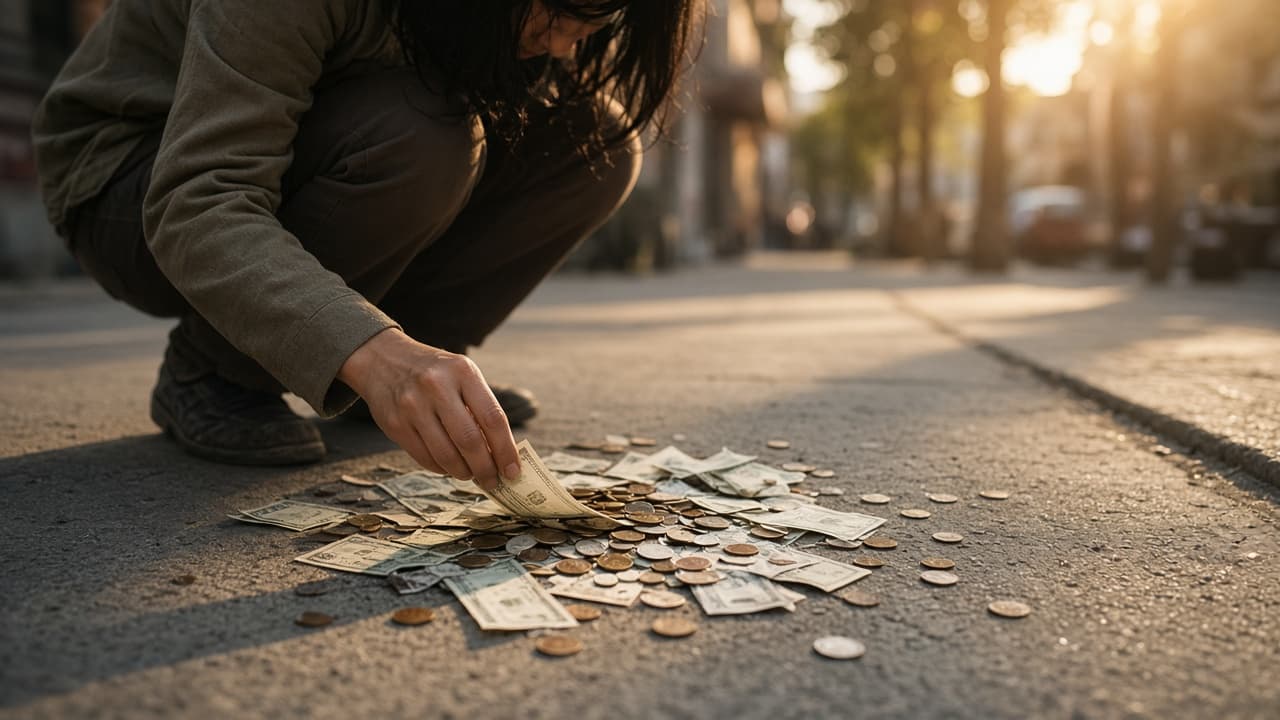
A pavement, a festival field, under a bench, in a puddle. You see it. You hesitate or you do not.
Ground-cash is unearned from the world's point of view and highly earned from the dream's: you noticed. Noticing is a skill. These dreams gather when a waking opportunity is similarly "just lying there", a grant, a spare room, a work opening nobody else has claimed.
If other people walked past, you may be the one in the system who still looks down. If a crowd competed, the resource is already social.
Dirty, Wet, or Bloody-Feeling Notes
Mud, a drain, a toilet-adjacent horror, money that smells.
Dirty money is a resource with a stain. Not always crime; often a job, a relative, a shortcut. You need the value. You do not want the story of how it got there. The dream lets you feel both at once.
Washing the notes is a purification plot: can this be made legitimate. If they disintegrated in water, the resource may not survive being cleaned, a deal that only works in the dark.
Coins Versus Notes
A jar, a fountain, a single heavy coin, a glittering scatter of change.
Coins pull childhood, wishing wells, and small increments. They show up around habits, tips, and ancestral thrift, a family that counted. A fortune in pennies is labour: you will have to pick up each unit. That is a picture of a gain that is real and exhausting.
Notes pull salaries, gifts, and adult shame about amounts. A single large note you cannot change is a resource in the wrong denomination, help you cannot use yet, a windfall that does not fit your life.
Finding Money That Is Clearly Not Yours
A labelled envelope, a till, a wallet on a café table, a houses drawer that is not yours.
The find becomes a theft decision. These dreams are ethics rehearsals. Returning it, taking it, splitting the difference, each is a stance you may be taking toward a waking extra: time on a company laptop, a partner's savings, praise meant for a team.
If you took it and felt nothing, the dream may be showing a numbness around entitlement you should not ignore. If you took it and ran, you already know the cost.
Have a Finding Money dream of your own?
Write what you remember and get a clear reading.
Guilt, Luck, and the Urge to Hide It
Pockets, a bag, a smile you cannot show. Someone might have seen.
Hiding found money is the scarcity hangover: extras must be concealed or they will be taken. It is common in people who became the family bank, and in people who were punished for having nice things.
The luck feeling, giddy, chosen, superstitious, is the other pole. You can have both in one night. Neither is a cosmic allocation. Both describe how you metabolise surplus.
A Hidden Stash You Discover in Your Own Place
Behind a wall, in a coat, in a cars glovebox you forgot, under a floor.
This is not a street find. It is a resource that was already yours and not in the budget. Skills, savings, a contact, an old version of confidence. Discovery-at-home dreams often follow a period of feeling broke in a non-cash sense.
If the stash was rotting, the unused resource has a shelf life. If it multiplied as you counted, you may be underestimating what you already hold.
You Cannot Count It, or It Keeps Changing Amount
Bills stick, numbers slide, a fortune becomes a few coins in the hand.
Uncountability is anxiety about magnitude. Raises, inheritances, and creative success all produce this: I cannot get a stable figure for what this is worth. Eating the money, absurd as it sounds, sometimes appears as an attempt to get it inside where it can be known, a poor method, an honest hunger.
Let the instability be the meaning. You may need waking tools (a spreadsheet, a conversation) more than a symbol.
Psychological Meaning
G. William Domhoff's 1996 Finding Meaning in Dreams (building on Hall's scoring system) treats dream objects as continuous with waking concerns. People under financial stress dream money more; people whose "money" is actually recognition still use cash as the token because cash is the culture's unit of value.
Freud's 1900 interest in gold and faeces as value-and-shame is optional colour. The cleaner research move is continuity plus the specific emotions of this plot: surprise, dirt, guilt, hiding. Those are entitlement and legitimacy feelings. They are not lottery tickets.
If you actually found money yesterday, start there. If you did not, ask what unbudgeted resource appeared, a compliment, a spare hour, a tool, a person who said yes.
A find inside a dream-job till, or in a stranger's coat on a train, is still this plot: surplus in the wrong pocket. The question is not luck. It is whether you have a waking ethic for extras, and whether that ethic was inherited as shame.
Luck Versus Entitlement
Repeating street-finds often mean you still do not believe extras can be claimed without punishment. Repeating dirty-money scenes often mean the current paying arrangement has a stain you have not admitted.
Count the find in waking nouns, not in dream currency. Then decide, like an adult, whether to pick it up, wash it, share it, or leave it. The night-time pavement is a practice square for that decision, not a forecast of notes in your path.
If the amount in the dream felt insultingly small, you may be describing a compliment or a raise that did not match the need. If it felt dangerously large, you may be describing a change of class or of obligation that you do not yet have a self for. Size is a feeling, not a prediction of a bank balance.


